 Add to Chrome
 Add to Firefox
 Add to Edge
Grounded Forcing: Bridging Time-Independent Semantics and Proximal Dynamics in Autoregressive Video Synthesis
Apr 08, 2026
Autoregressive video synthesis offers a promising pathway for infinite-horizon generation but is fundamentally hindered by three intertwined challenges: semantic forgetting from context limitations, visual drift due to positional extrapolation, and controllability loss during interactive instruction switching. Current methods often tackle these issues in isolation, limiting long-term coherence. We introduce Grounded Forcing, a novel framework that bridges time-independent semantics and proximal dynamics through three interlocking mechanisms. First, to address semantic forgetting, we propose a Dual Memory KV Cache that decouples local temporal dynamics from global semantic anchors, ensuring long-term semantic coherence and identity stability. Second, to suppress visual drift, we design Dual-Reference RoPE Injection, which confines positional embeddings within the training manifold while rendering global semantics time-invariant. Third, to resolve controllability issues, we develop Asymmetric Proximity Recache, which facilitates smooth semantic inheritance during prompt transitions via proximity-weighted cache updates. These components operate synergistically to tether the generative process to stable semantic cores while accommodating flexible local dynamics. Extensive experiments demonstrate that Grounded Forcing significantly enhances long-range consistency and visual stability, establishing a robust foundation for interactive long-form video synthesis.

AstraNav-Memory: Contexts Compression for Long Memory
Dec 25, 2025Lifelong embodied navigation requires agents to accumulate, retain, and exploit spatial-semantic experience across tasks, enabling efficient exploration in novel environments and rapid goal reaching in familiar ones. While object-centric memory is interpretable, it depends on detection and reconstruction pipelines that limit robustness and scalability. We propose an image-centric memory framework that achieves long-term implicit memory via an efficient visual context compression module end-to-end coupled with a Qwen2.5-VL-based navigation policy. Built atop a ViT backbone with frozen DINOv3 features and lightweight PixelUnshuffle+Conv blocks, our visual tokenizer supports configurable compression rates; for example, under a representative 16$\times$ compression setting, each image is encoded with about 30 tokens, expanding the effective context capacity from tens to hundreds of images. Experimental results on GOAT-Bench and HM3D-OVON show that our method achieves state-of-the-art navigation performance, improving exploration in unfamiliar environments and shortening paths in familiar ones. Ablation studies further reveal that moderate compression provides the best balance between efficiency and accuracy. These findings position compressed image-centric memory as a practical and scalable interface for lifelong embodied agents, enabling them to reason over long visual histories and navigate with human-like efficiency.
AstraNav-World: World Model for Foresight Control and Consistency
Dec 25, 2025Embodied navigation in open, dynamic environments demands accurate foresight of how the world will evolve and how actions will unfold over time. We propose AstraNav-World, an end-to-end world model that jointly reasons about future visual states and action sequences within a unified probabilistic framework. Our framework integrates a diffusion-based video generator with a vision-language policy, enabling synchronized rollouts where predicted scenes and planned actions are updated simultaneously. Training optimizes two complementary objectives: generating action-conditioned multi-step visual predictions and deriving trajectories conditioned on those predicted visuals. This bidirectional constraint makes visual predictions executable and keeps decisions grounded in physically consistent, task-relevant futures, mitigating cumulative errors common in decoupled "envision-then-plan" pipelines. Experiments across diverse embodied navigation benchmarks show improved trajectory accuracy and higher success rates. Ablations confirm the necessity of tight vision-action coupling and unified training, with either branch removal degrading both prediction quality and policy reliability. In real-world testing, AstraNav-World demonstrated exceptional zero-shot capabilities, adapting to previously unseen scenarios without any real-world fine-tuning. These results suggest that AstraNav-World captures transferable spatial understanding and planning-relevant navigation dynamics, rather than merely overfitting to simulation-specific data distribution. Overall, by unifying foresight vision and control within a single generative model, we move closer to reliable, interpretable, and general-purpose embodied agents that operate robustly in open-ended real-world settings.
The Unseen Bias: How Norm Discrepancy in Pre-Norm MLLMs Leads to Visual Information Loss
Dec 09, 2025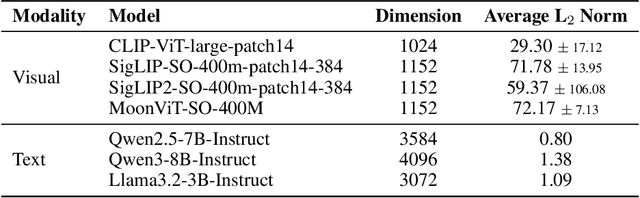

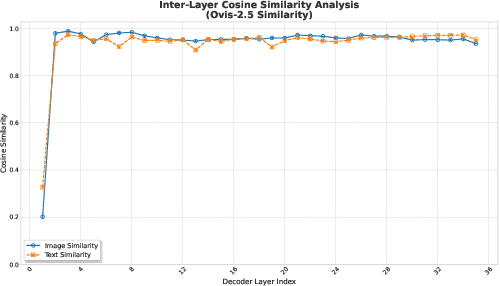
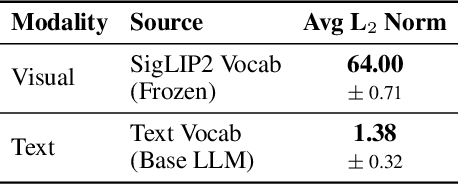
Multimodal Large Language Models (MLLMs), which couple pre-trained vision encoders and language models, have shown remarkable capabilities. However, their reliance on the ubiquitous Pre-Norm architecture introduces a subtle yet critical flaw: a severe norm disparity between the high-norm visual tokens and the low-norm text tokens. In this work, we present a formal theoretical analysis demonstrating that this imbalance is not a static issue. Instead, it induces an ``asymmetric update dynamic,'' where high-norm visual tokens exhibit a ``representational inertia,'' causing them to transform semantically much slower than their textual counterparts. This fundamentally impairs effective cross-modal feature fusion. Our empirical validation across a range of mainstream MLLMs confirms that this theoretical dynamic -- the persistence of norm disparity and the resulting asymmetric update rates -- is a prevalent phenomenon. Based on this insight, we propose a remarkably simple yet effective solution: inserting a single, carefully initialized LayerNorm layer after the visual projector to enforce norm alignment. Experiments conducted on the LLaVA-1.5 architecture show that this intervention yields significant performance gains not only on a wide suite of multimodal benchmarks but also, notably, on text-only evaluations such as MMLU, suggesting that resolving the architectural imbalance leads to a more holistically capable model.
RoboBrain: A Unified Brain Model for Robotic Manipulation from Abstract to Concrete
Feb 28, 2025Recent advancements in Multimodal Large Language Models (MLLMs) have shown remarkable capabilities across various multimodal contexts. However, their application in robotic scenarios, particularly for long-horizon manipulation tasks, reveals significant limitations. These limitations arise from the current MLLMs lacking three essential robotic brain capabilities: Planning Capability, which involves decomposing complex manipulation instructions into manageable sub-tasks; Affordance Perception, the ability to recognize and interpret the affordances of interactive objects; and Trajectory Prediction, the foresight to anticipate the complete manipulation trajectory necessary for successful execution. To enhance the robotic brain's core capabilities from abstract to concrete, we introduce ShareRobot, a high-quality heterogeneous dataset that labels multi-dimensional information such as task planning, object affordance, and end-effector trajectory. ShareRobot's diversity and accuracy have been meticulously refined by three human annotators. Building on this dataset, we developed RoboBrain, an MLLM-based model that combines robotic and general multi-modal data, utilizes a multi-stage training strategy, and incorporates long videos and high-resolution images to improve its robotic manipulation capabilities. Extensive experiments demonstrate that RoboBrain achieves state-of-the-art performance across various robotic tasks, highlighting its potential to advance robotic brain capabilities.