 Add to Chrome
 Add to Firefox
 Add to Edge
Towards Open Vocabulary Learning: A Survey
Jul 06, 2023
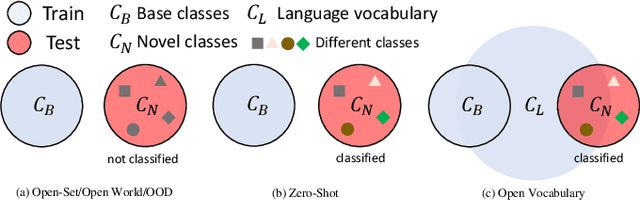
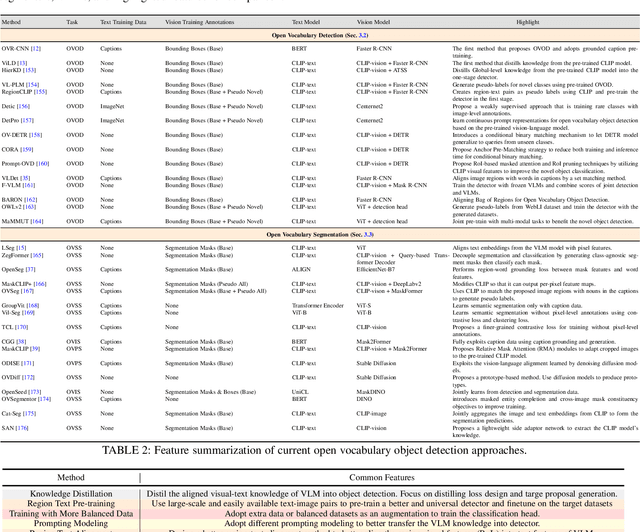


In the field of visual scene understanding, deep neural networks have made impressive advancements in various core tasks like segmentation, tracking, and detection. However, most approaches operate on the close-set assumption, meaning that the model can only identify pre-defined categories that are present in the training set. Recently, open vocabulary settings were proposed due to the rapid progress of vision language pre-training. These new approaches seek to locate and recognize categories beyond the annotated label space. The open vocabulary approach is more general, practical, and effective compared to weakly supervised and zero-shot settings. This paper provides a thorough review of open vocabulary learning, summarizing and analyzing recent developments in the field. In particular, we begin by comparing it to related concepts such as zero-shot learning, open-set recognition, and out-of-distribution detection. Then, we review several closely related tasks in the case of segmentation and detection, including long-tail problems, few-shot, and zero-shot settings. For the method survey, we first present the basic knowledge of detection and segmentation in close-set as the preliminary knowledge. Next, we examine various scenarios in which open vocabulary learning is used, identifying common design elements and core ideas. Then, we compare the recent detection and segmentation approaches in commonly used datasets and benchmarks. Finally, we conclude with insights, issues, and discussions regarding future research directions. To our knowledge, this is the first comprehensive literature review of open vocabulary learning. We keep tracing related works at https://github.com/jianzongwu/Awesome-Open-Vocabulary.

Magic123: One Image to High-Quality 3D Object Generation Using Both 2D and 3D Diffusion Priors
Jun 30, 2023
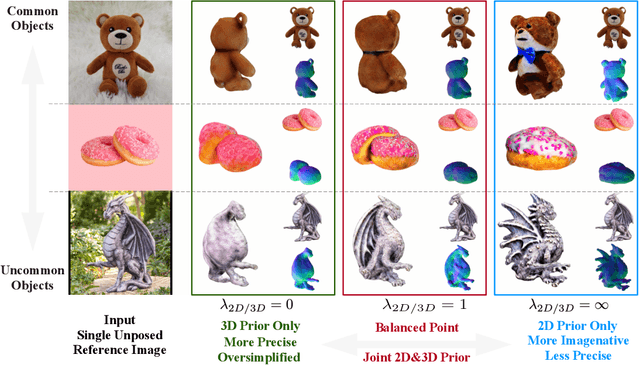

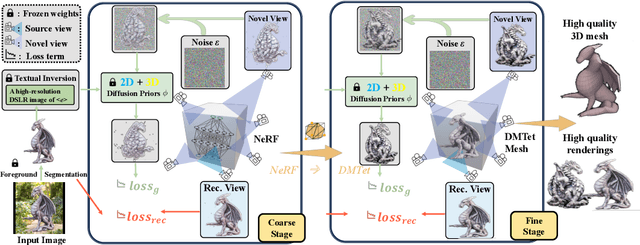
We present Magic123, a two-stage coarse-to-fine approach for high-quality, textured 3D meshes generation from a single unposed image in the wild using both2D and 3D priors. In the first stage, we optimize a neural radiance field to produce a coarse geometry. In the second stage, we adopt a memory-efficient differentiable mesh representation to yield a high-resolution mesh with a visually appealing texture. In both stages, the 3D content is learned through reference view supervision and novel views guided by a combination of 2D and 3D diffusion priors. We introduce a single trade-off parameter between the 2D and 3D priors to control exploration (more imaginative) and exploitation (more precise) of the generated geometry. Additionally, we employ textual inversion and monocular depth regularization to encourage consistent appearances across views and to prevent degenerate solutions, respectively. Magic123 demonstrates a significant improvement over previous image-to-3D techniques, as validated through extensive experiments on synthetic benchmarks and diverse real-world images. Our code, models, and generated 3D assets are available at https://github.com/guochengqian/Magic123.
Enhancing Neural Rendering Methods with Image Augmentations
Jun 15, 2023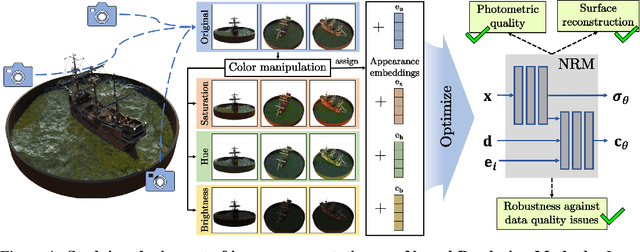
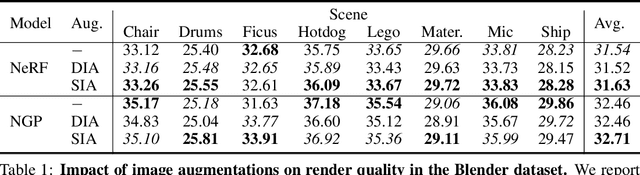

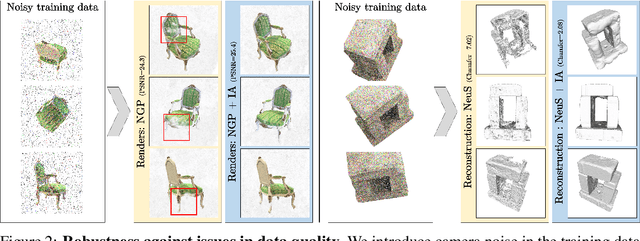
Faithfully reconstructing 3D geometry and generating novel views of scenes are critical tasks in 3D computer vision. Despite the widespread use of image augmentations across computer vision applications, their potential remains underexplored when learning neural rendering methods (NRMs) for 3D scenes. This paper presents a comprehensive analysis of the use of image augmentations in NRMs, where we explore different augmentation strategies. We found that introducing image augmentations during training presents challenges such as geometric and photometric inconsistencies for learning NRMs from images. Specifically, geometric inconsistencies arise from alterations in shapes, positions, and orientations from the augmentations, disrupting spatial cues necessary for accurate 3D reconstruction. On the other hand, photometric inconsistencies arise from changes in pixel intensities introduced by the augmentations, affecting the ability to capture the underlying 3D structures of the scene. We alleviate these issues by focusing on color manipulations and introducing learnable appearance embeddings that allow NRMs to explain away photometric variations. Our experiments demonstrate the benefits of incorporating augmentations when learning NRMs, including improved photometric quality and surface reconstruction, as well as enhanced robustness against data quality issues, such as reduced training data and image degradations.
Dynamically Masked Discriminator for Generative Adversarial Networks
Jun 13, 2023Training Generative Adversarial Networks (GANs) remains a challenging problem. The discriminator trains the generator by learning the distribution of real/generated data. However, the distribution of generated data changes throughout the training process, which is difficult for the discriminator to learn. In this paper, we propose a novel method for GANs from the viewpoint of online continual learning. We observe that the discriminator model, trained on historically generated data, often slows down its adaptation to the changes in the new arrival generated data, which accordingly decreases the quality of generated results. By treating the generated data in training as a stream, we propose to detect whether the discriminator slows down the learning of new knowledge in generated data. Therefore, we can explicitly enforce the discriminator to learn new knowledge fast. Particularly, we propose a new discriminator, which automatically detects its retardation and then dynamically masks its features, such that the discriminator can adaptively learn the temporally-vary distribution of generated data. Experimental results show our method outperforms the state-of-the-art approaches.
Exploring Open-Vocabulary Semantic Segmentation without Human Labels
Jun 01, 2023Semantic segmentation is a crucial task in computer vision that involves segmenting images into semantically meaningful regions at the pixel level. However, existing approaches often rely on expensive human annotations as supervision for model training, limiting their scalability to large, unlabeled datasets. To address this challenge, we present ZeroSeg, a novel method that leverages the existing pretrained vision-language (VL) model (e.g. CLIP) to train open-vocabulary zero-shot semantic segmentation models. Although acquired extensive knowledge of visual concepts, it is non-trivial to exploit knowledge from these VL models to the task of semantic segmentation, as they are usually trained at an image level. ZeroSeg overcomes this by distilling the visual concepts learned by VL models into a set of segment tokens, each summarizing a localized region of the target image. We evaluate ZeroSeg on multiple popular segmentation benchmarks, including PASCAL VOC 2012, PASCAL Context, and COCO, in a zero-shot manner (i.e., no training or adaption on target segmentation datasets). Our approach achieves state-of-the-art performance when compared to other zero-shot segmentation methods under the same training data, while also performing competitively compared to strongly supervised methods. Finally, we also demonstrated the effectiveness of ZeroSeg on open-vocabulary segmentation, through both human studies and qualitative visualizations.
Just a Glimpse: Rethinking Temporal Information for Video Continual Learning
May 28, 2023Class-incremental learning is one of the most important settings for the study of Continual Learning, as it closely resembles real-world application scenarios. With constrained memory sizes, catastrophic forgetting arises as the number of classes/tasks increases. Studying continual learning in the video domain poses even more challenges, as video data contains a large number of frames, which places a higher burden on the replay memory. The current common practice is to sub-sample frames from the video stream and store them in the replay memory. In this paper, we propose SMILE a novel replay mechanism for effective video continual learning based on individual/single frames. Through extensive experimentation, we show that under extreme memory constraints, video diversity plays a more significant role than temporal information. Therefore, our method focuses on learning from a small number of frames that represent a large number of unique videos. On three representative video datasets, Kinetics, UCF101, and ActivityNet, the proposed method achieves state-of-the-art performance, outperforming the previous state-of-the-art by up to 21.49%.
How To Not Train Your Dragon: Training-free Embodied Object Goal Navigation with Semantic Frontiers
May 26, 2023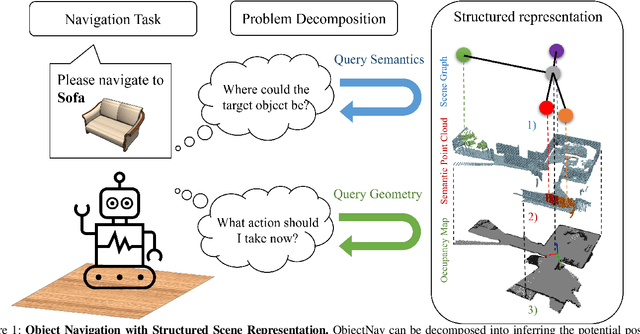
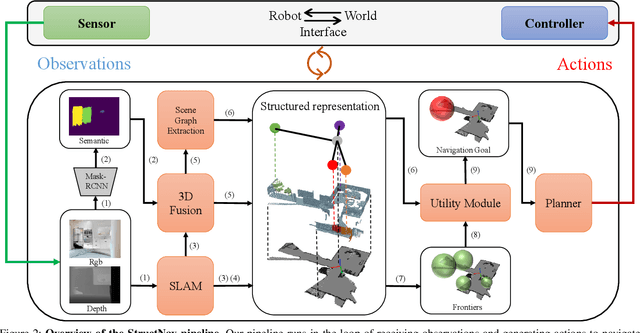
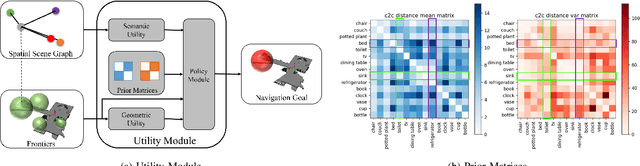
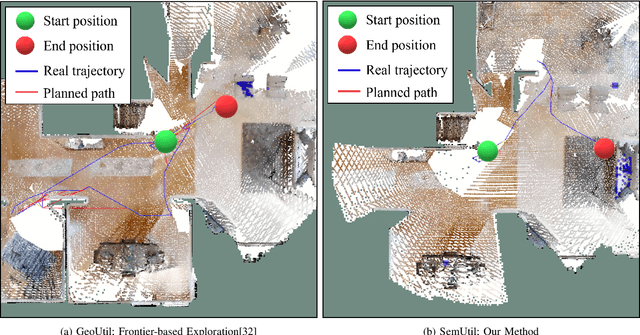
Object goal navigation is an important problem in Embodied AI that involves guiding the agent to navigate to an instance of the object category in an unknown environment -- typically an indoor scene. Unfortunately, current state-of-the-art methods for this problem rely heavily on data-driven approaches, \eg, end-to-end reinforcement learning, imitation learning, and others. Moreover, such methods are typically costly to train and difficult to debug, leading to a lack of transferability and explainability. Inspired by recent successes in combining classical and learning methods, we present a modular and training-free solution, which embraces more classic approaches, to tackle the object goal navigation problem. Our method builds a structured scene representation based on the classic visual simultaneous localization and mapping (V-SLAM) framework. We then inject semantics into geometric-based frontier exploration to reason about promising areas to search for a goal object. Our structured scene representation comprises a 2D occupancy map, semantic point cloud, and spatial scene graph. Our method propagates semantics on the scene graphs based on language priors and scene statistics to introduce semantic knowledge to the geometric frontiers. With injected semantic priors, the agent can reason about the most promising frontier to explore. The proposed pipeline shows strong experimental performance for object goal navigation on the Gibson benchmark dataset, outperforming the previous state-of-the-art. We also perform comprehensive ablation studies to identify the current bottleneck in the object navigation task.
Mindstorms in Natural Language-Based Societies of Mind
May 26, 2023


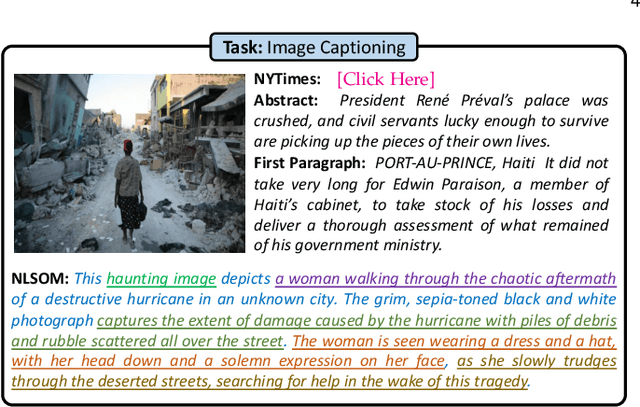
Both Minsky's "society of mind" and Schmidhuber's "learning to think" inspire diverse societies of large multimodal neural networks (NNs) that solve problems by interviewing each other in a "mindstorm." Recent implementations of NN-based societies of minds consist of large language models (LLMs) and other NN-based experts communicating through a natural language interface. In doing so, they overcome the limitations of single LLMs, improving multimodal zero-shot reasoning. In these natural language-based societies of mind (NLSOMs), new agents -- all communicating through the same universal symbolic language -- are easily added in a modular fashion. To demonstrate the power of NLSOMs, we assemble and experiment with several of them (having up to 129 members), leveraging mindstorms in them to solve some practical AI tasks: visual question answering, image captioning, text-to-image synthesis, 3D generation, egocentric retrieval, embodied AI, and general language-based task solving. We view this as a starting point towards much larger NLSOMs with billions of agents-some of which may be humans. And with this emergence of great societies of heterogeneous minds, many new research questions have suddenly become paramount to the future of artificial intelligence. What should be the social structure of an NLSOM? What would be the (dis)advantages of having a monarchical rather than a democratic structure? How can principles of NN economies be used to maximize the total reward of a reinforcement learning NLSOM? In this work, we identify, discuss, and try to answer some of these questions.
Rapid Adaptation in Online Continual Learning: Are We Evaluating It Right?
May 16, 2023We revisit the common practice of evaluating adaptation of Online Continual Learning (OCL) algorithms through the metric of online accuracy, which measures the accuracy of the model on the immediate next few samples. However, we show that this metric is unreliable, as even vacuous blind classifiers, which do not use input images for prediction, can achieve unrealistically high online accuracy by exploiting spurious label correlations in the data stream. Our study reveals that existing OCL algorithms can also achieve high online accuracy, but perform poorly in retaining useful information, suggesting that they unintentionally learn spurious label correlations. To address this issue, we propose a novel metric for measuring adaptation based on the accuracy on the near-future samples, where spurious correlations are removed. We benchmark existing OCL approaches using our proposed metric on large-scale datasets under various computational budgets and find that better generalization can be achieved by retaining and reusing past seen information. We believe that our proposed metric can aid in the development of truly adaptive OCL methods. We provide code to reproduce our results at https://github.com/drimpossible/EvalOCL.
LLM as A Robotic Brain: Unifying Egocentric Memory and Control
Apr 27, 2023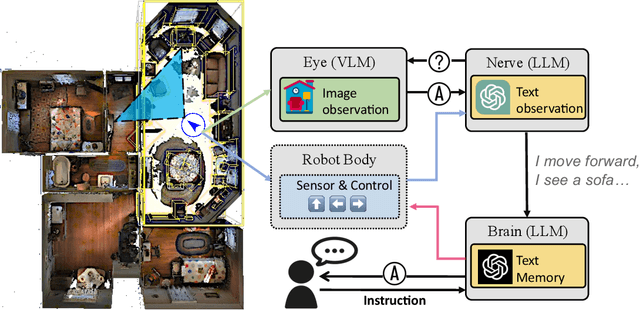
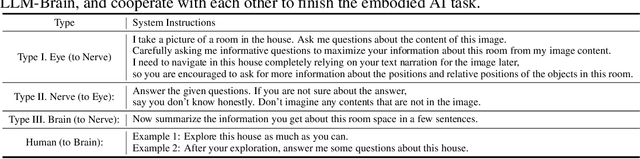
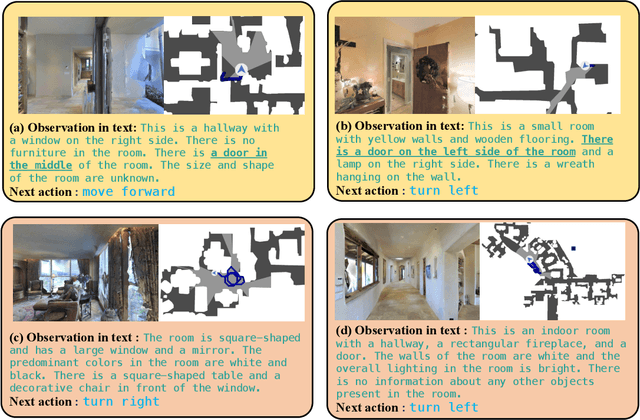
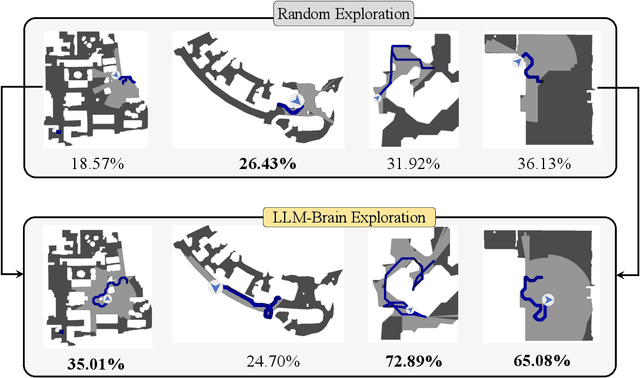
Embodied AI focuses on the study and development of intelligent systems that possess a physical or virtual embodiment (i.e. robots) and are able to dynamically interact with their environment. Memory and control are the two essential parts of an embodied system and usually require separate frameworks to model each of them. In this paper, we propose a novel and generalizable framework called LLM-Brain: using Large-scale Language Model as a robotic brain to unify egocentric memory and control. The LLM-Brain framework integrates multiple multimodal language models for robotic tasks, utilizing a zero-shot learning approach. All components within LLM-Brain communicate using natural language in closed-loop multi-round dialogues that encompass perception, planning, control, and memory. The core of the system is an embodied LLM to maintain egocentric memory and control the robot. We demonstrate LLM-Brain by examining two downstream tasks: active exploration and embodied question answering. The active exploration tasks require the robot to extensively explore an unknown environment within a limited number of actions. Meanwhile, the embodied question answering tasks necessitate that the robot answers questions based on observations acquired during prior explorations.