 Add to Chrome
 Add to Firefox
 Add to Edge
Give the Long-tail More SPACE: Promoting Provider Fairness in Next POI Recommendation
Aug 08, 2026
Next point-of-interest (POI) recommendation predicts users' future destinations from historical mobility sequences and has become a key component of location-based services. However, mainstream models often concentrate exposure on a small set of popular POIs, leaving long-tail merchants systematically under-exposed. While provider fairness has recently attracted increasing attention, directly applying existing provider-fairness techniques to POI recommendation is problematic: (i) users face execution constraints; and (ii) POIs face resource supply constraints. To address this, we propose SPACE (Supply- and Physics-Aware Conditional Embedding generation), a model-agnostic framework that improves long-tail POI exposure via virtual user generation under explicit feasibility and supply control. SPACE consists of three stages: (1) community inference to capture heterogeneous user execution constraints; (2) unbalanced optimal-transport allocation to decide how many virtual users each tail POI should receive from which communities under POI-specific supply budgets; and (3) constraint-guided latent diffusion to generate POI-conditional, community-consistent virtual user embeddings. The generated user-POI pairs can be seamlessly used to train existing recommenders without modifying their architectures. Extensive experiments on three real-world datasets demonstrate that SPACE substantially improves provider fairness while maintaining and often improving recommendation accuracy across multiple backbone models. Our code is publicly available at https://github.com/Anniran1/SPACE-main.

HyMobileAgent: Data-Environment Co-Scaling for Efficient GUI Agents
Jul 16, 2026As large multimodal models move from understanding content to operating on digital environments, mobile GUI has emerged as a challenging and consequential testbed for digital embodied intelligence. Mobile agents operate under three coupled constraints: precise perception of complex interfaces, scalable acquisition of high-quality interaction data, and robust long-horizon decision making under compounding execution errors. This report presents HyMobileAgent, a mobile GUI agent built on Hy3.0-VL-A3B, a vision-native foundation model featuring native any-resolution input, an A3B-scale deployment budget, and a 32K context window to model extended interaction histories. Rather than relying solely on model scaling, we develop a joint data and environment centric scaling framework to address the key bottlenecks of mobile interaction. Our framework integrates a GUI perception flywheel combining mock-interface synthesis, rejection sampling, and icon-specific augmentation; a knowledge pipeline that transforms tutorial videos into structured interaction data; a million-scale action data pipeline deployed across more than 2000 sandbox and real-device instances with automated failure attribution; the PhoneWorld Mock App Factory, providing a resettable training environment with 34 mock applications and over 34000 tasks; and a structured Planning-and-Reflection mechanism with explicit dead-loop detection for reliable long-horizon execution. We also introduce a progressive training recipe consisting of mid-training, supervised fine-tuning, and reinforcement learning with task-specific reward designs.
PhoneBuddy: Training Open Models for Agentic Phone Use
Jun 24, 2026Phones are becoming an important execution surface for general-purpose agents, but training open models for reliable phone use remains difficult because the environment that matters at deployment, real devices running real apps, is slow, stateful, side-effectful, and hard to reset or verify, while scalable mock environments only approximate real behavior. We present PhoneBuddy, a training recipe and open-model line for agentic phone use that combines a real-app environment with a mock-app environment, PhoneWorld, which reconstructs runnable mock apps from real GUI usage structure. PhoneBuddy first builds a shared supervised fine-tuning stage from trajectories collected in both environments, then compares real-app RL against mixed RL across both environments. Across a 150-task human evaluation on real phones spanning apps, mini-apps, and cross-app workflows, task success rate improves from 36.67\% after supervised fine-tuning to 40.67\% after real-app RL and 45.33\% after mixed RL. On AndroidWorld, the same progression rises from 60.3\% to 77.2\% to 83.2\%. These results show that mock-app training is not a replacement for real-app RL, but a complementary source of scalable, resettable, and automatically checked interaction. The gains are strongest on app and mini-app tasks, while long-horizontal cross-app workflows remain an important open challenge.
Robot Self-Improvement via Human-Video Dynamics Models
Jun 19, 2026A central question in robot learning is how to acquire skills from the kinds of data that humans learn from: passive observation, embodied practice, and the experience of failure. Human videos provide the first of these in abundance, and prior work has shown they can initialize useful policies. Far less clear is whether they can support the second and third: whether priors extracted from human videos can ground a robot's own attempts well enough to evaluate them, correct them, and improve from them. In this work, we show that human videos can be used to learn embodiment-agnostic action, dynamics, and value representations that transfer across robot embodiments, providing the predictive foundation required for robots to autonomously improve from their own rollouts and failures. We introduce Dynamics-Guided Action Correction (DGAC), a training-free approach that leverages these adapted models to repair failed states: each failure becomes a query for which the learned models propose and rank corrective actions, turning failures into supervision for the next policy update. Across seven real-world manipulation tasks spanning both a mobile manipulator and a static manipulator arm, our approach improves success rates from 40% to 81% across multiple policy backbones, demonstrating cross-embodiment robot self-improvement from human-video priors. These results show that human priors and robot failures can be combined to enable scalable autonomous policy improvement. Project page: https://ethz-mrl.github.io/robot-self-improvement-website/.
PhoneHarness: Harnessing Phone-Use Agents through Mixed GUI, CLI, and Tool Actions
Jun 12, 2026Phone agents are increasingly expected to complete real mobile workflows rather than merely predict the next screen action. However, much of the current mobile-agent literature still evaluates agents primarily as GUI controllers that observe a screen, emit taps and swipes, and are scored by target app state. Real phone-use tasks are broader: they require deciding when to use app GUIs, device-side commands, or structured tools, while leaving evidence that the intended side effect actually occurred. We introduce PhoneHarness, a mixed-action benchmark and execution harness for studying phone-use agents on verifiable mobile workflows. PhoneHarness runs a device-side agent loop over GUI, CLI, and host-side tool actions, combining deterministic action routing with bounded GUI delegation and auditable execution traces. Its benchmark, PhoneHarness Bench, evaluates whether agents complete tasks with observable side effects, not only whether they produce plausible final answers. On the annotated evaluation split, PhoneHarness reaches a 75.0% pass rate, outperforming the strongest non-PhoneHarness settings by 12.9 percentage points. PhoneHarness and PhoneHarness Bench therefore play distinct but mutually dependent roles: the harness makes mixed phone workflows executable, while the benchmark measures whether agents can use that harness reliably and safely. Our findings suggest that reliable phone automation depends on action-surface routing and verifiable execution, not only visual GUI control.
PhoneWorld: Scaling Phone-Use Agent Environments
May 28, 2026A central bottleneck for phone-use agents is that controllable, reproducible environments covering real mobile behavior are hard to build at scale. Existing mobile-agent benchmarks have made important progress on evaluation, but they do not by themselves provide a scalable way to construct many new phone-use environments. We present PhoneWorld, a reusable pipeline that converts real GUI trajectories and screenshots into controllable phone-use environments, executable tasks, automatic verifiers, and training rollouts. Rather than hand-building one mobile benchmark at a time, PhoneWorld uses real trajectories to recover which screens matter, how screens connect, which interactions must change environment state, and which user goals admit automatic verification. From these signals, it builds runnable mock Android apps backed by read-only app content and mutable state, then derives executable tasks, rule-based verifiers, and training rollouts from the same environments. In its current instantiation, PhoneWorld covers 34 apps across 16 domains, spanning common consumer mobile behaviors such as search, browsing, shopping, booking, media, and social interaction. Under a fixed training budget, replacing 10K steps from an auxiliary AndroidWorld corpus in an AndroidWorld-based baseline with broad PhoneWorld supervision improves all four evaluation benchmarks at once, raising HYMobileBench by 17.7 points, AndroidControl by 6.0 points, AndroidWorld by 14.7 points, and PhoneWorld by 52.5 points. We then study two additional scaling questions: increasing the amount of PhoneWorld supervision strongly improves PhoneWorld performance, and under a fixed PhoneWorld budget, expanding app coverage yields even larger gains. Overall, PhoneWorld shifts the focus from building one mobile benchmark at a time to scaling the supply of phone-use environments themselves.
ASRL:A robust loss function with potential for development
Apr 09, 2025In this article, we proposed a partition:wise robust loss function based on the previous robust loss function. The characteristics of this loss function are that it achieves high robustness and a wide range of applicability through partition-wise design and adaptive parameter adjustment. Finally, the advantages and development potential of this loss function were verified by applying this loss function to the regression question and using five different datasets (with different dimensions, different sample numbers, and different fields) to compare with the other loss functions. The results of multiple experiments have proven the advantages of our loss function .
Beyond Intermediate States: Explaining Visual Redundancy through Language
Mar 26, 2025Multi-modal Large Langue Models (MLLMs) often process thousands of visual tokens, which consume a significant portion of the context window and impose a substantial computational burden. Prior work has empirically explored visual token pruning methods based on MLLMs' intermediate states (e.g., attention scores). However, they have limitations in precisely defining visual redundancy due to their inability to capture the influence of visual tokens on MLLMs' visual understanding (i.e., the predicted probabilities for textual token candidates). To address this issue, we manipulate the visual input and investigate variations in the textual output from both token-centric and context-centric perspectives, achieving intuitive and comprehensive analysis. Experimental results reveal that visual tokens with low ViT-[cls] association and low text-to-image attention scores can contain recognizable information and significantly contribute to images' overall information. To develop a more reliable method for identifying and pruning redundant visual tokens, we integrate these two perspectives and introduce a context-independent condition to identify redundant prototypes from training images, which probes the redundancy of each visual token during inference. Extensive experiments on single-image, multi-image and video comprehension tasks demonstrate the effectiveness of our method, notably achieving 90% to 110% of the performance while pruning 80% to 90% of visual tokens.
VidBot: Learning Generalizable 3D Actions from In-the-Wild 2D Human Videos for Zero-Shot Robotic Manipulation
Mar 10, 2025
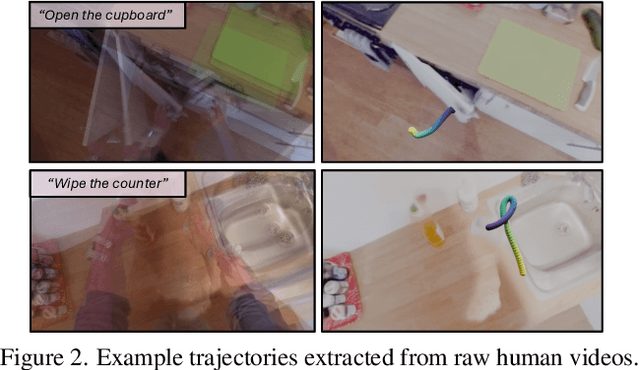
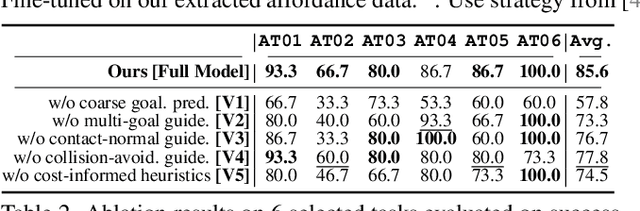
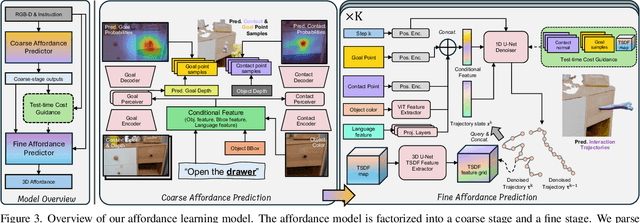
Future robots are envisioned as versatile systems capable of performing a variety of household tasks. The big question remains, how can we bridge the embodiment gap while minimizing physical robot learning, which fundamentally does not scale well. We argue that learning from in-the-wild human videos offers a promising solution for robotic manipulation tasks, as vast amounts of relevant data already exist on the internet. In this work, we present VidBot, a framework enabling zero-shot robotic manipulation using learned 3D affordance from in-the-wild monocular RGB-only human videos. VidBot leverages a pipeline to extract explicit representations from them, namely 3D hand trajectories from videos, combining a depth foundation model with structure-from-motion techniques to reconstruct temporally consistent, metric-scale 3D affordance representations agnostic to embodiments. We introduce a coarse-to-fine affordance learning model that first identifies coarse actions from the pixel space and then generates fine-grained interaction trajectories with a diffusion model, conditioned on coarse actions and guided by test-time constraints for context-aware interaction planning, enabling substantial generalization to novel scenes and embodiments. Extensive experiments demonstrate the efficacy of VidBot, which significantly outperforms counterparts across 13 manipulation tasks in zero-shot settings and can be seamlessly deployed across robot systems in real-world environments. VidBot paves the way for leveraging everyday human videos to make robot learning more scalable.
HACD: Harnessing Attribute Semantics and Mesoscopic Structure for Community Detection
Nov 04, 2024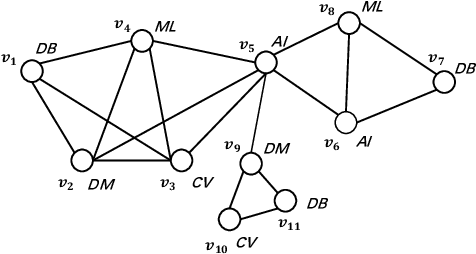
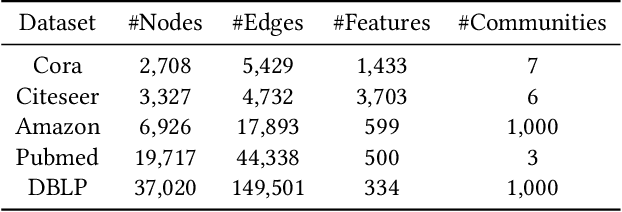
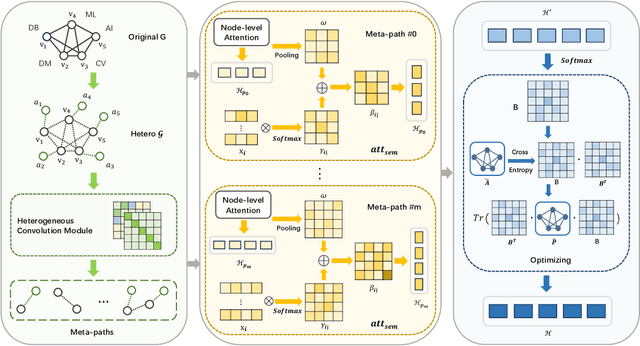
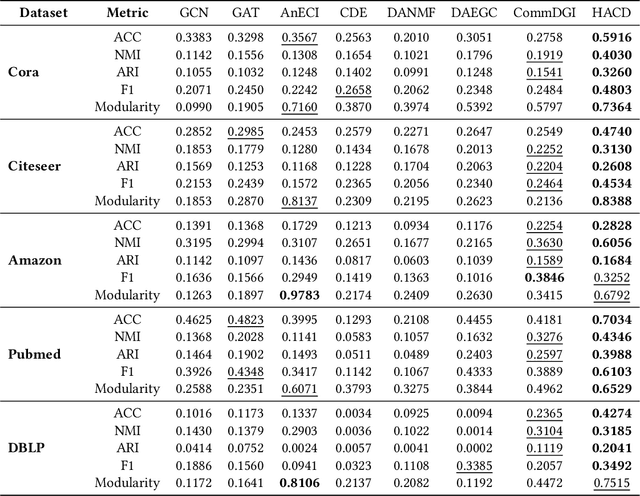
Community detection plays a pivotal role in uncovering closely connected subgraphs, aiding various real-world applications such as recommendation systems and anomaly detection. With the surge of rich information available for entities in real-world networks, the community detection problem in attributed networks has attracted widespread attention. While previous research has effectively leveraged network topology and attribute information for attributed community detection, these methods overlook two critical issues: (i) the semantic similarity between node attributes within the community, and (ii) the inherent mesoscopic structure, which differs from the pairwise connections of the micro-structure. To address these limitations, we propose HACD, a novel attributed community detection model based on heterogeneous graph attention networks. HACD treats node attributes as another type of node, constructs attributed networks into heterogeneous graph structures and employs attribute-level attention mechanisms to capture semantic similarity. Furthermore, HACD introduces a community membership function to explore mesoscopic community structures, enhancing the robustness of detected communities. Extensive experiments demonstrate the effectiveness and efficiency of HACD, outperforming state-of-the-art methods in attributed community detection tasks. Our code is publicly available at https://github.com/Anniran1/HACD1-wsdm.