 Add to Chrome
 Add to Firefox
 Add to Edge
Scalix: Uncertainty-Aware Scale-Consistent Monocular SLAM
Aug 18, 2026
Cameras are ubiquitous sensors in robotics due to their compact form factor and the perceptual richness captured through visual information. Monocular SLAM enables robots to understand the environment with a minimum setup, however, it inherently suffers from scale ambiguity. A common solution is to provide multi-modal sensor configurations, such as visual-inertial systems, where scale is observable unless the robot navigates under a constant-velocity motion, a common scenario in mobile robotics. With the advent of deep-learning, geometric foundation models have been used to address this problem, but the depths maps are often noisy and scale-inconsistent across frames. In this paper, we propose Scalix, a real-time monocular SLAM framework that achieves metric-scale state estimation by integrating learned depth cues into a probabilistic factor-graph formulation. By augmenting existing monocular depth models with both per-pixel depth uncertainty and per-frame scale uncertainty, Scalix treats scale predictions as independent measurements within its optimization, leading to improved scale consistency through multi-view data associations. Experiments in large-scale outdoor and indoor environments demonstrate state-of-the-art performance on both metric and up-to-scale benchmarks while maintaining real-time operation and generalization.

SpotlessGS: Relightable 3D Gaussian Splatting under Dynamic Illumination for Robotic Perception
Aug 11, 2026Robots operating in dark or poorly lit environments rely on onboard lights, which often produce uneven illumination that degrades downstream perception tasks. Prior approaches based on 2D image enhancement lack reliable supervision and fail to preserve multi-view geometric consistency. To address these limitations, we extend Dark Gaussian Splatting (DarkGS) toward a more accurate and flexible relightable 3D reconstruction framework. First, we eliminate the need for explicit light parameter calibration by jointly optimizing lighting parameters within the Gaussian Splatting framework. Second, we introduce a low-frequency illumination model based on spherical harmonics (SH) to capture spatially varying residual and ambient lighting effects. Third, we incorporate an MLP-based Bidirectional Reflectance Distribution Function (BRDF) to model non-Lambertian reflectance. Experiments on synthetic and real-world datasets demonstrate that our method effectively mitigates illumination artifacts while improving rendering quality and quantitative performance over prior approaches. We further validate its benefits for robotic perception through a downstream task.
Robot Self-Improvement via Human-Video Dynamics Models
Jun 19, 2026A central question in robot learning is how to acquire skills from the kinds of data that humans learn from: passive observation, embodied practice, and the experience of failure. Human videos provide the first of these in abundance, and prior work has shown they can initialize useful policies. Far less clear is whether they can support the second and third: whether priors extracted from human videos can ground a robot's own attempts well enough to evaluate them, correct them, and improve from them. In this work, we show that human videos can be used to learn embodiment-agnostic action, dynamics, and value representations that transfer across robot embodiments, providing the predictive foundation required for robots to autonomously improve from their own rollouts and failures. We introduce Dynamics-Guided Action Correction (DGAC), a training-free approach that leverages these adapted models to repair failed states: each failure becomes a query for which the learned models propose and rank corrective actions, turning failures into supervision for the next policy update. Across seven real-world manipulation tasks spanning both a mobile manipulator and a static manipulator arm, our approach improves success rates from 40% to 81% across multiple policy backbones, demonstrating cross-embodiment robot self-improvement from human-video priors. These results show that human priors and robot failures can be combined to enable scalable autonomous policy improvement. Project page: https://ethz-mrl.github.io/robot-self-improvement-website/.
HumanFlow -- Diffusion-Driven MAV Navigation Among Humans via Tightly-Coupled Motion Tracking, Forecasting, and Control
May 25, 2026Robust and accurate perception of humans in their 3D scene context is essential for integrating robots into everyday environments. Existing approaches, however, often fail to predict plausible and accurate human motion estimates that are consistent with the surrounding scene, especially in the presence of heavy occlusions or partial visibility. This can limit both safety and efficiency for robotic operations. We introduce HumanFlow, a latent diffusion model that unifies human motion tracking and forecasting, conditioned on the 3D scene context. We show that our human motion model produces smooth and accurate predictions under challenging conditions, including heavy occlusions, and outperforms state-of-the-art methods in tracking accuracy while being significantly more efficient. Furthermore, we show how HumanFlow's latent space can be tightly coupled with control by conditioning a flow-matching-based, approximate MPC policy on these representations. We validate our policy in simulation with real human trajectories for MAV social navigation, demonstrating superior navigation performance and remaining collision-free, even under partial observability of the human.
Large-Scale High-Quality 3D Gaussian Head Reconstruction from Multi-View Captures
May 05, 2026We propose HeadsUp, a scalable feed-forward method for reconstructing high-quality 3D Gaussian heads from large-scale multi-camera setups. Our method employs an efficient encoder-decoder architecture that compresses input views into a compact latent representation. This latent representation is then decoded into a set of UV-parameterized 3D Gaussians anchored to a neutral head template. This UV representation decouples the number of 3D Gaussians from the number and resolution of input images, enabling training with many high-resolution input views. We train and evaluate our model on an internal dataset with more than 10,000 subjects, which is an order of magnitude larger than existing multi-view human head datasets. HeadsUp achieves state-of-the-art reconstruction quality and generalizes to novel identities without test-time optimization. We extensively analyze the scaling behavior of our model across identities, views, and model capacity, revealing practical insights for quality-compute trade-offs. Finally, we highlight the strength of our latent space by showcasing two downstream applications: generating novel 3D identities and animating the 3D heads with expression blendshapes.
GSFix3D: Diffusion-Guided Repair of Novel Views in Gaussian Splatting
Aug 20, 2025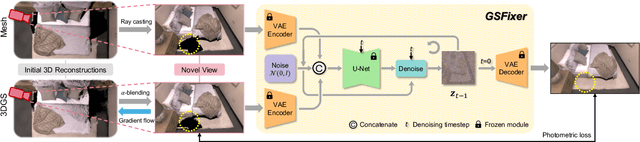
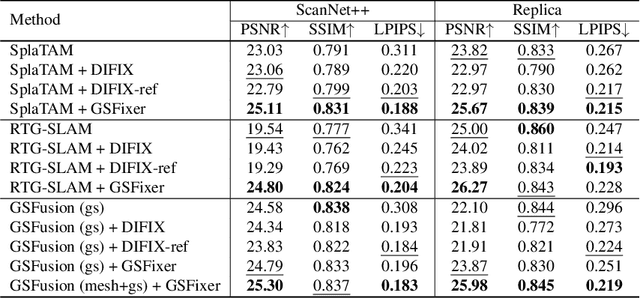
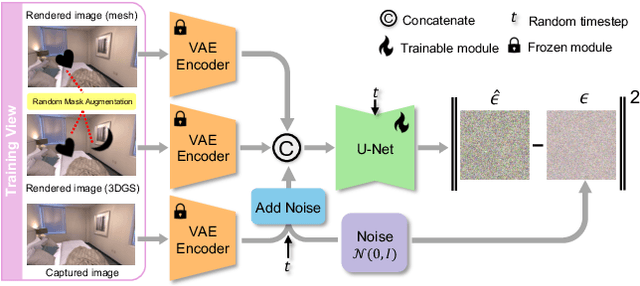
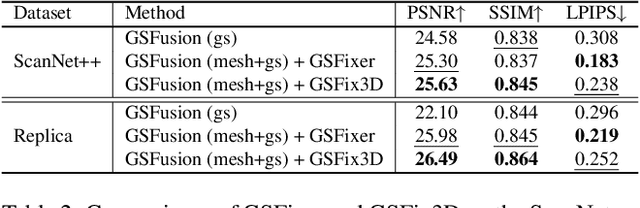
Recent developments in 3D Gaussian Splatting have significantly enhanced novel view synthesis, yet generating high-quality renderings from extreme novel viewpoints or partially observed regions remains challenging. Meanwhile, diffusion models exhibit strong generative capabilities, but their reliance on text prompts and lack of awareness of specific scene information hinder accurate 3D reconstruction tasks. To address these limitations, we introduce GSFix3D, a novel framework that improves the visual fidelity in under-constrained regions by distilling prior knowledge from diffusion models into 3D representations, while preserving consistency with observed scene details. At its core is GSFixer, a latent diffusion model obtained via our customized fine-tuning protocol that can leverage both mesh and 3D Gaussians to adapt pretrained generative models to a variety of environments and artifact types from different reconstruction methods, enabling robust novel view repair for unseen camera poses. Moreover, we propose a random mask augmentation strategy that empowers GSFixer to plausibly inpaint missing regions. Experiments on challenging benchmarks demonstrate that our GSFix3D and GSFixer achieve state-of-the-art performance, requiring only minimal scene-specific fine-tuning on captured data. Real-world test further confirms its resilience to potential pose errors. Our code and data will be made publicly available. Project page: https://gsfix3d.github.io.
FindAnything: Open-Vocabulary and Object-Centric Mapping for Robot Exploration in Any Environment
Apr 11, 2025Geometrically accurate and semantically expressive map representations have proven invaluable to facilitate robust and safe mobile robot navigation and task planning. Nevertheless, real-time, open-vocabulary semantic understanding of large-scale unknown environments is still an open problem. In this paper we present FindAnything, an open-world mapping and exploration framework that incorporates vision-language information into dense volumetric submaps. Thanks to the use of vision-language features, FindAnything bridges the gap between pure geometric and open-vocabulary semantic information for a higher level of understanding while allowing to explore any environment without the help of any external source of ground-truth pose information. We represent the environment as a series of volumetric occupancy submaps, resulting in a robust and accurate map representation that deforms upon pose updates when the underlying SLAM system corrects its drift, allowing for a locally consistent representation between submaps. Pixel-wise vision-language features are aggregated from efficient SAM (eSAM)-generated segments, which are in turn integrated into object-centric volumetric submaps, providing a mapping from open-vocabulary queries to 3D geometry that is scalable also in terms of memory usage. The open-vocabulary map representation of FindAnything achieves state-of-the-art semantic accuracy in closed-set evaluations on the Replica dataset. This level of scene understanding allows a robot to explore environments based on objects or areas of interest selected via natural language queries. Our system is the first of its kind to be deployed on resource-constrained devices, such as MAVs, leveraging vision-language information for real-world robotic tasks.
SuperEvent: Cross-Modal Learning of Event-based Keypoint Detection
Mar 31, 2025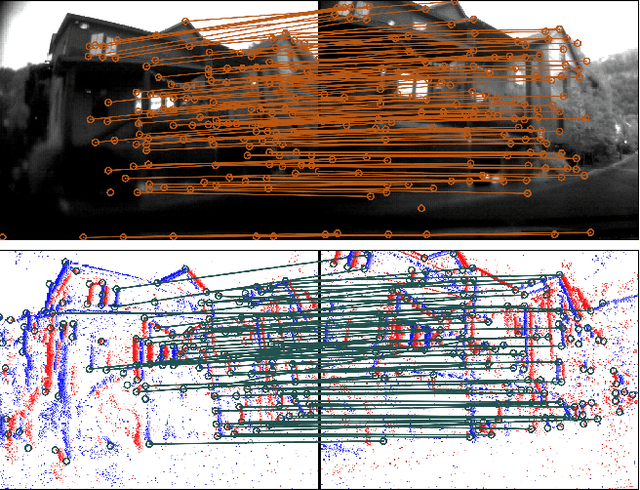
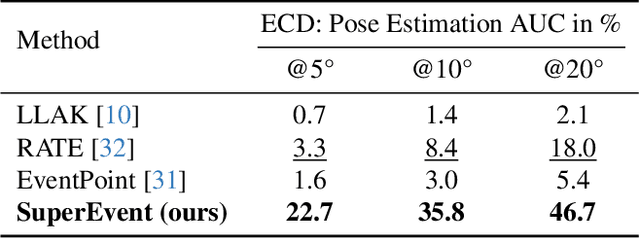
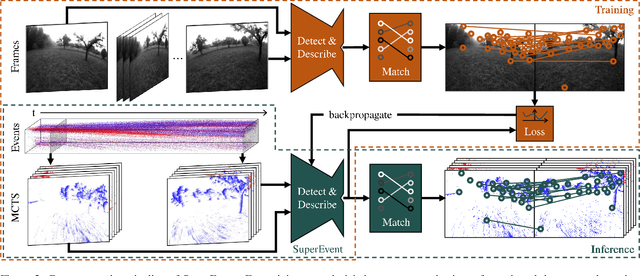
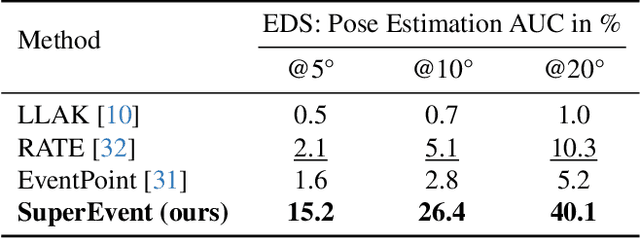
Event-based keypoint detection and matching holds significant potential, enabling the integration of event sensors into highly optimized Visual SLAM systems developed for frame cameras over decades of research. Unfortunately, existing approaches struggle with the motion-dependent appearance of keypoints and the complex noise prevalent in event streams, resulting in severely limited feature matching capabilities and poor performance on downstream tasks. To mitigate this problem, we propose SuperEvent, a data-driven approach to predict stable keypoints with expressive descriptors. Due to the absence of event datasets with ground truth keypoint labels, we leverage existing frame-based keypoint detectors on readily available event-aligned and synchronized gray-scale frames for self-supervision: we generate temporally sparse keypoint pseudo-labels considering that events are a product of both scene appearance and camera motion. Combined with our novel, information-rich event representation, we enable SuperEvent to effectively learn robust keypoint detection and description in event streams. Finally, we demonstrate the usefulness of SuperEvent by its integration into a modern sparse keypoint and descriptor-based SLAM framework originally developed for traditional cameras, surpassing the state-of-the-art in event-based SLAM by a wide margin. Source code and multimedia material are available at smartroboticslab.github.io/SuperEvent.
Online Tree Reconstruction and Forest Inventory on a Mobile Robotic System
Mar 26, 2024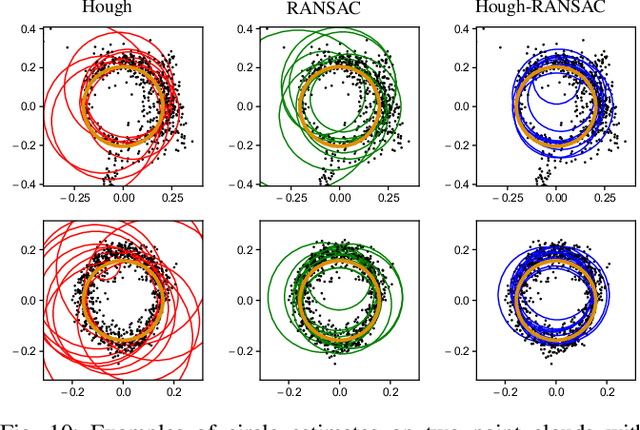
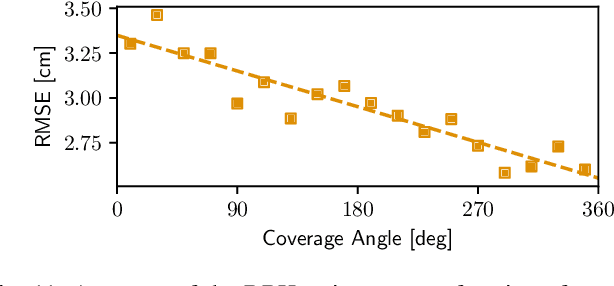
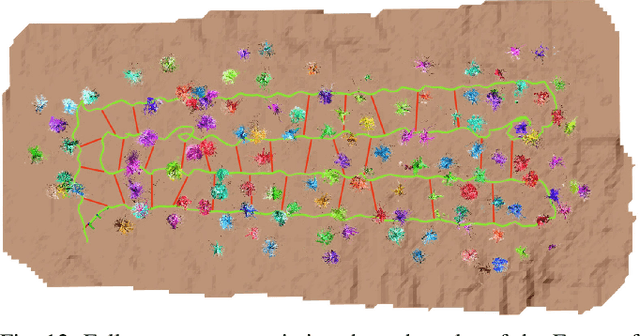
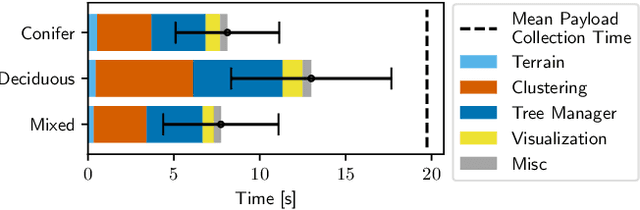
Terrestrial laser scanning (TLS) is the standard technique used to create accurate point clouds for digital forest inventories. However, the measurement process is demanding, requiring up to two days per hectare for data collection, significant data storage, as well as resource-heavy post-processing of 3D data. In this work, we present a real-time mapping and analysis system that enables online generation of forest inventories using mobile laser scanners that can be mounted e.g. on mobile robots. Given incrementally created and locally accurate submaps-data payloads-our approach extracts tree candidates using a custom, Voronoi-inspired clustering algorithm. Tree candidates are reconstructed using an adapted Hough algorithm, which enables robust modeling of the tree stem. Further, we explicitly incorporate the incremental nature of the data collection by consistently updating the database using a pose graph LiDAR SLAM system. This enables us to refine our estimates of the tree traits if an area is revisited later during a mission. We demonstrate competitive accuracy to TLS or manual measurements using laser scanners that we mounted on backpacks or mobile robots operating in conifer, broad-leaf and mixed forests. Our results achieve RMSE of 1.93 cm, a bias of 0.65 cm and a standard deviation of 1.81 cm (averaged across these sequences)-with no post-processing required after the mission is complete.
DynamicGlue: Epipolar and Time-Informed Data Association in Dynamic Environments using Graph Neural Networks
Mar 19, 2024
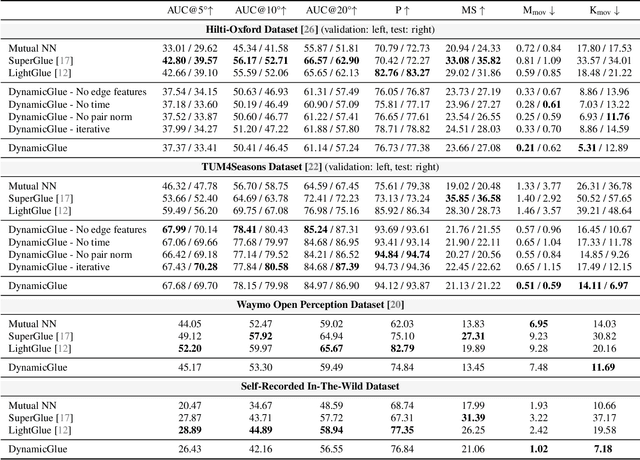
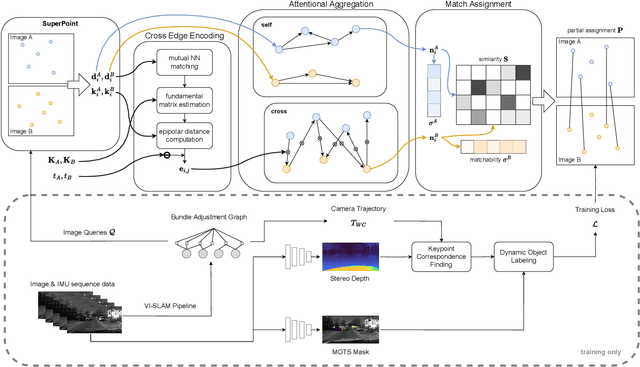

The assumption of a static environment is common in many geometric computer vision tasks like SLAM but limits their applicability in highly dynamic scenes. Since these tasks rely on identifying point correspondences between input images within the static part of the environment, we propose a graph neural network-based sparse feature matching network designed to perform robust matching under challenging conditions while excluding keypoints on moving objects. We employ a similar scheme of attentional aggregation over graph edges to enhance keypoint representations as state-of-the-art feature-matching networks but augment the graph with epipolar and temporal information and vastly reduce the number of graph edges. Furthermore, we introduce a self-supervised training scheme to extract pseudo labels for image pairs in dynamic environments from exclusively unprocessed visual-inertial data. A series of experiments show the superior performance of our network as it excludes keypoints on moving objects compared to state-of-the-art feature matching networks while still achieving similar results regarding conventional matching metrics. When integrated into a SLAM system, our network significantly improves performance, especially in highly dynamic scenes.