 Add to Chrome
 Add to Firefox
 Add to Edge
Point Cloud Registration
Papers and Code
RGBD-Glue: General Feature Combination for Robust RGB-D Point Cloud Registration
May 13, 2024
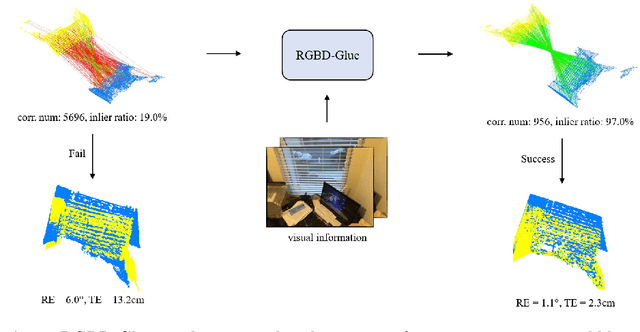
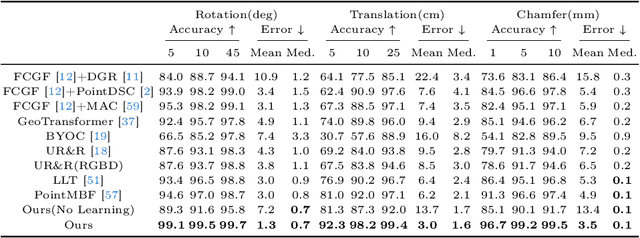
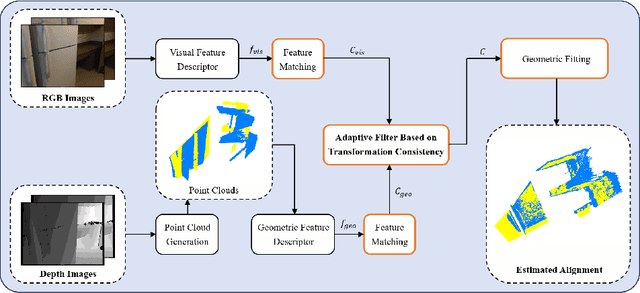
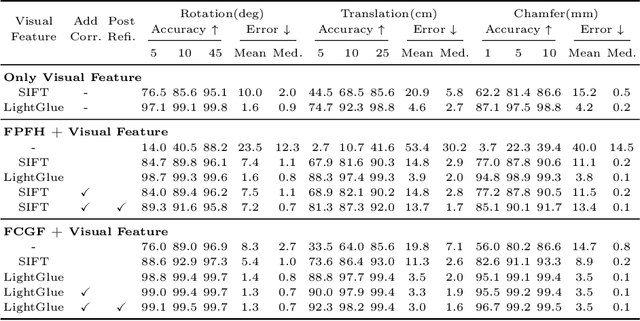
Point cloud registration is a fundamental task for estimating rigid transformations between point clouds. Previous studies have used geometric information for extracting features, matching and estimating transformation. Recently, owing to the advancement of RGB-D sensors, researchers have attempted to utilize visual information to improve registration performance. However, these studies focused on extracting distinctive features by deep feature fusion, which cannot effectively solve the negative effects of each feature's weakness, and cannot sufficiently leverage the valid information. In this paper, we propose a new feature combination framework, which applies a looser but more effective fusion and can achieve better performance. An explicit filter based on transformation consistency is designed for the combination framework, which can overcome each feature's weakness. And an adaptive threshold determined by the error distribution is proposed to extract more valid information from the two types of features. Owing to the distinctive design, our proposed framework can estimate more accurate correspondences and is applicable to both hand-crafted and learning-based feature descriptors. Experiments on ScanNet show that our method achieves a state-of-the-art performance and the rotation accuracy of 99.1%.

GeoNLF: Geometry guided Pose-Free Neural LiDAR Fields
Jul 08, 2024Although recent efforts have extended Neural Radiance Fields (NeRF) into LiDAR point cloud synthesis, the majority of existing works exhibit a strong dependence on precomputed poses. However, point cloud registration methods struggle to achieve precise global pose estimation, whereas previous pose-free NeRFs overlook geometric consistency in global reconstruction. In light of this, we explore the geometric insights of point clouds, which provide explicit registration priors for reconstruction. Based on this, we propose Geometry guided Neural LiDAR Fields(GeoNLF), a hybrid framework performing alternately global neural reconstruction and pure geometric pose optimization. Furthermore, NeRFs tend to overfit individual frames and easily get stuck in local minima under sparse-view inputs. To tackle this issue, we develop a selective-reweighting strategy and introduce geometric constraints for robust optimization. Extensive experiments on NuScenes and KITTI-360 datasets demonstrate the superiority of GeoNLF in both novel view synthesis and multi-view registration of low-frequency large-scale point clouds.
Deep-PE: A Learning-Based Pose Evaluator for Point Cloud Registration
May 25, 2024
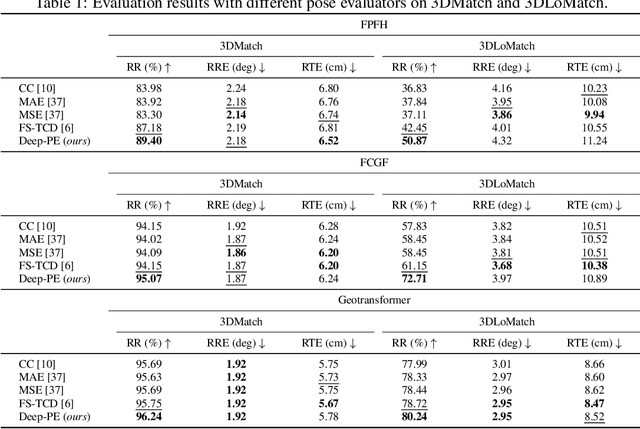


In the realm of point cloud registration, the most prevalent pose evaluation approaches are statistics-based, identifying the optimal transformation by maximizing the number of consistent correspondences. However, registration recall decreases significantly when point clouds exhibit a low overlap rate, despite efforts in designing feature descriptors and establishing correspondences. In this paper, we introduce Deep-PE, a lightweight, learning-based pose evaluator designed to enhance the accuracy of pose selection, especially in challenging point cloud scenarios with low overlap. Our network incorporates a Pose-Aware Attention (PAA) module to simulate and learn the alignment status of point clouds under various candidate poses, alongside a Pose Confidence Prediction (PCP) module that predicts the likelihood of successful registration. These two modules facilitate the learning of both local and global alignment priors. Extensive tests across multiple benchmarks confirm the effectiveness of Deep-PE. Notably, on 3DLoMatch with a low overlap rate, Deep-PE significantly outperforms state-of-the-art methods by at least 8% and 11% in registration recall under handcrafted FPFH and learning-based FCGF descriptors, respectively. To the best of our knowledge, this is the first study to utilize deep learning to select the optimal pose without the explicit need for input correspondences.
CS-Net:Contribution-based Sampling Network for Point Cloud Simplification
Jan 18, 2025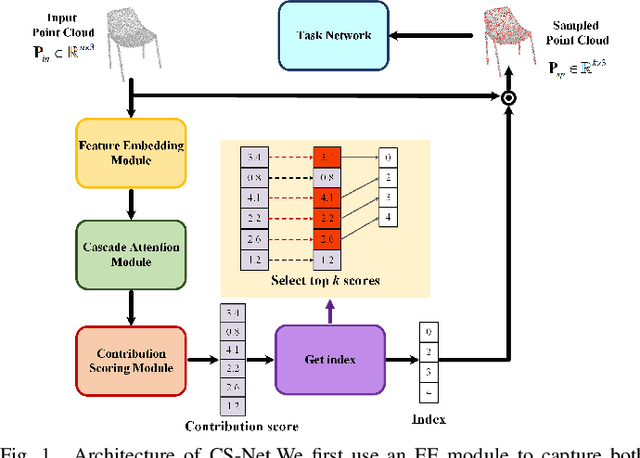
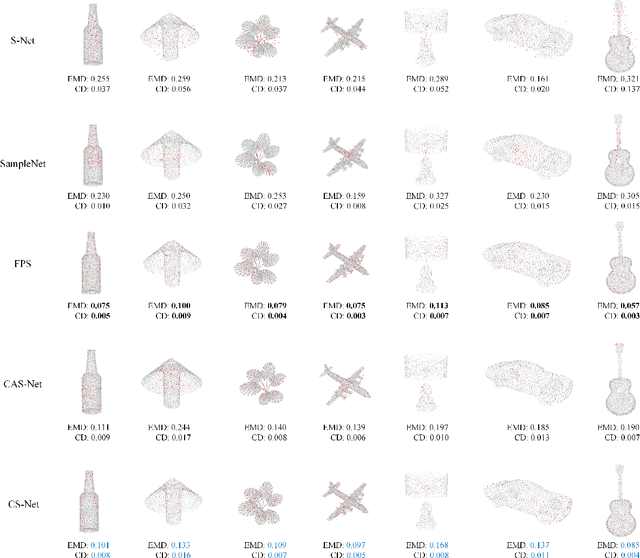
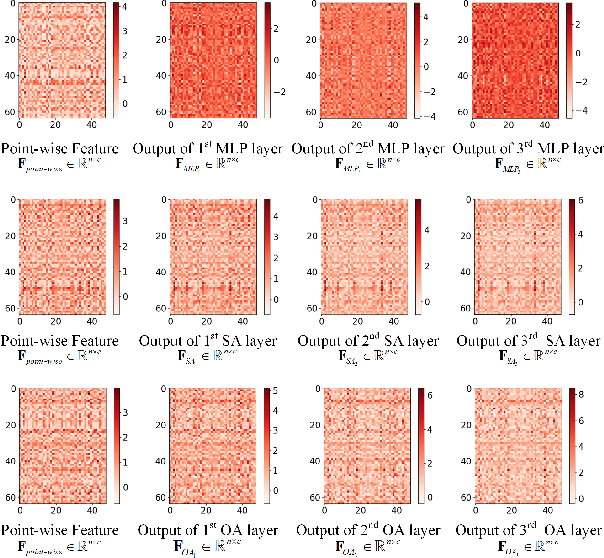
Point cloud sampling plays a crucial role in reducing computation costs and storage requirements for various vision tasks. Traditional sampling methods, such as farthest point sampling, lack task-specific information and, as a result, cannot guarantee optimal performance in specific applications. Learning-based methods train a network to sample the point cloud for the targeted downstream task. However, they do not guarantee that the sampled points are the most relevant ones. Moreover, they may result in duplicate sampled points, which requires completion of the sampled point cloud through post-processing techniques. To address these limitations, we propose a contribution-based sampling network (CS-Net), where the sampling operation is formulated as a Top-k operation. To ensure that the network can be trained in an end-to-end way using gradient descent algorithms, we use a differentiable approximation to the Top-k operation via entropy regularization of an optimal transport problem. Our network consists of a feature embedding module, a cascade attention module, and a contribution scoring module. The feature embedding module includes a specifically designed spatial pooling layer to reduce parameters while preserving important features. The cascade attention module combines the outputs of three skip connected offset attention layers to emphasize the attractive features and suppress less important ones. The contribution scoring module generates a contribution score for each point and guides the sampling process to prioritize the most important ones. Experiments on the ModelNet40 and PU147 showed that CS-Net achieved state-of-the-art performance in two semantic-based downstream tasks (classification and registration) and two reconstruction-based tasks (compression and surface reconstruction).
GlobalPointer: Large-Scale Plane Adjustment with Bi-Convex Relaxation
Jul 19, 2024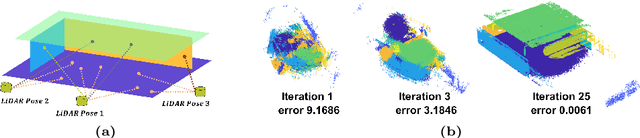
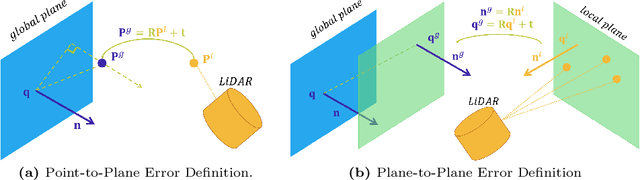
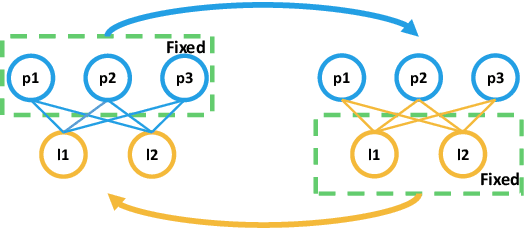
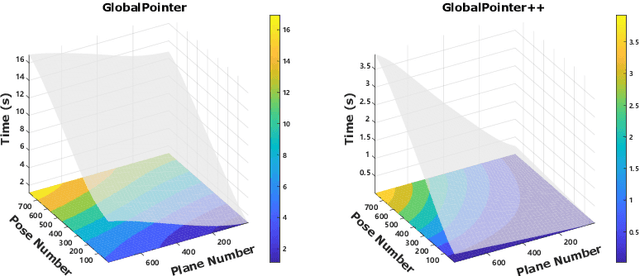
Plane adjustment (PA) is crucial for many 3D applications, involving simultaneous pose estimation and plane recovery. Despite recent advancements, it remains a challenging problem in the realm of multi-view point cloud registration. Current state-of-the-art methods can achieve globally optimal convergence only with good initialization. Furthermore, their high time complexity renders them impractical for large-scale problems. To address these challenges, we first exploit a novel optimization strategy termed \textit{Bi-Convex Relaxation}, which decouples the original problem into two simpler sub-problems, reformulates each sub-problem using a convex relaxation technique, and alternately solves each one until the original problem converges. Building on this strategy, we propose two algorithmic variants for solving the plane adjustment problem, namely \textit{GlobalPointer} and \textit{GlobalPointer++}, based on point-to-plane and plane-to-plane errors, respectively. Extensive experiments on both synthetic and real datasets demonstrate that our method can perform large-scale plane adjustment with linear time complexity, larger convergence region, and robustness to poor initialization, while achieving similar accuracy as prior methods. The code is available at https://github.com/wu-cvgl/GlobalPointer.
PointDifformer: Robust Point Cloud Registration With Neural Diffusion and Transformer
Apr 22, 2024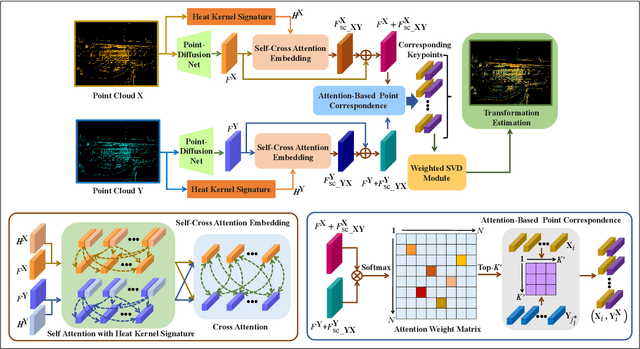
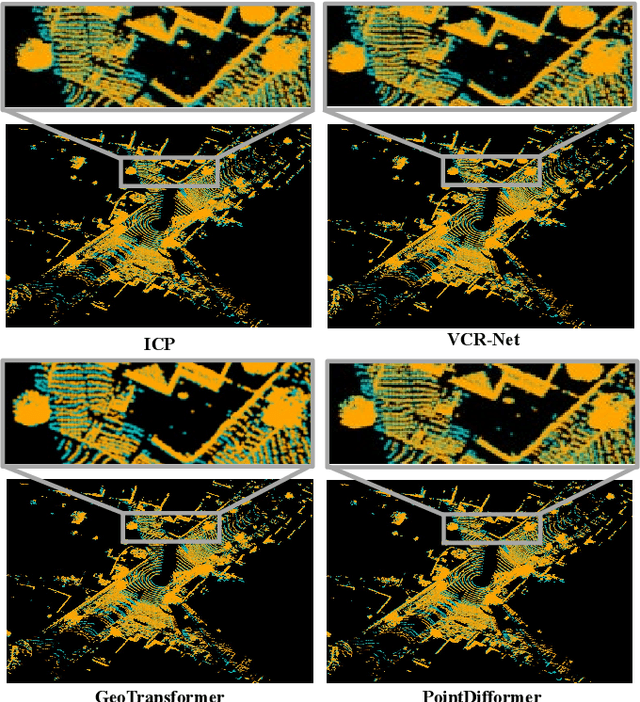
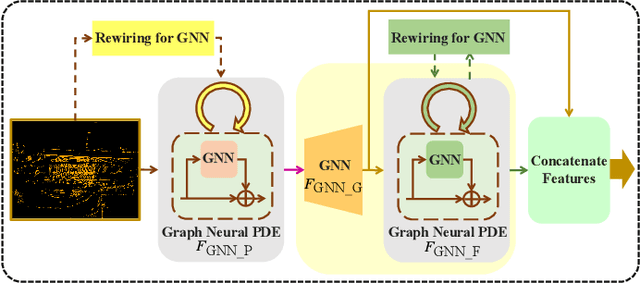
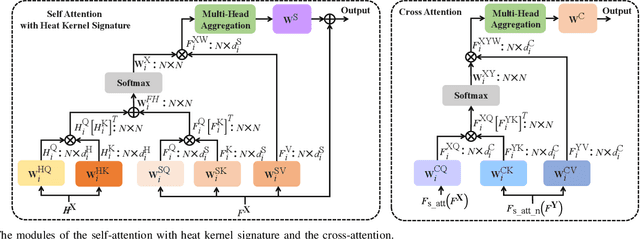
Point cloud registration is a fundamental technique in 3-D computer vision with applications in graphics, autonomous driving, and robotics. However, registration tasks under challenging conditions, under which noise or perturbations are prevalent, can be difficult. We propose a robust point cloud registration approach that leverages graph neural partial differential equations (PDEs) and heat kernel signatures. Our method first uses graph neural PDE modules to extract high dimensional features from point clouds by aggregating information from the 3-D point neighborhood, thereby enhancing the robustness of the feature representations. Then, we incorporate heat kernel signatures into an attention mechanism to efficiently obtain corresponding keypoints. Finally, a singular value decomposition (SVD) module with learnable weights is used to predict the transformation between two point clouds. Empirical experiments on a 3-D point cloud dataset demonstrate that our approach not only achieves state-of-the-art performance for point cloud registration but also exhibits better robustness to additive noise or 3-D shape perturbations.
Benchmarking Classical and Learning-Based Multibeam Point Cloud Registration
May 10, 2024Deep learning has shown promising results for multiple 3D point cloud registration datasets. However, in the underwater domain, most registration of multibeam echo-sounder (MBES) point cloud data are still performed using classical methods in the iterative closest point (ICP) family. In this work, we curate and release DotsonEast Dataset, a semi-synthetic MBES registration dataset constructed from an autonomous underwater vehicle in West Antarctica. Using this dataset, we systematically benchmark the performance of 2 classical and 4 learning-based methods. The experimental results show that the learning-based methods work well for coarse alignment, and are better at recovering rough transforms consistently at high overlap (20-50%). In comparison, GICP (a variant of ICP) performs well for fine alignment and is better across all metrics at extremely low overlap (10%). To the best of our knowledge, this is the first work to benchmark both learning-based and classical registration methods on an AUV-based MBES dataset. To facilitate future research, both the code and data are made available online.
A Comprehensive Survey and Taxonomy on Point Cloud Registration Based on Deep Learning
Apr 22, 2024



Point cloud registration (PCR) involves determining a rigid transformation that aligns one point cloud to another. Despite the plethora of outstanding deep learning (DL)-based registration methods proposed, comprehensive and systematic studies on DL-based PCR techniques are still lacking. In this paper, we present a comprehensive survey and taxonomy of recently proposed PCR methods. Firstly, we conduct a taxonomy of commonly utilized datasets and evaluation metrics. Secondly, we classify the existing research into two main categories: supervised and unsupervised registration, providing insights into the core concepts of various influential PCR models. Finally, we highlight open challenges and potential directions for future research. A curated collection of valuable resources is made available at https://github.com/yxzhang15/PCR.
SRIF: Semantic Shape Registration Empowered by Diffusion-based Image Morphing and Flow Estimation
Sep 18, 2024
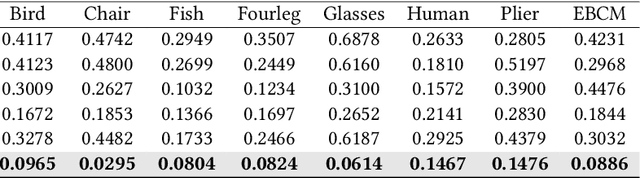
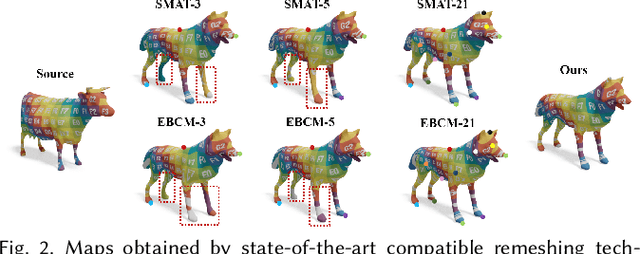
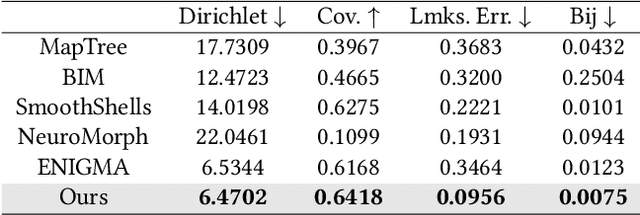
In this paper, we propose SRIF, a novel Semantic shape Registration framework based on diffusion-based Image morphing and Flow estimation. More concretely, given a pair of extrinsically aligned shapes, we first render them from multi-views, and then utilize an image interpolation framework based on diffusion models to generate sequences of intermediate images between them. The images are later fed into a dynamic 3D Gaussian splatting framework, with which we reconstruct and post-process for intermediate point clouds respecting the image morphing processing. In the end, tailored for the above, we propose a novel registration module to estimate continuous normalizing flow, which deforms source shape consistently towards the target, with intermediate point clouds as weak guidance. Our key insight is to leverage large vision models (LVMs) to associate shapes and therefore obtain much richer semantic information on the relationship between shapes than the ad-hoc feature extraction and alignment. As a consequence, SRIF achieves high-quality dense correspondences on challenging shape pairs, but also delivers smooth, semantically meaningful interpolation in between. Empirical evidence justifies the effectiveness and superiority of our method as well as specific design choices. The code is released at https://github.com/rqhuang88/SRIF.
Snail-Radar: A large-scale diverse dataset for the evaluation of 4D-radar-based SLAM systems
Jul 16, 2024


4D radars are increasingly favored for odometry and mapping of autonomous systems due to their robustness in harsh weather and dynamic environments. Existing datasets, however, often cover limited areas and are typically captured using a single platform. To address this gap, we present a diverse large-scale dataset specifically designed for 4D radar-based localization and mapping. This dataset was gathered using three different platforms: a handheld device, an e-bike, and an SUV, under a variety of environmental conditions, including clear days, nighttime, and heavy rain. The data collection occurred from September 2023 to February 2024, encompassing diverse settings such as roads in a vegetated campus and tunnels on highways. Each route was traversed multiple times to facilitate place recognition evaluations. The sensor suite included a 3D lidar, 4D radars, stereo cameras, consumer-grade IMUs, and a GNSS/INS system. Sensor data packets were synchronized to GNSS time using a two-step process: a convex hull algorithm was applied to smooth host time jitter, and then odometry and correlation algorithms were used to correct constant time offsets. Extrinsic calibration between sensors was achieved through manual measurements and subsequent nonlinear optimization. The reference motion for the platforms was generated by registering lidar scans to a terrestrial laser scanner (TLS) point cloud map using a lidar inertial odometry (LIO) method in localization mode. Additionally, a data reversion technique was introduced to enable backward LIO processing. We believe this dataset will boost research in radar-based point cloud registration, odometry, mapping, and place recognition.