 Add to Chrome
 Add to Firefox
 Add to Edge
TeaMatch: Teachable Cross-Modal Representation Learning for 2D-3D Matching
Aug 10, 2026
Learning reliable correspondences between images and point clouds is fundamental for 2D-3D matching. Despite recent progress in detection-free methods, existing approaches primarily optimize matching within a single model and often struggle to maintain reliable correspondences under challenging conditions such as noisy inputs, low overlap, and ambiguous structures. In this work, we propose TeaMatch, a novel framework that introduces teachability as a criterion for cross-modal representation learning. We define teachability as the ability of a representation to be effectively recovered by weak learners under degraded inputs, reflecting its structural consistency and robustness. To this end, we construct a set of task-specific weak students that simulate common failure modes and train them to imitate the teacher on a training split while evaluating their recoverability on a disjoint meta split. The teacher is then optimized to improve the students' ability to recover reliable correspondences, guided by correspondence-level and geometry-aware constraints. Our framework can be seamlessly integrated into existing coarse-to-fine matching pipelines without additional inference cost. Extensive experiments demonstrate that TeaMatch improves matching robustness and achieves state-of-the-art performance on challenging 2D-3D matching benchmarks.

SWINSleepNet: A Hierarchical Context-Aware Framework for Sleep Staging (v2)
Aug 03, 2026Automatic sleep staging is a critical role in sleep disorder diagnosis, sleep quality assessment, and long-term health monitoring; however, existing approaches suffer poor performance on ambiguous and transition-related sleep stages, caused by inadequate modeling of fine-grained intra-epoch structures and complex cross-region spectral dependencies. Traditional epoch-level encoders commonly fail to extract subtle temporal microstructures and intra-epoch cross-region interactions, resulting in unsatisfactory recognition accuracy for hard categories such as the N1 stage. To tackle these drawbacks, we propose SwinSleepNet, a hierarchical context-aware dual-stream framework that separately optimizes intra-epoch representation learning and inter-epoch contextual modeling. Concretely, we characterize each sleep epoch from two complementary perspectives: raw time-domain EEG signal and its time-frequency transformation. The time-domain branch adopts convolutional encoders to capture fine waveform temporal details, and the time-frequency branch uses Swin Transformer to extract local spectro-temporal features, hierarchical multi-scale information and long-range spatial dependencies. The multi-branch extracted features are fused into integrated embeddings, which are optimized by a bidirectional context module to capture cross-epoch temporal dependencies for final sleep stage classification. Comprehensive experiments on Sleep-EDF-20, Sleep-EDF-78 and SHHS datasets verify that our method achieves competitive overall performance, and exhibits stronger robustness and stability on difficult N1 stages and transitional epochs. The results prove that optimized intra-epoch representation learning based on hierarchical architecture greatly benefits automatic sleep staging tasks.
LGFNet: A CTC-Guided Local-Global Fusion Framework for Single-Channel Sleep Staging
Jul 28, 2026Sleep staging remains challenging due to long-range temporal dependencies, ambiguous stage transitions-particularly in N1-and substantial distribution shifts across subjects, sampling rates, and EEG montages. These difficulties are further amplified in single-channel, low-latency scenarios required by wearable and real-world applications. To address these issues, we propose LGFNet, a CTC-guided sequence-to-sequence framework for robust sleep staging. LGFNet introduces a Local-Global Fusion encoder that jointly models fine-grained temporal dynamics and long-range sleep structure, overcoming the limitations of conventional serial hybrid architectures. A CTC-Attention joint training paradigm is adopted to unify temporal alignment with context-dependent modeling, enabling more accurate recognition of stage boundaries and transitions. Furthermore, a three-stage decoding strategy is devised, leveraging CTC-guided decoding and Viterbi-based smoothing to reduce error accumulation and enforce physiological consistency. Extensive cross-dataset evaluations on five public benchmarks demonstrate that LGFNet consistently outperforms state-of-the-art single-channel methods. In particular, on Sleep-EDF-78, LGFNet surpasses DMIN by +1.27% accuracy, +1.74% macro-F1, and +1.93% kappa, with pronounced gains on N1 and transition segments, highlighting its robustness and strong generalization across diverse sampling rates, montages, and recording environments.
SHReg: Strictly Rotation-Equivariant Point Cloud Registration via Spherical Harmonics
Jul 25, 2026Point cloud registration critically depends on local features that are both distinctive and robust to arbitrary 3D rotations. Existing learning-based methods typically approximate rotation invariance via fragile local reference frames or extensive data augmentation, providing only empirical invariance and often degrading under unseen rotational transformations. In this paper, we propose SHReg, a strictly rotation-equivariant point cloud registration framework grounded in the representation theory of $SO(3)$. By representing local geometric features as irreducible representations of $SO(3)$, SHReg guarantees exact equivariance under arbitrary rotations without relying on local reference frames. Built upon a spherical-harmonics-based equivariant backbone, SHReg jointly learns rotation-invariant descriptors for robust correspondence matching and rotation-equivariant features that preserve fine-grained orientation information. The preserved equivariant structure enables each correspondence to directly hypothesize a rigid transformation, reducing reliance on large-scale hypothesis sampling in conventional RANSAC-based pipelines and leading to improved robustness under challenging rotational variations. Extensive experiments on 3DMatch, 3DLoMatch, and KITTI demonstrate that SHReg consistently outperforms state-of-the-art methods in registration accuracy, particularly under large rotational perturbations.
Deep-PE: A Learning-Based Pose Evaluator for Point Cloud Registration
May 25, 2024
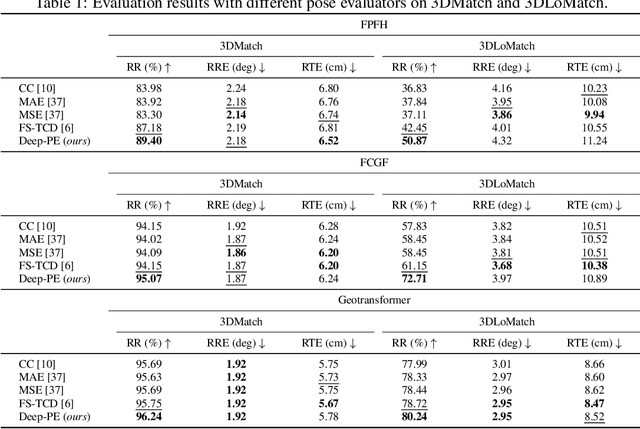


In the realm of point cloud registration, the most prevalent pose evaluation approaches are statistics-based, identifying the optimal transformation by maximizing the number of consistent correspondences. However, registration recall decreases significantly when point clouds exhibit a low overlap rate, despite efforts in designing feature descriptors and establishing correspondences. In this paper, we introduce Deep-PE, a lightweight, learning-based pose evaluator designed to enhance the accuracy of pose selection, especially in challenging point cloud scenarios with low overlap. Our network incorporates a Pose-Aware Attention (PAA) module to simulate and learn the alignment status of point clouds under various candidate poses, alongside a Pose Confidence Prediction (PCP) module that predicts the likelihood of successful registration. These two modules facilitate the learning of both local and global alignment priors. Extensive tests across multiple benchmarks confirm the effectiveness of Deep-PE. Notably, on 3DLoMatch with a low overlap rate, Deep-PE significantly outperforms state-of-the-art methods by at least 8% and 11% in registration recall under handcrafted FPFH and learning-based FCGF descriptors, respectively. To the best of our knowledge, this is the first study to utilize deep learning to select the optimal pose without the explicit need for input correspondences.