 Add to Chrome
 Add to Firefox
 Add to Edge
QwenPaw-Data: Bridging Facts, Methodology, and Execution for Autonomous Enterprise Data Analytics
Jul 14, 2026
Enterprise data analysis is emerging as a distinct frontier for autonomous agents. Compared with general-purpose interaction and software engineering, it operates in an open, ambiguous, and continuously evolving environment. These characteristics call for a data-agent architecture that treats semantics, methodology, execution, and evolution as first-class system concerns. To this end, we introduce QwenPaw-Data, an agentic data system designed for enterprise intelligent data analysis. QwenPaw-Data consolidates heterogeneous assets from warehouses, dashboards, documents, interaction logs, and historical tasks into reusable, governable, and evolvable analysis assets, then turns natural-language requests into end-to-end analytical workflows spanning data understanding, retrieval, analysis, report generation, and decision support. Its architecture decomposes the problem into three collaborative subsystems: DataBridge provides trustworthy semantic grounding through interconnected metadata, knowledge, and trace graphs; Skill-Hub codifies expert analytical methodology into reusable and verifiable skills; and Host materializes these evidence and method assets into controllable, artifact-centric runtime execution. Across these subsystems, semantics, methods, traces, and feedback are continuously deposited back into the system, forming a self-evolving asset flywheel. Experiments on public benchmarks and real-world industrial BI workloads show that QwenPaw-Data improves both verifiable data access capability and higher-level analytical quality, offering a practical foundation for reliable, traceable, and continuously improving enterprise data agents.

Deep-PE: A Learning-Based Pose Evaluator for Point Cloud Registration
May 25, 2024
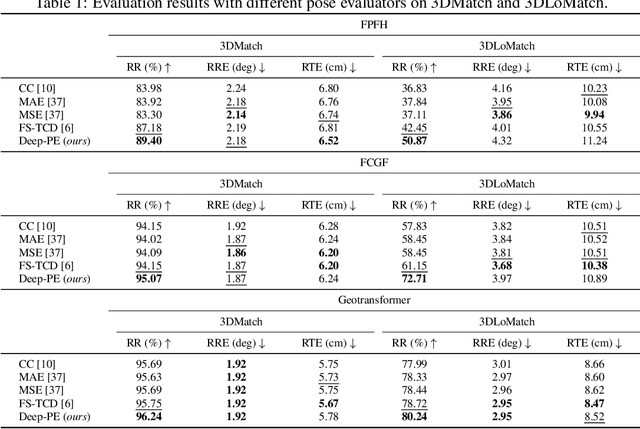


In the realm of point cloud registration, the most prevalent pose evaluation approaches are statistics-based, identifying the optimal transformation by maximizing the number of consistent correspondences. However, registration recall decreases significantly when point clouds exhibit a low overlap rate, despite efforts in designing feature descriptors and establishing correspondences. In this paper, we introduce Deep-PE, a lightweight, learning-based pose evaluator designed to enhance the accuracy of pose selection, especially in challenging point cloud scenarios with low overlap. Our network incorporates a Pose-Aware Attention (PAA) module to simulate and learn the alignment status of point clouds under various candidate poses, alongside a Pose Confidence Prediction (PCP) module that predicts the likelihood of successful registration. These two modules facilitate the learning of both local and global alignment priors. Extensive tests across multiple benchmarks confirm the effectiveness of Deep-PE. Notably, on 3DLoMatch with a low overlap rate, Deep-PE significantly outperforms state-of-the-art methods by at least 8% and 11% in registration recall under handcrafted FPFH and learning-based FCGF descriptors, respectively. To the best of our knowledge, this is the first study to utilize deep learning to select the optimal pose without the explicit need for input correspondences.