 Add to Chrome
 Add to Firefox
 Add to Edge
SwiftGS: Episodic Priors for Immediate Satellite Surface Recovery
Mar 19, 2026
Rapid, large-scale 3D reconstruction from multi-date satellite imagery is vital for environmental monitoring, urban planning, and disaster response, yet remains difficult due to illumination changes, sensor heterogeneity, and the cost of per-scene optimization. We introduce SwiftGS, a meta-learned system that reconstructs 3D surfaces in a single forward pass by predicting geometry-radiation-decoupled Gaussian primitives together with a lightweight SDF, replacing expensive per-scene fitting with episodic training that captures transferable priors. The model couples a differentiable physics graph for projection, illumination, and sensor response with spatial gating that blends sparse Gaussian detail and global SDF structure, and incorporates semantic-geometric fusion, conditional lightweight task heads, and multi-view supervision from a frozen geometric teacher under an uncertainty-aware multi-task loss. At inference, SwiftGS operates zero-shot with optional compact calibration and achieves accurate DSM reconstruction and view-consistent rendering at significantly reduced computational cost, with ablations highlighting the benefits of the hybrid representation, physics-aware rendering, and episodic meta-training.

LiveGraph: Active-Structure Neural Re-ranking for Exercise Recommendation
Feb 19, 2026The continuous expansion of digital learning environments has catalyzed the demand for intelligent systems capable of providing personalized educational content. While current exercise recommendation frameworks have made significant strides, they frequently encounter obstacles regarding the long-tailed distribution of student engagement and the failure to adapt to idiosyncratic learning trajectories. We present LiveGraph, a novel active-structure neural re-ranking framework designed to overcome these limitations. Our approach utilizes a graph-based representation enhancement strategy to bridge the information gap between active and inactive students while integrating a dynamic re-ranking mechanism to foster content diversity. By prioritizing the structural relationships within learning histories, the proposed model effectively balances recommendation precision with pedagogical variety. Comprehensive experimental evaluations conducted on multiple real-world datasets demonstrate that LiveGraph surpasses contemporary baselines in both predictive accuracy and the breadth of exercise diversity.
Emotion Collider: Dual Hyperbolic Mirror Manifolds for Sentiment Recovery via Anti Emotion Reflection
Feb 18, 2026Emotional expression underpins natural communication and effective human-computer interaction. We present Emotion Collider (EC-Net), a hyperbolic hypergraph framework for multimodal emotion and sentiment modeling. EC-Net represents modality hierarchies using Poincare-ball embeddings and performs fusion through a hypergraph mechanism that passes messages bidirectionally between nodes and hyperedges. To sharpen class separation, contrastive learning is formulated in hyperbolic space with decoupled radial and angular objectives. High-order semantic relations across time steps and modalities are preserved via adaptive hyperedge construction. Empirical results on standard multimodal emotion benchmarks show that EC-Net produces robust, semantically coherent representations and consistently improves accuracy, particularly when modalities are partially available or contaminated by noise. These findings indicate that explicit hierarchical geometry combined with hypergraph fusion is effective for resilient multimodal affect understanding.
DAV-GSWT: Diffusion-Active-View Sampling for Data-Efficient Gaussian Splatting Wang Tiles
Feb 17, 2026The emergence of 3D Gaussian Splatting has fundamentally redefined the capabilities of photorealistic neural rendering by enabling high-throughput synthesis of complex environments. While procedural methods like Wang Tiles have recently been integrated to facilitate the generation of expansive landscapes, these systems typically remain constrained by a reliance on densely sampled exemplar reconstructions. We present DAV-GSWT, a data-efficient framework that leverages diffusion priors and active view sampling to synthesize high-fidelity Gaussian Splatting Wang Tiles from minimal input observations. By integrating a hierarchical uncertainty quantification mechanism with generative diffusion models, our approach autonomously identifies the most informative viewpoints while hallucinating missing structural details to ensure seamless tile transitions. Experimental results indicate that our system significantly reduces the required data volume while maintaining the visual integrity and interactive performance necessary for large-scale virtual environments.
LiDARDraft: Generating LiDAR Point Cloud from Versatile Inputs
Dec 23, 2025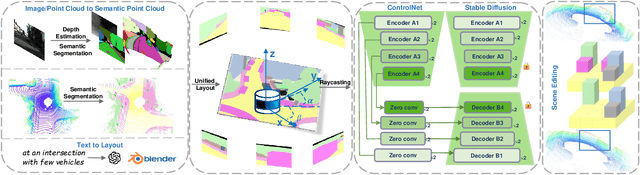
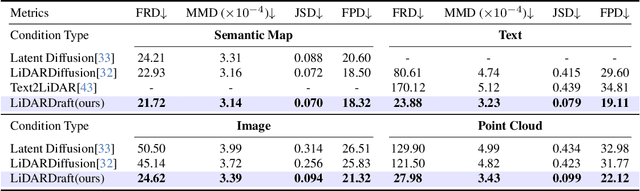
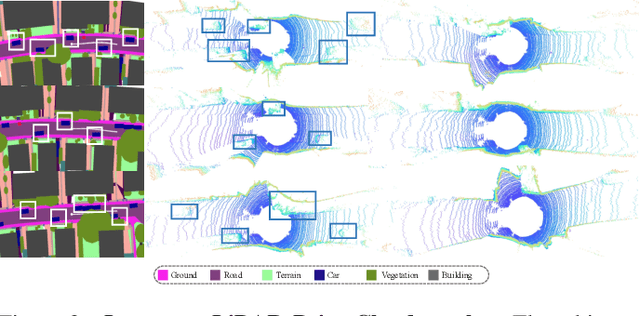
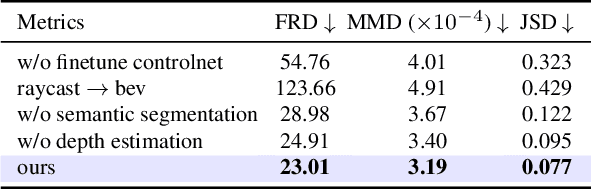
Generating realistic and diverse LiDAR point clouds is crucial for autonomous driving simulation. Although previous methods achieve LiDAR point cloud generation from user inputs, they struggle to attain high-quality results while enabling versatile controllability, due to the imbalance between the complex distribution of LiDAR point clouds and the simple control signals. To address the limitation, we propose LiDARDraft, which utilizes the 3D layout to build a bridge between versatile conditional signals and LiDAR point clouds. The 3D layout can be trivially generated from various user inputs such as textual descriptions and images. Specifically, we represent text, images, and point clouds as unified 3D layouts, which are further transformed into semantic and depth control signals. Then, we employ a rangemap-based ControlNet to guide LiDAR point cloud generation. This pixel-level alignment approach demonstrates excellent performance in controllable LiDAR point clouds generation, enabling "simulation from scratch", allowing self-driving environments to be created from arbitrary textual descriptions, images and sketches.
GeoNLF: Geometry guided Pose-Free Neural LiDAR Fields
Jul 08, 2024Although recent efforts have extended Neural Radiance Fields (NeRF) into LiDAR point cloud synthesis, the majority of existing works exhibit a strong dependence on precomputed poses. However, point cloud registration methods struggle to achieve precise global pose estimation, whereas previous pose-free NeRFs overlook geometric consistency in global reconstruction. In light of this, we explore the geometric insights of point clouds, which provide explicit registration priors for reconstruction. Based on this, we propose Geometry guided Neural LiDAR Fields(GeoNLF), a hybrid framework performing alternately global neural reconstruction and pure geometric pose optimization. Furthermore, NeRFs tend to overfit individual frames and easily get stuck in local minima under sparse-view inputs. To tackle this issue, we develop a selective-reweighting strategy and introduce geometric constraints for robust optimization. Extensive experiments on NuScenes and KITTI-360 datasets demonstrate the superiority of GeoNLF in both novel view synthesis and multi-view registration of low-frequency large-scale point clouds.