 Add to Chrome
 Add to Firefox
 Add to Edge
Stochastic Human Motion Prediction
Papers and Code
How Human Motion Prediction Quality Shapes Social Robot Navigation Performance in Constrained Spaces
Jan 14, 2026
Motivated by the vision of integrating mobile robots closer to humans in warehouses, hospitals, manufacturing plants, and the home, we focus on robot navigation in dynamic and spatially constrained environments. Ensuring human safety, comfort, and efficiency in such settings requires that robots are endowed with a model of how humans move around them. Human motion prediction around robots is especially challenging due to the stochasticity of human behavior, differences in user preferences, and data scarcity. In this work, we perform a methodical investigation of the effects of human motion prediction quality on robot navigation performance, as well as human productivity and impressions. We design a scenario involving robot navigation among two human subjects in a constrained workspace and instantiate it in a user study ($N=80$) involving two different robot platforms, conducted across two sites from different world regions. Key findings include evidence that: 1) the widely adopted average displacement error is not a reliable predictor of robot navigation performance and human impressions; 2) the common assumption of human cooperation breaks down in constrained environments, with users often not reciprocating robot cooperation, and causing performance degradations; 3) more efficient robot navigation often comes at the expense of human efficiency and comfort.

Semantic Belief-State World Model for 3D Human Motion Prediction
Jan 07, 2026Human motion prediction has traditionally been framed as a sequence regression problem where models extrapolate future joint coordinates from observed pose histories. While effective over short horizons this approach does not separate observation reconstruction with dynamics modeling and offers no explicit representation of the latent causes governing motion. As a result, existing methods exhibit compounding drift, mean-pose collapse, and poorly calibrated uncertainty when rolled forward beyond the training regime. Here we propose a Semantic Belief-State World Model (SBWM) that reframes human motion prediction as latent dynamical simulation on the human body manifold. Rather than predicting poses directly, SBWM maintains a recurrent probabilistic belief state whose evolution is learned independently of pose reconstruction and explicitly aligned with the SMPL-X anatomical parameterization. This alignment imposes a structural information bottleneck that prevents the latent state from encoding static geometry or sensor noise, forcing it to capture motion dynamics, intent, and control-relevant structure. Inspired by belief-state world models developed for model-based reinforcement learning, SBWM adapts stochastic latent transitions and rollout-centric training to the domain of human motion. In contrast to RSSM-based, transformer, and diffusion approaches optimized for reconstruction fidelity, SBWM prioritizes stable forward simulation. We demonstrate coherent long-horizon rollouts, and competitive accuracy at substantially lower computational cost. These results suggest that treating the human body as part of the world models state space rather than its output fundamentally changes how motion is simulated, and predicted.
PrediFlow: A Flow-Based Prediction-Refinement Framework for Real-Time Human Motion Prediction in Human-Robot Collaboration
Dec 15, 2025Stochastic human motion prediction is critical for safe and effective human-robot collaboration (HRC) in industrial remanufacturing, as it captures human motion uncertainties and multi-modal behaviors that deterministic methods cannot handle. While earlier works emphasize highly diverse predictions, they often generate unrealistic human motions. More recent methods focus on accuracy and real-time performance, yet there remains potential to improve prediction quality further without exceeding time budgets. Additionally, current research on stochastic human motion prediction in HRC typically considers human motion in isolation, neglecting the influence of robot motion on human behavior. To address these research gaps and enable real-time, realistic, and interaction-aware human motion prediction, we propose a novel prediction-refinement framework that integrates both human and robot observed motion to refine the initial predictions produced by a pretrained state-of-the-art predictor. The refinement module employs a Flow Matching structure to account for uncertainty. Experimental studies on the HRC desktop disassembly dataset demonstrate that our method significantly improves prediction accuracy while preserving the uncertainties and multi-modalities of human motion. Moreover, the total inference time of the proposed framework remains within the time budget, highlighting the effectiveness and practicality of our approach.
Uncertainty Aware-Predictive Control Barrier Functions: Safer Human Robot Interaction through Probabilistic Motion Forecasting
Aug 28, 2025To enable flexible, high-throughput automation in settings where people and robots share workspaces, collaborative robotic cells must reconcile stringent safety guarantees with the need for responsive and effective behavior. A dynamic obstacle is the stochastic, task-dependent variability of human motion: when robots fall back on purely reactive or worst-case envelopes, they brake unnecessarily, stall task progress, and tamper with the fluidity that true Human-Robot Interaction demands. In recent years, learning-based human-motion prediction has rapidly advanced, although most approaches produce worst-case scenario forecasts that often do not treat prediction uncertainty in a well-structured way, resulting in over-conservative planning algorithms, limiting their flexibility. We introduce Uncertainty-Aware Predictive Control Barrier Functions (UA-PCBFs), a unified framework that fuses probabilistic human hand motion forecasting with the formal safety guarantees of Control Barrier Functions. In contrast to other variants, our framework allows for dynamic adjustment of the safety margin thanks to the human motion uncertainty estimation provided by a forecasting module. Thanks to uncertainty estimation, UA-PCBFs empower collaborative robots with a deeper understanding of future human states, facilitating more fluid and intelligent interactions through informed motion planning. We validate UA-PCBFs through comprehensive real-world experiments with an increasing level of realism, including automated setups (to perform exactly repeatable motions) with a robotic hand and direct human-robot interactions (to validate promptness, usability, and human confidence). Relative to state-of-the-art HRI architectures, UA-PCBFs show better performance in task-critical metrics, significantly reducing the number of violations of the robot's safe space during interaction with respect to the state-of-the-art.
Intention Enhanced Diffusion Model for Multimodal Pedestrian Trajectory Prediction
Aug 06, 2025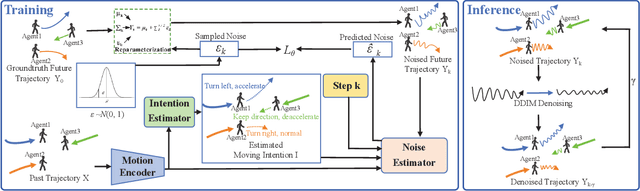
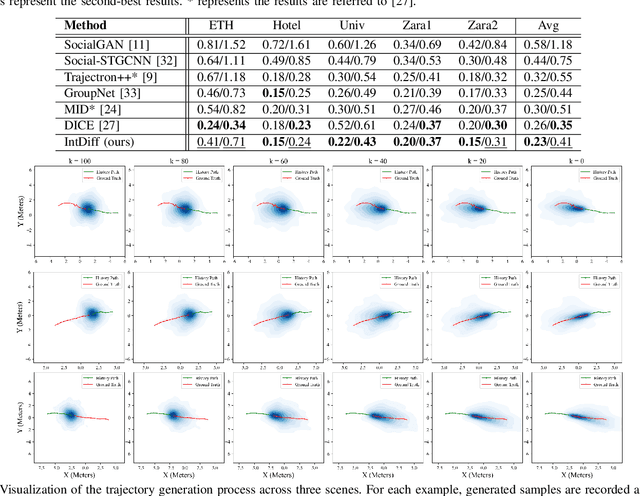
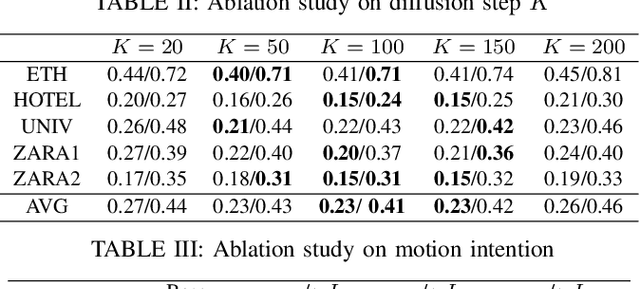
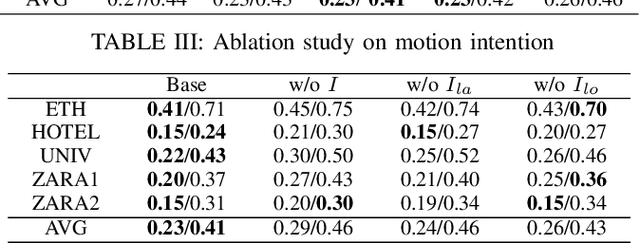
Predicting pedestrian motion trajectories is critical for path planning and motion control of autonomous vehicles. However, accurately forecasting crowd trajectories remains a challenging task due to the inherently multimodal and uncertain nature of human motion. Recent diffusion-based models have shown promising results in capturing the stochasticity of pedestrian behavior for trajectory prediction. However, few diffusion-based approaches explicitly incorporate the underlying motion intentions of pedestrians, which can limit the interpretability and precision of prediction models. In this work, we propose a diffusion-based multimodal trajectory prediction model that incorporates pedestrians' motion intentions into the prediction framework. The motion intentions are decomposed into lateral and longitudinal components, and a pedestrian intention recognition module is introduced to enable the model to effectively capture these intentions. Furthermore, we adopt an efficient guidance mechanism that facilitates the generation of interpretable trajectories. The proposed framework is evaluated on two widely used human trajectory prediction benchmarks, ETH and UCY, on which it is compared against state-of-the-art methods. The experimental results demonstrate that our method achieves competitive performance.
SICNav-Diffusion: Safe and Interactive Crowd Navigation with Diffusion Trajectory Predictions
Mar 11, 2025To navigate crowds without collisions, robots must interact with humans by forecasting their future motion and reacting accordingly. While learning-based prediction models have shown success in generating likely human trajectory predictions, integrating these stochastic models into a robot controller presents several challenges. The controller needs to account for interactive coupling between planned robot motion and human predictions while ensuring both predictions and robot actions are safe (i.e. collision-free). To address these challenges, we present a receding horizon crowd navigation method for single-robot multi-human environments. We first propose a diffusion model to generate joint trajectory predictions for all humans in the scene. We then incorporate these multi-modal predictions into a SICNav Bilevel MPC problem that simultaneously solves for a robot plan (upper-level) and acts as a safety filter to refine the predictions for non-collision (lower-level). Combining planning and prediction refinement into one bilevel problem ensures that the robot plan and human predictions are coupled. We validate the open-loop trajectory prediction performance of our diffusion model on the commonly used ETH/UCY benchmark and evaluate the closed-loop performance of our robot navigation method in simulation and extensive real-robot experiments demonstrating safe, efficient, and reactive robot motion.
Speech-to-Trajectory: Learning Human-Like Verbal Guidance for Robot Motion
Apr 07, 2025Full integration of robots into real-life applications necessitates their ability to interpret and execute natural language directives from untrained users. Given the inherent variability in human language, equivalent directives may be phrased differently, yet require consistent robot behavior. While Large Language Models (LLMs) have advanced language understanding, they often falter in handling user phrasing variability, rely on predefined commands, and exhibit unpredictable outputs. This letter introduces the Directive Language Model (DLM), a novel speech-to-trajectory framework that directly maps verbal commands to executable motion trajectories, bypassing predefined phrases. DLM utilizes Behavior Cloning (BC) on simulated demonstrations of human-guided robot motion. To enhance generalization, GPT-based semantic augmentation generates diverse paraphrases of training commands, labeled with the same motion trajectory. DLM further incorporates a diffusion policy-based trajectory generation for adaptive motion refinement and stochastic sampling. In contrast to LLM-based methods, DLM ensures consistent, predictable motion without extensive prompt engineering, facilitating real-time robotic guidance. As DLM learns from trajectory data, it is embodiment-agnostic, enabling deployment across diverse robotic platforms. Experimental results demonstrate DLM's improved command generalization, reduced dependence on structured phrasing, and achievement of human-like motion.
Embrace Collisions: Humanoid Shadowing for Deployable Contact-Agnostics Motions
Feb 03, 2025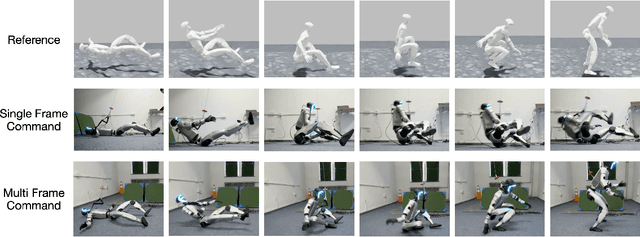
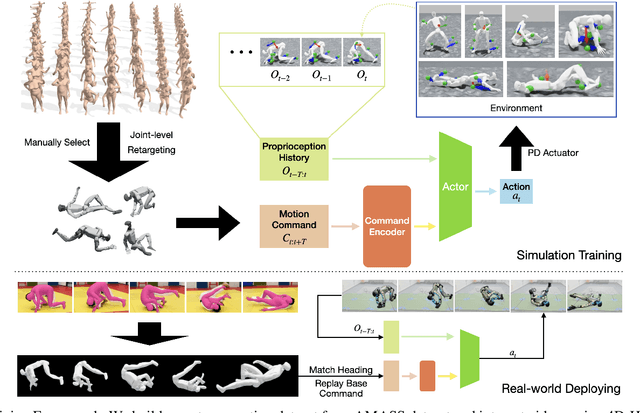
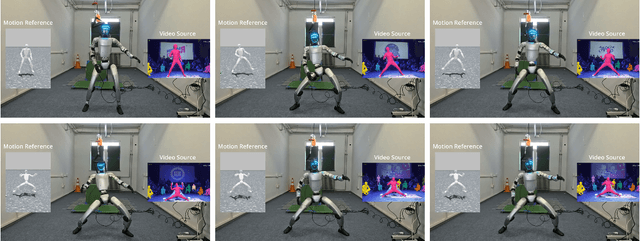
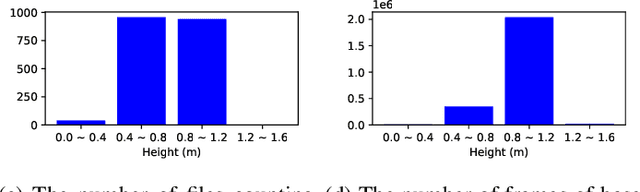
Previous humanoid robot research works treat the robot as a bipedal mobile manipulation platform, where only the feet and hands contact the environment. However, we humans use all body parts to interact with the world, e.g., we sit in chairs, get up from the ground, or roll on the floor. Contacting the environment using body parts other than feet and hands brings significant challenges in both model-predictive control and reinforcement learning-based methods. An unpredictable contact sequence makes it almost impossible for model-predictive control to plan ahead in real time. The success of the zero-shot sim-to-real reinforcement learning method for humanoids heavily depends on the acceleration of GPU-based rigid-body physical simulator and simplification of the collision detection. Lacking extreme torso movement of the humanoid research makes all other components non-trivial to design, such as termination conditions, motion commands and reward designs. To address these potential challenges, we propose a general humanoid motion framework that takes discrete motion commands and controls the robot's motor action in real time. Using a GPU-accelerated rigid-body simulator, we train a humanoid whole-body control policy that follows the high-level motion command in the real world in real time, even with stochastic contacts and extremely large robot base rotation and not-so-feasible motion command. More details at https://project-instinct.github.io
Learning Semantic Latent Directions for Accurate and Controllable Human Motion Prediction
Jul 16, 2024


In the realm of stochastic human motion prediction (SHMP), researchers have often turned to generative models like GANS, VAEs and diffusion models. However, most previous approaches have struggled to accurately predict motions that are both realistic and coherent with past motion due to a lack of guidance on the latent distribution. In this paper, we introduce Semantic Latent Directions (SLD) as a solution to this challenge, aiming to constrain the latent space to learn meaningful motion semantics and enhance the accuracy of SHMP. SLD defines a series of orthogonal latent directions and represents the hypothesis of future motion as a linear combination of these directions. By creating such an information bottleneck, SLD excels in capturing meaningful motion semantics, thereby improving the precision of motion predictions. Moreover, SLD offers controllable prediction capabilities by adjusting the coefficients of the latent directions during the inference phase. Expanding on SLD, we introduce a set of motion queries to enhance the diversity of predictions. By aligning these motion queries with the SLD space, SLD is further promoted to more accurate and coherent motion predictions. Through extensive experiments conducted on widely used benchmarks, we showcase the superiority of our method in accurately predicting motions while maintaining a balance of realism and diversity. Our code and pretrained models are available at https://github.com/GuoweiXu368/SLD-HMP.
Risk-aware MPPI for Stochastic Hybrid Systems
Nov 14, 2024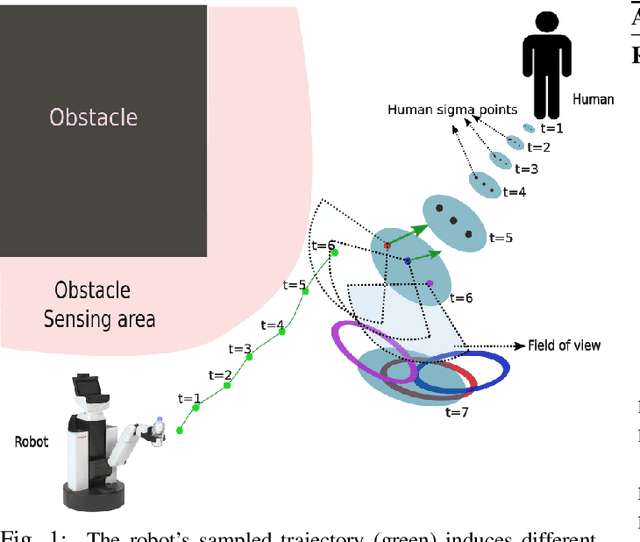

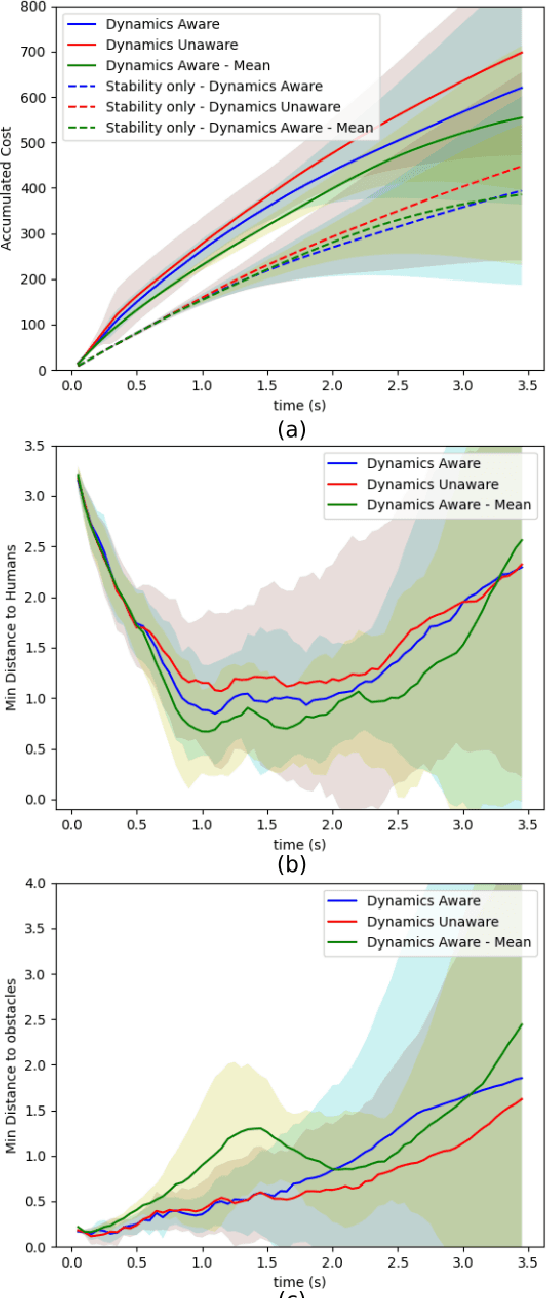
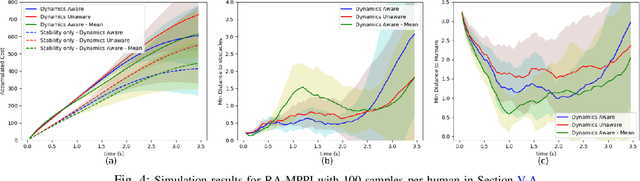
Path Planning for stochastic hybrid systems presents a unique challenge of predicting distributions of future states subject to a state-dependent dynamics switching function. In this work, we propose a variant of Model Predictive Path Integral Control (MPPI) to plan kinodynamic paths for such systems. Monte Carlo may be inaccurate when few samples are chosen to predict future states under state-dependent disturbances. We employ recently proposed Unscented Transform-based methods to capture stochasticity in the states as well as the state-dependent switching surfaces. This is in contrast to previous works that perform switching based only on the mean of predicted states. We focus our motion planning application on the navigation of a mobile robot in the presence of dynamically moving agents whose responses are based on sensor-constrained attention zones. We evaluate our framework on a simulated mobile robot and show faster convergence to a goal without collisions when the robot exploits the hybrid human dynamics versus when it does not.