 Add to Chrome
 Add to Firefox
 Add to Edge
How Human Motion Prediction Quality Shapes Social Robot Navigation Performance in Constrained Spaces
Jan 14, 2026
Motivated by the vision of integrating mobile robots closer to humans in warehouses, hospitals, manufacturing plants, and the home, we focus on robot navigation in dynamic and spatially constrained environments. Ensuring human safety, comfort, and efficiency in such settings requires that robots are endowed with a model of how humans move around them. Human motion prediction around robots is especially challenging due to the stochasticity of human behavior, differences in user preferences, and data scarcity. In this work, we perform a methodical investigation of the effects of human motion prediction quality on robot navigation performance, as well as human productivity and impressions. We design a scenario involving robot navigation among two human subjects in a constrained workspace and instantiate it in a user study ($N=80$) involving two different robot platforms, conducted across two sites from different world regions. Key findings include evidence that: 1) the widely adopted average displacement error is not a reliable predictor of robot navigation performance and human impressions; 2) the common assumption of human cooperation breaks down in constrained environments, with users often not reciprocating robot cooperation, and causing performance degradations; 3) more efficient robot navigation often comes at the expense of human efficiency and comfort.

SocRATES: Towards Automated Scenario-based Testing of Social Navigation Algorithms
Dec 27, 2024Current social navigation methods and benchmarks primarily focus on proxemics and task efficiency. While these factors are important, qualitative aspects such as perceptions of a robot's social competence are equally crucial for successful adoption and integration into human environments. We propose a more comprehensive evaluation of social navigation through scenario-based testing, where specific human-robot interaction scenarios can reveal key robot behaviors. However, creating such scenarios is often labor-intensive and complex. In this work, we address this challenge by introducing a pipeline that automates the generation of context-, and location-appropriate social navigation scenarios, ready for simulation. Our pipeline transforms simple scenario metadata into detailed textual scenarios, infers pedestrian and robot trajectories, and simulates pedestrian behaviors, which enables more controlled evaluation. We leverage the social reasoning and code-generation capabilities of Large Language Models (LLMs) to streamline scenario generation and translation. Our experiments show that our pipeline produces realistic scenarios and significantly improves scenario translation over naive LLM prompting. Additionally, we present initial feedback from a usability study with social navigation experts and a case-study demonstrating a scenario-based evaluation of three navigation algorithms.
LTLDoG: Satisfying Temporally-Extended Symbolic Constraints for Safe Diffusion-based Planning
May 07, 2024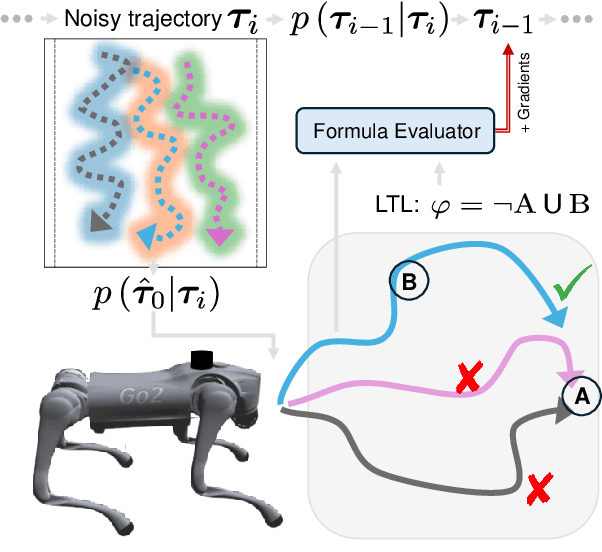
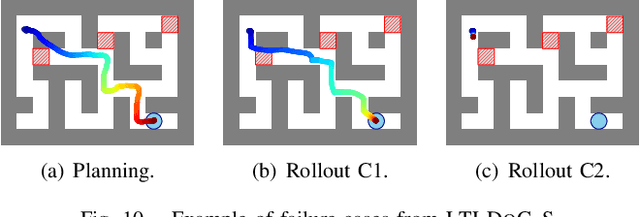

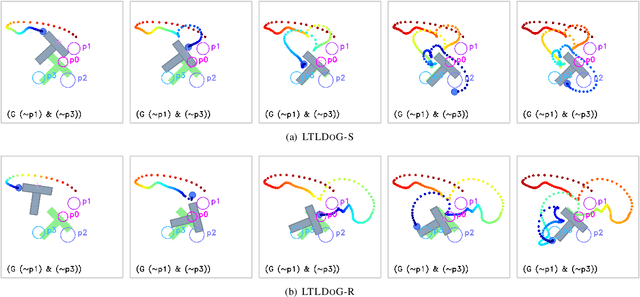
Operating effectively in complex environments while complying with specified constraints is crucial for the safe and successful deployment of robots that interact with and operate around people. In this work, we focus on generating long-horizon trajectories that adhere to novel static and temporally-extended constraints/instructions at test time. We propose a data-driven diffusion-based framework, LTLDoG, that modifies the inference steps of the reverse process given an instruction specified using finite linear temporal logic ($\text{LTL}_f$). LTLDoG leverages a satisfaction value function on $\text{LTL}_f$ and guides the sampling steps using its gradient field. This value function can also be trained to generalize to new instructions not observed during training, enabling flexible test-time adaptability. Experiments in robot navigation and manipulation illustrate that the method is able to generate trajectories that satisfy formulae that specify obstacle avoidance and visitation sequences.