 Add to Chrome
 Add to Firefox
 Add to Edge
Diffusion-Guided Search via Exponential Tilting (DiffTilt): An Application to Falsification of Safety-Critical Systems
Jul 25, 2026
Discovering rare safety-critical failures in autonomous and cyber-physical systems is a fundamental challenge in verification and validation. Existing falsification approaches rely on conditional sampling strategies that factor the joint distribution over environments and system executions, and therefore suffer from multiplicative rarity effects: the simultaneous scarcity of failure-inducing inputs and failure-inducing traces makes exhaustive search prohibitively expensive. This paper develops DiffTilt, a distributional framework that exponentially tilts a diffusion model-induced joint distribution over environments and executions. We show that diffusion-guided sampling admits an exact interpretation as importance sampling in the joint space, where guidance scores induce a KL-optimal reallocation of probability mass towards failure-relevant behaviors. We further show that tilting provably amplifies failure probability and strictly outperforms conditional sampling, which is limited by multiplicative rarity. In this framework, the joint generative model serves as a reusable prior over scenarios and need not faithfully represent the system under test. Expensive system simulations are instead limited to learning a scoring function that characterizes scenario quality, enabling their selective and adaptive use. We study DiffTilt on ARCH-COMP benchmarks, and we propose an additional tractor-trailer benchmark showing the behavior of several approaches when scenario generation is guided by a well-defined specification rather than a reward. The proposed method achieves competitive or improved falsification performance compared to state-of-the-art approaches, with larger gains when specification definition is not limited to STL formulas.

FalconTrack: Photorealistic Auto-Labeled Perception and Physics-Aware Vision-Based Aerial Tracking
Jun 29, 2026Vision-based aerial tracking is critical in GPS-denied environments. Reliable perception for tracking depends on large-scale labeled data, yet most photorealistic datasets rely on heavy manual annotation and are time-consuming to produce. We present FalconTrack, a unified perception-and-tracking framework that (i) leverages a photorealistic editable simulator for automated label generation and (ii) combines multi-head perception with physics-aware tracking for zero-shot sim-to-real transfer. FalconTrack provides an automated labeling pipeline in a Gaussian Splatting simulator that isolates target Gaussians from short object videos and composites them with randomized backgrounds to generate RGB, mask, class, and 6-DoF pose labels, producing about 10k labeled images in under 20 minutes. Using this dataset, we train a multi-head perception module with staged learning and reprojection consistency, and fuse its outputs with class-conditioned dynamics priors in an EKF for tracking. Our perception model outperforms two baselines and reaches 96-100% class accuracy in zero-shot sim-to-real transfer on three geometrically diverse objects and two environments, while maintaining consistent performance in unseen simulated and real scenes. In real hardware closed-loop visual tracking, the onboard system runs at about 25 Hz and achieves 100% success in sim-to-real F1-tenth and gate tracking in five trajectories across two environments, while a mask-centered vision baseline drops to 60% success on F1-tenth during fast out-of-view scenarios.
Sample-Efficient Learning of Probabilistic Causes for Reachability in Markov Decision Processes with Probabilistic Guarantees
Jun 29, 2026Probabilistic model checking for Markov decision processes (MDPs) provides quantitative guarantees, but often offers limited insight into why undesired outcomes occur. Probability-raising (PR) causality addresses this by identifying states whose visitation increases the probability of reaching designated states. Existing PR-cause identification methods, however, use MDP modifications not well-suited for learning: the gap between conditional and unconditional reachability probabilities can be hard to detect from transition samples, and construction requires reachability probabilities of the MDP, which are unavailable when transition probabilities are unknown. We study unknown MDPs and propose a learning approach with probabilistic guarantees for PR-cause identification. Our key ingredient is a restart-based MDP modification that reduces PR-cause checking to two conditional reachability queries without using reachability values of the original MDP. We prove correctness, establish sample-complexity bounds, and develop an anytime learning-and-checking algorithm based on two-sided value iteration that progressively classifies states as causal, non-causal, or undecided. Experiments on two benchmarks demonstrate reliable and fast identification of PR causes.
Vision-Based Runtime Monitoring under Varying Specifications using Semantic Latent Representations
May 13, 2026We study certified runtime monitoring of past-time signal temporal logic (ptSTL) from visual observations under partial observability. The monitor must infer safety-relevant quantities from images and provide finite-sample guarantees, while being \emph{reusable}: once trained and calibrated, it should certify any formula in a target fragment without per-formula retraining. For fragments induced by a finite dictionary of temporal atoms, we prove that the \emph{semantic basis}, the vector of atom robustness scores, is the minimum prediction target within the class of monotone, 1-Lipschitz reusable interfaces: any formula is evaluated by a deterministic decoder derived from the parse tree, and a single conformal calibration pass certifies the entire fragment with no union bound. We also introduce a \emph{rolling prediction monitor} that predicts only current predicate values and reconstructs temporal history online; this is easier to learn but grows conservative at long horizons. On a pedestrian-crossroad benchmark, rolling achieves tighter certified bounds at short horizons while the semantic-basis monitor is up to 4-times tighter at long horizons. We validate the presented monitors on real-world Waymo driving data, where both monitors satisfy the conformal coverage guarantee empirically.
Spatio-Temporal Grounding of Large Language Models from Perception Streams
Apr 08, 2026Embodied-AI agents must reason about how objects move and interact in 3-D space over time, yet existing smaller frontier Large Language Models (LLMs) still mis-handle fine-grained spatial relations, metric distances, and temporal orderings. We introduce the general framework Formally Explainable Spatio-Temporal Scenes (FESTS) that injects verifiable spatio-temporal supervision into an LLM by compiling natural-language queries into Spatial Regular Expression (SpRE) -- a language combining regular expression syntax with S4u spatial logic and extended here with universal and existential quantification. The pipeline matches each SpRE against any structured video log and exports aligned (query, frames, match, explanation) tuples, enabling unlimited training data without manual labels. Training a 3-billion-parameter model on 27k such tuples boosts frame-level F1 from 48.5% to 87.5%, matching GPT-4.1 on complex spatio-temporal reasoning while remaining two orders of magnitude smaller, and, hence, enabling spatio-temporal intelligence for Video LLM.
Performance-Guided Refinement for Visual Aerial Navigation using Editable Gaussian Splatting in FalconGym 2.0
Oct 02, 2025Visual policy design is crucial for aerial navigation. However, state-of-the-art visual policies often overfit to a single track and their performance degrades when track geometry changes. We develop FalconGym 2.0, a photorealistic simulation framework built on Gaussian Splatting (GSplat) with an Edit API that programmatically generates diverse static and dynamic tracks in milliseconds. Leveraging FalconGym 2.0's editability, we propose a Performance-Guided Refinement (PGR) algorithm, which concentrates visual policy's training on challenging tracks while iteratively improving its performance. Across two case studies (fixed-wing UAVs and quadrotors) with distinct dynamics and environments, we show that a single visual policy trained with PGR in FalconGym 2.0 outperforms state-of-the-art baselines in generalization and robustness: it generalizes to three unseen tracks with 100% success without per-track retraining and maintains higher success rates under gate-pose perturbations. Finally, we demonstrate that the visual policy trained with PGR in FalconGym 2.0 can be zero-shot sim-to-real transferred to a quadrotor hardware, achieving a 98.6% success rate (69 / 70 gates) over 30 trials spanning two three-gate tracks and a moving-gate track.
BR-MPPI: Barrier Rate guided MPPI for Enforcing Multiple Inequality Constraints with Learned Signed Distance Field
Jun 08, 2025Model Predictive Path Integral (MPPI) controller is used to solve unconstrained optimal control problems and Control Barrier Function (CBF) is a tool to impose strict inequality constraints, a.k.a, barrier constraints. In this work, we propose an integration of these two methods that employ CBF-like conditions to guide the control sampling procedure of MPPI. CBFs provide an inequality constraint restricting the rate of change of barrier functions by a classK function of the barrier itself. We instead impose the CBF condition as an equality constraint by choosing a parametric linear classK function and treating this parameter as a state in an augmented system. The time derivative of this parameter acts as an additional control input that is designed by MPPI. A cost function is further designed to reignite Nagumo's theorem at the boundary of the safe set by promoting specific values of classK parameter to enforce safety. Our problem formulation results in an MPPI subject to multiple state and control-dependent equality constraints which are non-trivial to satisfy with randomly sampled control inputs. We therefore also introduce state transformations and control projection operations, inspired by the literature on path planning for manifolds, to resolve the aforementioned issue. We show empirically through simulations and experiments on quadrotor that our proposed algorithm exhibits better sampled efficiency and enhanced capability to operate closer to the safe set boundary over vanilla MPPI.
MRTA-Sim: A Modular Simulator for Multi-Robot Allocation, Planning, and Control in Open-World Environments
Apr 21, 2025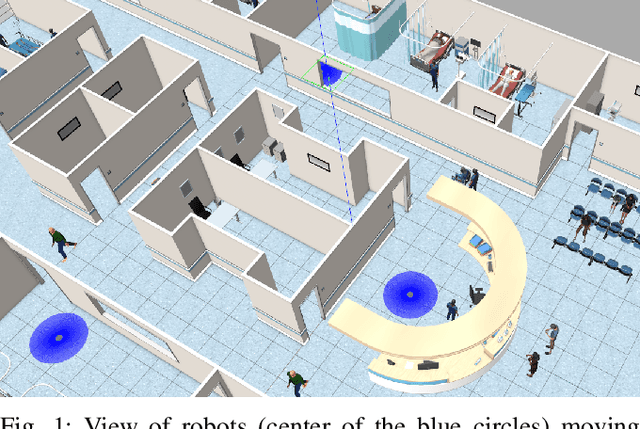
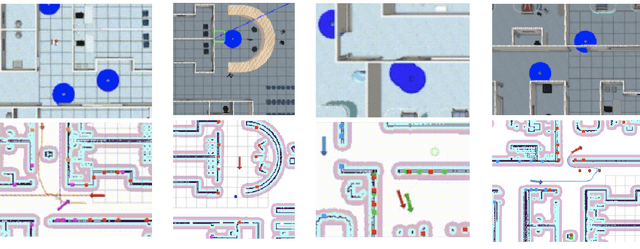
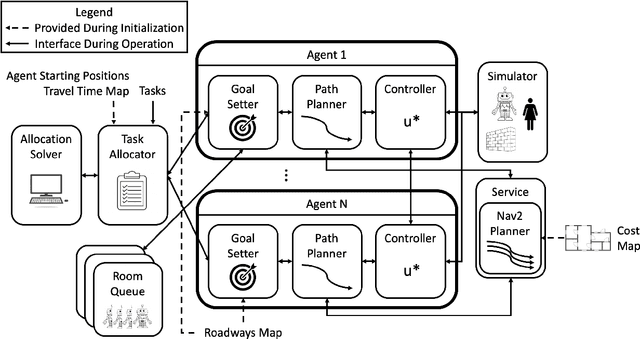
This paper introduces MRTA-Sim, a Python/ROS2/Gazebo simulator for testing approaches to Multi-Robot Task Allocation (MRTA) problems on simulated robots in complex, indoor environments. Grid-based approaches to MRTA problems can be too restrictive for use in complex, dynamic environments such in warehouses, department stores, hospitals, etc. However, approaches that operate in free-space often operate at a layer of abstraction above the control and planning layers of a robot and make an assumption on approximate travel time between points of interest in the system. These abstractions can neglect the impact of the tight space and multi-agent interactions on the quality of the solution. Therefore, MRTA solutions should be tested with the navigation stacks of the robots in mind, taking into account robot planning, conflict avoidance between robots, and human interaction and avoidance. This tool connects the allocation output of MRTA solvers to individual robot planning using the NAV2 stack and local, centralized multi-robot deconfliction using Control Barrier Function-Quadrtic Programs (CBF-QPs), creating a platform closer to real-world operation for more comprehensive testing of these approaches. The simulation architecture is modular so that users can swap out methods at different levels of the stack. We show the use of our system with a Satisfiability Modulo Theories (SMT)-based approach to dynamic MRTA on a fleet of indoor delivery robots.
From Dashcam Videos to Driving Simulations: Stress Testing Automated Vehicles against Rare Events
Nov 25, 2024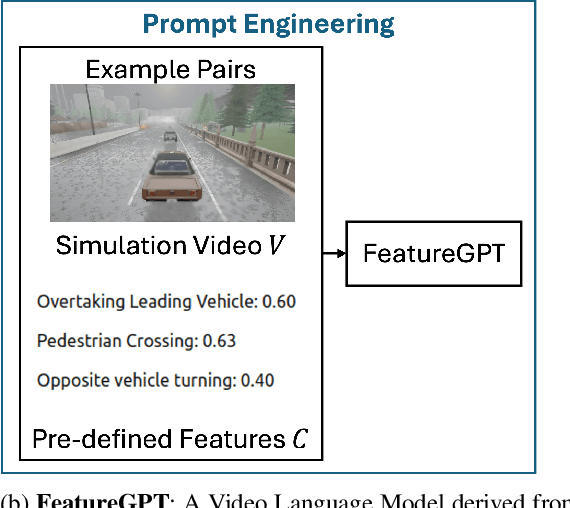
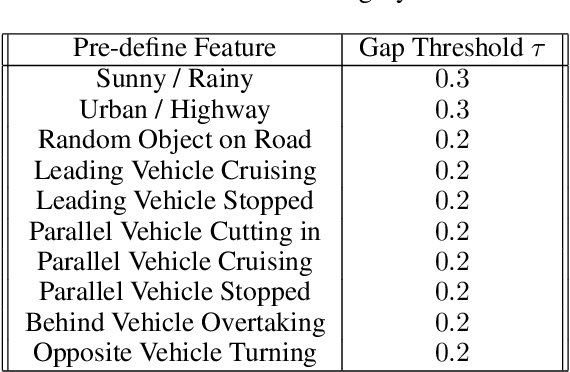

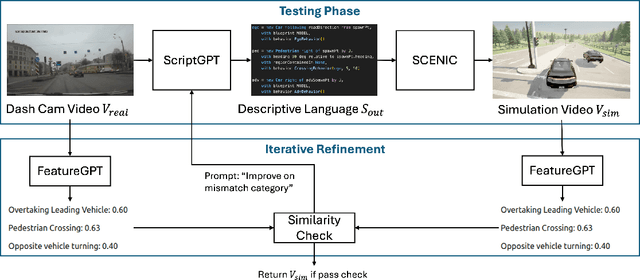
Testing Automated Driving Systems (ADS) in simulation with realistic driving scenarios is important for verifying their performance. However, converting real-world driving videos into simulation scenarios is a significant challenge due to the complexity of interpreting high-dimensional video data and the time-consuming nature of precise manual scenario reconstruction. In this work, we propose a novel framework that automates the conversion of real-world car crash videos into detailed simulation scenarios for ADS testing. Our approach leverages prompt-engineered Video Language Models(VLM) to transform dashcam footage into SCENIC scripts, which define the environment and driving behaviors in the CARLA simulator, enabling the generation of realistic simulation scenarios. Importantly, rather than solely aiming for one-to-one scenario reconstruction, our framework focuses on capturing the essential driving behaviors from the original video while offering flexibility in parameters such as weather or road conditions to facilitate search-based testing. Additionally, we introduce a similarity metric that helps iteratively refine the generated scenario through feedback by comparing key features of driving behaviors between the real and simulated videos. Our preliminary results demonstrate substantial time efficiency, finishing the real-to-sim conversion in minutes with full automation and no human intervention, while maintaining high fidelity to the original driving events.
Risk-aware MPPI for Stochastic Hybrid Systems
Nov 14, 2024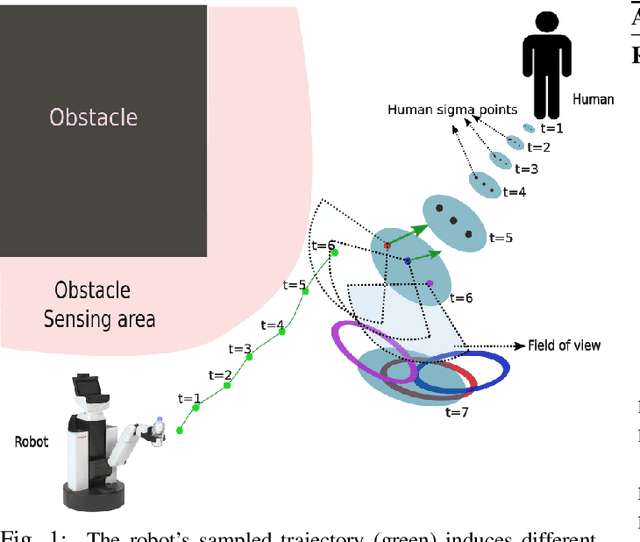

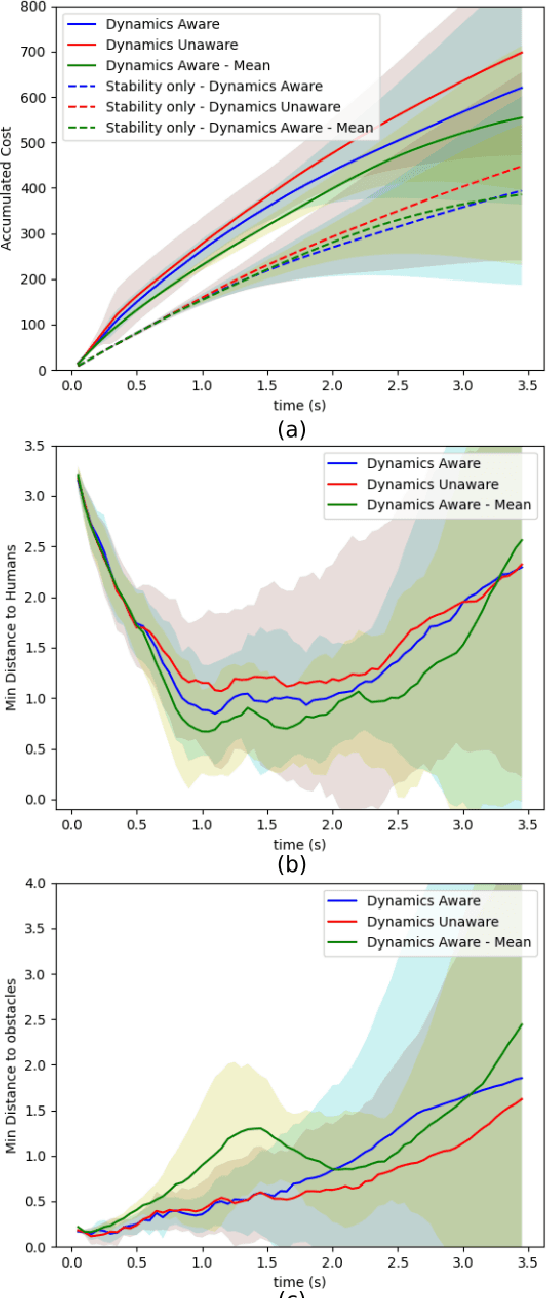
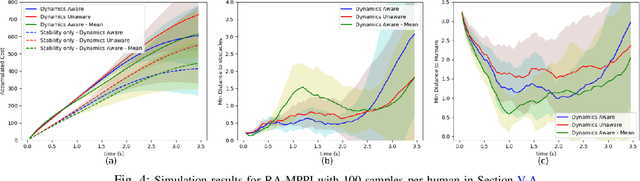
Path Planning for stochastic hybrid systems presents a unique challenge of predicting distributions of future states subject to a state-dependent dynamics switching function. In this work, we propose a variant of Model Predictive Path Integral Control (MPPI) to plan kinodynamic paths for such systems. Monte Carlo may be inaccurate when few samples are chosen to predict future states under state-dependent disturbances. We employ recently proposed Unscented Transform-based methods to capture stochasticity in the states as well as the state-dependent switching surfaces. This is in contrast to previous works that perform switching based only on the mean of predicted states. We focus our motion planning application on the navigation of a mobile robot in the presence of dynamically moving agents whose responses are based on sensor-constrained attention zones. We evaluate our framework on a simulated mobile robot and show faster convergence to a goal without collisions when the robot exploits the hybrid human dynamics versus when it does not.