 Add to Chrome
 Add to Firefox
 Add to Edge
Shadow Detection And Removal
Shadow detection and removal is the process of identifying and removing shadows from images to improve their quality.
Papers and Code
deSEO: Physics-Aware Dataset Creation for High-Resolution Satellite Image Shadow Removal
May 05, 2026
Shadows cast by terrain and tall structures remain a major obstacle for high-resolution satellite image analysis, degrading classification, detection, and 3D reconstruction performance. Public resources offering geometry-consistent paired shadow/shadow-free satellite imagery are essentially missing, and most Earth-observation datasets are designed for shadow detection or 3D modelling rather than removal. Existing deep shadow-removal datasets either target ground-level or aerial scenes or rely on unpaired and weakly supervised formulations rather than explicit satellite pairs. We address this gap with deSEO, a geometry-aware and physics-informed methodology that, to the best of our knowledge, is the first to derive paired supervision for satellite shadow removal from the S-EO shadow detection dataset through a fully replicable pipeline. For each tile, deSEO selects a minimally shadowed acquisition as a weak reference and pairs it with shadowed counterparts using temporal and geometric filtering, Jacobian-based orientation normalisation, and LoFTR-RANSAC registration. A per-pixel validity mask restricts learning to reliably aligned regions, enabling supervision despite residual off-nadir parallax. In addition to this paired dataset, we develop a DSM-aware deshadowing model that combines residual translation, perceptual objectives, and mask-constrained adversarial learning. In contrast, a direct adaptation of a UAV-based SRNet/pix2pix architecture fails to converge under satellite viewpoint variability. Our model consistently reduces the visual impact of cast shadows across diverse illumination and viewing conditions, achieving improved structural and perceptual fidelity on held-out scenes. deSEO therefore provides the first reproducible, geometry-aware paired dataset and baseline for shadow removal in satellite Earth observation.

Systematic Discovery of Semantic Attacks in Online Map Construction through Conditional Diffusion
May 14, 2026Autonomous vehicles depend on online HD map construction to perceive lane boundaries, dividers, and pedestrian crossings -- safety-critical road elements that directly govern motion planning. While existing pixel perturbation attacks can disrupt the mapping, they can be neutralized by standard adversarial defenses. We present MIRAGE, a framework for systematic discovery of semantic attacks that bypass adversarial defenses and degrade mapping predictions by finding plausible environmental variation (e.g. shadows, wet roads). MIRAGE exploits the latent manifold of real-world data learned by diffusion models, and searches for semantically mutated scenes neighboring the ground truth with the same road topology yet mislead the mapping predictions. We evaluate MIRAGE on nuScenes and demonstrate two attacks: (1) boundary removal, suppressing 57.7% of detections and corrupting 96% of planned trajectories; and (2) boundary injection, the only method that successfully injects fictitious boundaries, while pixel PGD and AdvPatch fail entirely. Both attacks remain potent under various adversarial defenses. We use two independent VLM judges to quantify realism, where MIRAGE passes as realistic 80--84% of the time (vs. 97--99% for clean nuScenes), while AdvPatch only 0--9%. Our findings expose a categorical gap in current adversarial defenses: semantic-level perturbations that manifest as legitimate environmental variation are substantially harder to mitigate than pixel-level perturbations.
SARU: A Shadow-Aware and Removal Unified Framework for Remote Sensing Images with New Benchmarks
Apr 28, 2026Shadows are a prevalent problem in remote sensing imagery (RSI), degrading visual quality and severely limiting the performance of downstream tasks like object detection and semantic segmentation. Most prior works treat shadow detection and removal as separate, cascaded tasks, which can lead to cumbersome process and error accumulation. Furthermore, many deep learning methods rely on paired shadow and non-shadow images for training, which are often unavailable in practice. To address these challenges, we propose Shadow-Aware and Removal Unified (SARU) Framework , a cohesive two-stage framework. First, its dual-branch detection module (DBCSF-Net) fuses multi-color space and semantic features to generate high-fidelity shadow masks, effectively distinguishing shadows from dark objects. Then, leveraging these masks, a novel, training-free physical algorithm (N$^2$SGSR) restores illumination by transferring properties from adjacent non-shadow regions within the single input image. To facilitate rigorous evaluation and foster future work, we also introduce two new benchmark datasets: the RSI Shadow Detection (RSISD) dataset and the Single-image Shadow Removal Benchmark (SiSRB). Extensive experiments demonstrate that SARU achieves state-of-the-art performance on both the public AISD dataset and our newly introduced benchmarks. By holistically integrating shadow detection and removal to mitigate error propagation and eliminating the dependency on paired training data, SARU establishes a robust, practical framework for real-world RSI analysis. The source code and datasets are publicly available at: https://github.com/AeroVILab-AHU/SARU-Framework.
Learning the Signature of Memorization in Autoregressive Language Models
Apr 03, 2026All prior membership inference attacks for fine-tuned language models use hand-crafted heuristics (e.g., loss thresholding, Min-K\%, reference calibration), each bounded by the designer's intuition. We introduce the first transferable learned attack, enabled by the observation that fine-tuning any model on any corpus yields unlimited labeled data, since membership is known by construction. This removes the shadow model bottleneck and brings membership inference into the deep learning era: learning what matters rather than designing it, with generalization through training diversity and scale. We discover that fine-tuning language models produces an invariant signature of memorization detectable across architectural families and data domains. We train a membership inference classifier exclusively on transformer-based models. It transfers zero-shot to Mamba (state-space), RWKV-4 (linear attention), and RecurrentGemma (gated recurrence), achieving 0.963, 0.972, and 0.936 AUC respectively. Each evaluation combines an architecture and dataset never seen during training, yet all three exceed performance on held-out transformers (0.908 AUC). These four families share no computational mechanisms, their only commonality is gradient descent on cross-entropy loss. Even simple likelihood-based methods exhibit strong transfer, confirming the signature exists independently of the detection method. Our method, Learned Transfer MIA (LT-MIA), captures this signal most effectively by reframing membership inference as sequence classification over per-token distributional statistics. On transformers, LT-MIA achieves 2.8$\times$ higher TPR at 0.1\% FPR than the strongest baseline. The method also transfers to code (0.865 AUC) despite training only on natural language texts. Code and trained classifier available at https://github.com/JetBrains-Research/learned-mia.
Benchmarking Dataset for Presence-Only Passive Reconnaissance in Wireless Smart-Grid Communications
Mar 10, 2026Benchmarking presence-only passive reconnaissance in smart-grid communications is challenging because the adversary is receive-only, yet nearby observers can still alter propagation through additional shadowing and multipath that reshapes channel coherence. Public smart-grid cybersecurity datasets largely target active protocol- or measurement-layer attacks and rarely provide propagation-driven observables with tiered topology context, which limits reproducible evaluation under strictly passive threat models. This paper introduces an IEEE-inspired, literature-anchored benchmark dataset generator for passive reconnaissance over a tiered Home Area Network (HAN), Neighborhood Area Network (NAN), and Wide Area Network (WAN) communication graph with heterogeneous wireless and wireline links. Node-level time series are produced through a physically consistent channel-to-metrics mapping where channel state information (CSI) is represented via measurement-realistic amplitude and phase proxies that drive inferred signal-to-noise ratio (SNR), packet error behavior, and delay dynamics. Passive attacks are modeled only as windowed excess attenuation and coherence degradation with increased channel innovation, so reliability and latency deviations emerge through the same causal mapping without labels or feature shortcuts. The release provides split-independent realizations with burn-in removal, strictly causal temporal descriptors, adjacency-weighted neighbor aggregates and deviation features, and federated-ready per-node train, validation, and test partitions with train-only normalization metadata. Baseline federated experiments highlight technology-dependent detectability and enable standardized benchmarking of graph-temporal and federated detectors for passive reconnaissance.
MetaShadow: Object-Centered Shadow Detection, Removal, and Synthesis
Dec 03, 2024
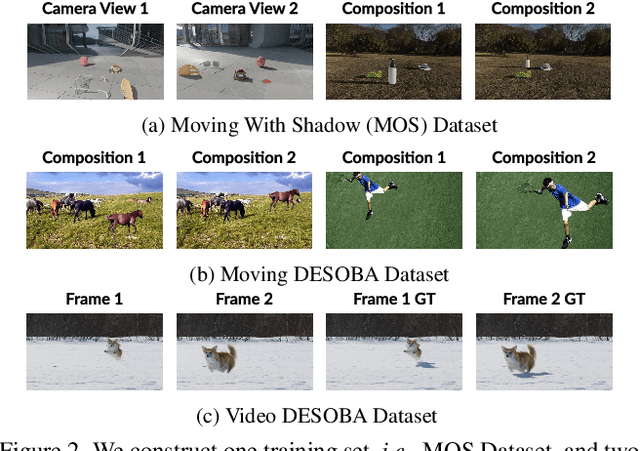


Shadows are often under-considered or even ignored in image editing applications, limiting the realism of the edited results. In this paper, we introduce MetaShadow, a three-in-one versatile framework that enables detection, removal, and controllable synthesis of shadows in natural images in an object-centered fashion. MetaShadow combines the strengths of two cooperative components: Shadow Analyzer, for object-centered shadow detection and removal, and Shadow Synthesizer, for reference-based controllable shadow synthesis. Notably, we optimize the learning of the intermediate features from Shadow Analyzer to guide Shadow Synthesizer to generate more realistic shadows that blend seamlessly with the scene. Extensive evaluations on multiple shadow benchmark datasets show significant improvements of MetaShadow over the existing state-of-the-art methods on object-centered shadow detection, removal, and synthesis. MetaShadow excels in image-editing tasks such as object removal, relocation, and insertion, pushing the boundaries of object-centered image editing.
Unveiling Deep Shadows: A Survey on Image and Video Shadow Detection, Removal, and Generation in the Era of Deep Learning
Sep 03, 2024

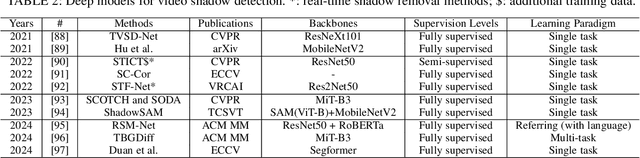
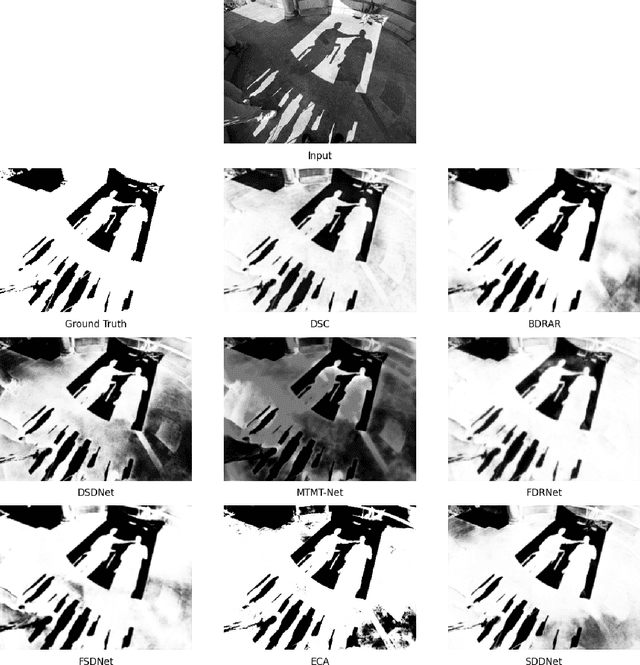
Shadows are formed when light encounters obstacles, leading to areas of diminished illumination. In computer vision, shadow detection, removal, and generation are crucial for enhancing scene understanding, refining image quality, ensuring visual consistency in video editing, and improving virtual environments. This paper presents a comprehensive survey of shadow detection, removal, and generation in images and videos within the deep learning landscape over the past decade, covering tasks, deep models, datasets, and evaluation metrics. Our key contributions include a comprehensive survey of shadow analysis, standardization of experimental comparisons, exploration of the relationships among model size, speed, and performance, a cross-dataset generalization study, identification of open issues and future directions, and provision of publicly available resources to support further research.
WavShadow: Wavelet Based Shadow Segmentation and Removal
Nov 08, 2024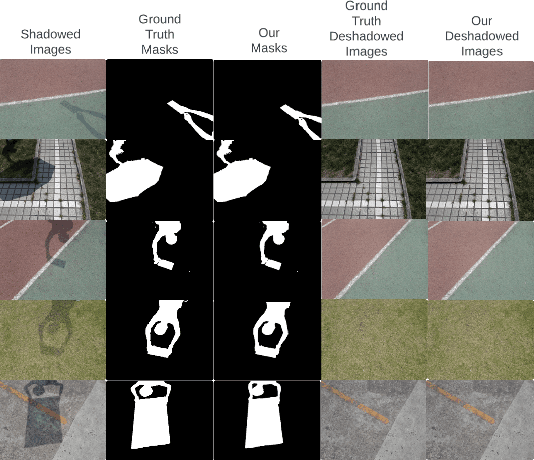
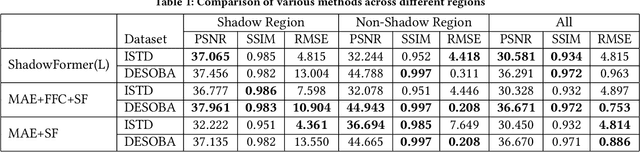
Shadow removal and segmentation remain challenging tasks in computer vision, particularly in complex real-world scenarios. This study presents a novel approach that enhances the ShadowFormer model by incorporating Masked Autoencoder (MAE) priors and Fast Fourier Convolution (FFC) blocks, leading to significantly faster convergence and improved performance. We introduce key innovations: (1) integration of MAE priors trained on Places2 dataset for better context understanding, (2) adoption of Haar wavelet features for enhanced edge detection and multi-scale analysis, and (3) implementation of a modified SAM Adapter for robust shadow segmentation. Extensive experiments on the challenging DESOBA dataset demonstrate that our approach achieves state-of-the-art results, with notable improvements in both convergence speed and shadow removal quality.
RAG-WM: An Efficient Black-Box Watermarking Approach for Retrieval-Augmented Generation of Large Language Models
Jan 09, 2025
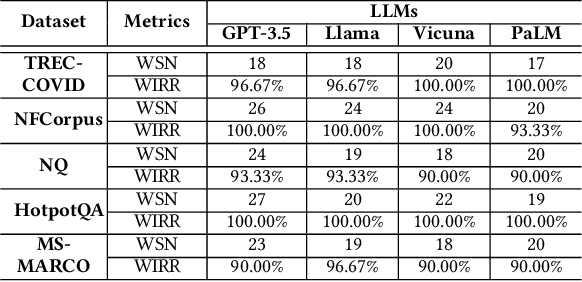


In recent years, tremendous success has been witnessed in Retrieval-Augmented Generation (RAG), widely used to enhance Large Language Models (LLMs) in domain-specific, knowledge-intensive, and privacy-sensitive tasks. However, attackers may steal those valuable RAGs and deploy or commercialize them, making it essential to detect Intellectual Property (IP) infringement. Most existing ownership protection solutions, such as watermarks, are designed for relational databases and texts. They cannot be directly applied to RAGs because relational database watermarks require white-box access to detect IP infringement, which is unrealistic for the knowledge base in RAGs. Meanwhile, post-processing by the adversary's deployed LLMs typically destructs text watermark information. To address those problems, we propose a novel black-box "knowledge watermark" approach, named RAG-WM, to detect IP infringement of RAGs. RAG-WM uses a multi-LLM interaction framework, comprising a Watermark Generator, Shadow LLM & RAG, and Watermark Discriminator, to create watermark texts based on watermark entity-relationship tuples and inject them into the target RAG. We evaluate RAG-WM across three domain-specific and two privacy-sensitive tasks on four benchmark LLMs. Experimental results show that RAG-WM effectively detects the stolen RAGs in various deployed LLMs. Furthermore, RAG-WM is robust against paraphrasing, unrelated content removal, knowledge insertion, and knowledge expansion attacks. Lastly, RAG-WM can also evade watermark detection approaches, highlighting its promising application in detecting IP infringement of RAG systems.
DGS-SLAM: Gaussian Splatting SLAM in Dynamic Environment
Nov 16, 2024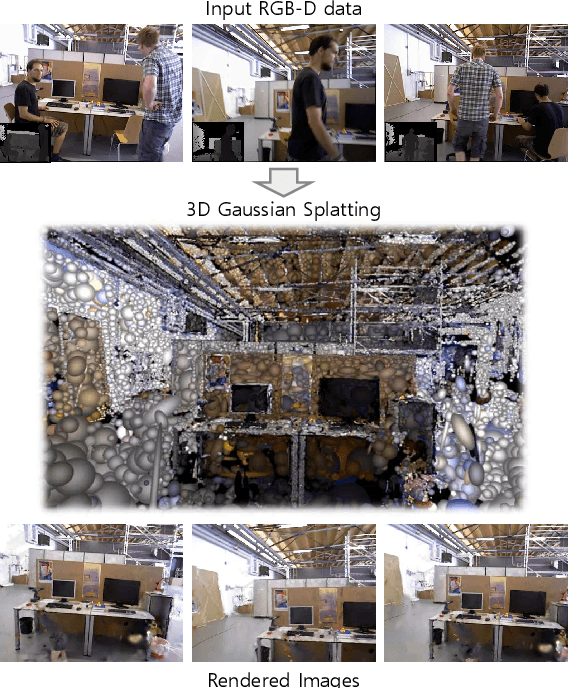
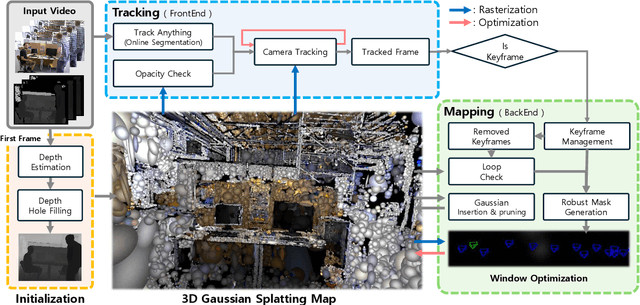
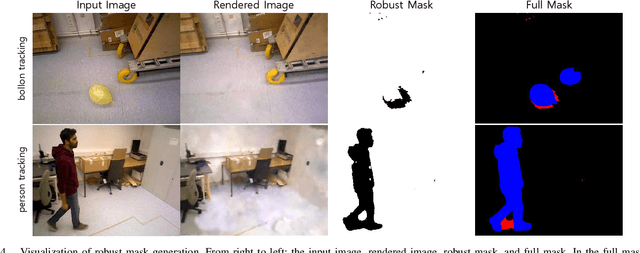

We introduce Dynamic Gaussian Splatting SLAM (DGS-SLAM), the first dynamic SLAM framework built on the foundation of Gaussian Splatting. While recent advancements in dense SLAM have leveraged Gaussian Splatting to enhance scene representation, most approaches assume a static environment, making them vulnerable to photometric and geometric inconsistencies caused by dynamic objects. To address these challenges, we integrate Gaussian Splatting SLAM with a robust filtering process to handle dynamic objects throughout the entire pipeline, including Gaussian insertion and keyframe selection. Within this framework, to further improve the accuracy of dynamic object removal, we introduce a robust mask generation method that enforces photometric consistency across keyframes, reducing noise from inaccurate segmentation and artifacts such as shadows. Additionally, we propose the loop-aware window selection mechanism, which utilizes unique keyframe IDs of 3D Gaussians to detect loops between the current and past frames, facilitating joint optimization of the current camera poses and the Gaussian map. DGS-SLAM achieves state-of-the-art performance in both camera tracking and novel view synthesis on various dynamic SLAM benchmarks, proving its effectiveness in handling real-world dynamic scenes.