 Add to Chrome
 Add to Firefox
 Add to Edge
AlbumFill: Album-Guided Reasoning and Retrieval for Personalized Image Completion
May 04, 2026
Personalized image completion aims to restore occluded regions in personal photos while preserving identity and appearance. Existing methods either rely on generic inpainting models that often fail to maintain identity consistency, or assume that suitable reference images are explicitly provided. In practice, suitable references are often not explicitly provided, requiring the system to search for identity-consistent images within personal photo collections. We present AlbumFill, a training-free framework that retrieves identity-consistent references from personal albums for personalized completion. Given an occluded image and a personal album, a vision-language model infers missing semantic cues to guide composed image retrieval, and the retrieved references are used by reference-based completion models. To facilitate this task, we introduce a dataset containing 54K human-centric samples with associated album images. Experiments across multiple baselines demonstrate the difficulty of personalized completion and highlight the importance of identity-consistent reference retrieval. Project Page: https://liagm.github.io/AlbumFill/

CompleteMe: Reference-based Human Image Completion
Apr 28, 2025Recent methods for human image completion can reconstruct plausible body shapes but often fail to preserve unique details, such as specific clothing patterns or distinctive accessories, without explicit reference images. Even state-of-the-art reference-based inpainting approaches struggle to accurately capture and integrate fine-grained details from reference images. To address this limitation, we propose CompleteMe, a novel reference-based human image completion framework. CompleteMe employs a dual U-Net architecture combined with a Region-focused Attention (RFA) Block, which explicitly guides the model's attention toward relevant regions in reference images. This approach effectively captures fine details and ensures accurate semantic correspondence, significantly improving the fidelity and consistency of completed images. Additionally, we introduce a challenging benchmark specifically designed for evaluating reference-based human image completion tasks. Extensive experiments demonstrate that our proposed method achieves superior visual quality and semantic consistency compared to existing techniques. Project page: https://liagm.github.io/CompleteMe/
MetaShadow: Object-Centered Shadow Detection, Removal, and Synthesis
Dec 03, 2024
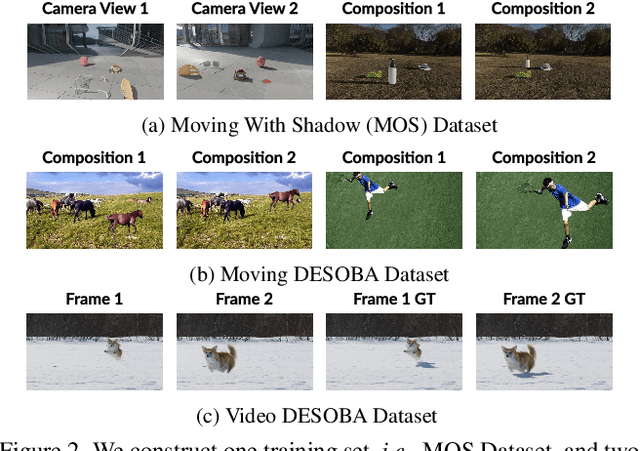


Shadows are often under-considered or even ignored in image editing applications, limiting the realism of the edited results. In this paper, we introduce MetaShadow, a three-in-one versatile framework that enables detection, removal, and controllable synthesis of shadows in natural images in an object-centered fashion. MetaShadow combines the strengths of two cooperative components: Shadow Analyzer, for object-centered shadow detection and removal, and Shadow Synthesizer, for reference-based controllable shadow synthesis. Notably, we optimize the learning of the intermediate features from Shadow Analyzer to guide Shadow Synthesizer to generate more realistic shadows that blend seamlessly with the scene. Extensive evaluations on multiple shadow benchmark datasets show significant improvements of MetaShadow over the existing state-of-the-art methods on object-centered shadow detection, removal, and synthesis. MetaShadow excels in image-editing tasks such as object removal, relocation, and insertion, pushing the boundaries of object-centered image editing.
Latent Feature-Guided Diffusion Models for Shadow Removal
Dec 04, 2023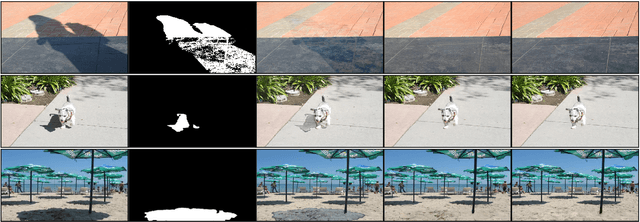
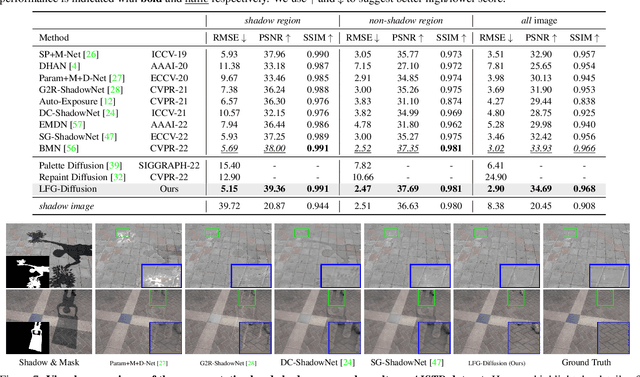
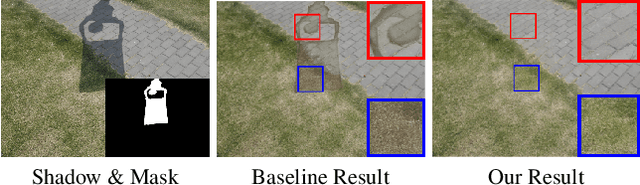
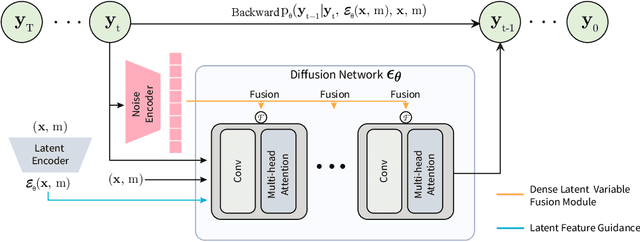
Recovering textures under shadows has remained a challenging problem due to the difficulty of inferring shadow-free scenes from shadow images. In this paper, we propose the use of diffusion models as they offer a promising approach to gradually refine the details of shadow regions during the diffusion process. Our method improves this process by conditioning on a learned latent feature space that inherits the characteristics of shadow-free images, thus avoiding the limitation of conventional methods that condition on degraded images only. Additionally, we propose to alleviate potential local optima during training by fusing noise features with the diffusion network. We demonstrate the effectiveness of our approach which outperforms the previous best method by 13% in terms of RMSE on the AISTD dataset. Further, we explore instance-level shadow removal, where our model outperforms the previous best method by 82% in terms of RMSE on the DESOBA dataset.