 Add to Chrome
 Add to Firefox
 Add to Edge
Kimi K2
Papers and Code
KLong: Training LLM Agent for Extremely Long-horizon Tasks
Feb 19, 2026
This paper introduces KLong, an open-source LLM agent trained to solve extremely long-horizon tasks. The principle is to first cold-start the model via trajectory-splitting SFT, then scale it via progressive RL training. Specifically, we first activate basic agentic abilities of a base model with a comprehensive SFT recipe. Then, we introduce Research-Factory, an automated pipeline that generates high-quality training data by collecting research papers and constructing evaluation rubrics. Using this pipeline, we build thousands of long-horizon trajectories distilled from Claude 4.5 Sonnet (Thinking). To train with these extremely long trajectories, we propose a new trajectory-splitting SFT, which preserves early context, progressively truncates later context, and maintains overlap between sub-trajectories. In addition, to further improve long-horizon task-solving capability, we propose a novel progressive RL, which schedules training into multiple stages with progressively extended timeouts. Experiments demonstrate the superiority and generalization of KLong, as shown in Figure 1. Notably, our proposed KLong (106B) surpasses Kimi K2 Thinking (1T) by 11.28% on PaperBench, and the performance improvement generalizes to other coding benchmarks like SWE-bench Verified and MLE-bench.

Gaia2: Benchmarking LLM Agents on Dynamic and Asynchronous Environments
Feb 12, 2026We introduce Gaia2, a benchmark for evaluating large language model agents in realistic, asynchronous environments. Unlike prior static or synchronous evaluations, Gaia2 introduces scenarios where environments evolve independently of agent actions, requiring agents to operate under temporal constraints, adapt to noisy and dynamic events, resolve ambiguity, and collaborate with other agents. Each scenario is paired with a write-action verifier, enabling fine-grained, action-level evaluation and making Gaia2 directly usable for reinforcement learning from verifiable rewards. Our evaluation of state-of-the-art proprietary and open-source models shows that no model dominates across capabilities: GPT-5 (high) reaches the strongest overall score of 42% pass@1 but fails on time-sensitive tasks, Claude-4 Sonnet trades accuracy and speed for cost, Kimi-K2 leads among open-source models with 21% pass@1. These results highlight fundamental trade-offs between reasoning, efficiency, robustness, and expose challenges in closing the "sim2real" gap. Gaia2 is built on a consumer environment with the open-source Agents Research Environments platform and designed to be easy to extend. By releasing Gaia2 alongside the foundational ARE framework, we aim to provide the community with a flexible infrastructure for developing, benchmarking, and training the next generation of practical agent systems.
EGSS: Entropy-guided Stepwise Scaling for Reliable Software Engineering
Feb 05, 2026Agentic Test-Time Scaling (TTS) has delivered state-of-the-art (SOTA) performance on complex software engineering tasks such as code generation and bug fixing. However, its practical adoption remains limited due to significant computational overhead, primarily driven by two key challenges: (1) the high cost associated with deploying excessively large ensembles, and (2) the lack of a reliable mechanism for selecting the optimal candidate solution, ultimately constraining the performance gains that can be realized. To address these challenges, we propose Entropy-Guided Stepwise Scaling (EGSS), a novel TTS framework that dynamically balances efficiency and effectiveness through entropy-guided adaptive search and robust test-suite augmentation. Extensive experiments on SWE-Bench-Verified demonstrate that EGSS consistently boosts performance by 5-10% across all evaluated models. Specifically, it increases the resolved ratio of Kimi-K2-Intruct from 63.2% to 72.2%, and GLM-4.6 from 65.8% to 74.6%. Furthermore, when paired with GLM-4.6, EGSS achieves a new state-of-the-art among open-source large language models. In addition to these accuracy improvements, EGSS reduces inference-time token usage by over 28% compared to existing TTS methods, achieving simultaneous gains in both effectiveness and computational efficiency.
Fat-Cat: Document-Driven Metacognitive Multi-Agent System for Complex Reasoning
Feb 02, 2026The effectiveness of LLM-based agents is often limited not by model capacity alone, but by how efficiently contextual information is utilized at runtime. Existing agent frameworks rely on rigid, syntax-heavy state representations such as nested JSON, which require models to devote a substantial portion of their limited attention to syntactic processing rather than semantic reasoning. In this paper, we propose Fat-Cat, a document-driven agent architecture that improves the signal-to-noise ratio of state management. By integrating three key components: (1) a Semantic File System that represents agent state as Markdown documents aligned with common pre-training corpora, (2) a Textual Strategy Evolution module that accumulates task-solving knowledge without parameter updates, and (3) a Closed-Loop Watcher that monitors reasoning trajectories to reduce hallucinations. Extensive reasoning, retrieval, and coding benchmarks, Fat-Cat consistently improves agent performance. It enables the Kimi-k2 model to outperform the proprietary GPT-4o baseline on HotPotQA. Replacing the document-based state with JSON leads to performance drop, while empirically validating the critical necessity of document-driven state modeling over rigid syntax. The code is available at https://github.com/answeryt/Fat-Cat.
Semantic Compression of LLM Instructions via Symbolic Metalanguages
Jan 12, 2026We introduce MetaGlyph, a symbolic language for compressing prompts by encoding instructions as mathematical symbols rather than prose. Unlike systems requiring explicit decoding rules, MetaGlyph uses symbols like $\in$ (membership) and $\Rightarrow$ (implication) that models already understand from their training data. We test whether these symbols work as ''instruction shortcuts'' that models can interpret without additional teaching. We evaluate eight models across two dimensions relevant to practitioners: scale (3B-1T parameters) and accessibility (open-source for local deployment vs. proprietary APIs). MetaGlyph achieves 62-81% token reduction across all task types. For API-based deployments, this translates directly to cost savings; for local deployments, it reduces latency and memory pressure. Results vary by model. Gemini 2.5 Flash achieves 75% semantic equivalence between symbolic and prose instructions on selection tasks, with 49.9% membership operator fidelity. Kimi K2 reaches 98.1% fidelity for implication ($\Rightarrow$) and achieves perfect (100%) accuracy on selection tasks with symbolic prompts. GPT-5.2 Chat shows the highest membership fidelity observed (91.3%), though with variable parse success across task types. Claude Haiku 4.5 achieves 100% parse success with 26% membership fidelity. Among mid-sized models, Qwen 2.5 7B shows 62% equivalence on extraction tasks. Mid-sized open-source models (7B-12B) show near-zero operator fidelity, suggesting a U-shaped relationship where sufficient scale overcomes instruction-tuning biases.
Coding in a Bubble? Evaluating LLMs in Resolving Context Adaptation Bugs During Code Adaptation
Jan 10, 2026Code adaptation is a fundamental but challenging task in software development, requiring developers to modify existing code for new contexts. A key challenge is to resolve Context Adaptation Bugs (CtxBugs), which occurs when code correct in its original context violates constraints in the target environment. Unlike isolated bugs, CtxBugs cannot be resolved through local fixes and require cross-context reasoning to identify semantic mismatches. Overlooking them may lead to critical failures in adaptation. Although Large Language Models (LLMs) show great potential in automating code-related tasks, their ability to resolve CtxBugs remains a significant and unexplored obstacle to their practical use in code adaptation. To bridge this gap, we propose CtxBugGen, a novel framework for generating CtxBugs to evaluate LLMs. Its core idea is to leverage LLMs' tendency to generate plausible but context-free code when contextual constraints are absent. The framework generates CtxBugs through a four-step process to ensure their relevance and validity: (1) Adaptation Task Selection, (2) Task-specific Perturbation,(3) LLM-based Variant Generation and (4) CtxBugs Identification. Based on the benchmark constructed by CtxBugGen, we conduct an empirical study with four state-of-the-art LLMs. Our results reveal their unsatisfactory performance in CtxBug resolution. The best performing LLM, Kimi-K2, achieves 55.93% on Pass@1 and resolves just 52.47% of CtxBugs. The presence of CtxBugs degrades LLMs' adaptation performance by up to 30%. Failure analysis indicates that LLMs often overlook CtxBugs and replicate them in their outputs. Our study highlights a critical weakness in LLMs' cross-context reasoning and emphasize the need for new methods to enhance their context awareness for reliable code adaptation.
MiMo-V2-Flash Technical Report
Jan 08, 2026We present MiMo-V2-Flash, a Mixture-of-Experts (MoE) model with 309B total parameters and 15B active parameters, designed for fast, strong reasoning and agentic capabilities. MiMo-V2-Flash adopts a hybrid attention architecture that interleaves Sliding Window Attention (SWA) with global attention, with a 128-token sliding window under a 5:1 hybrid ratio. The model is pre-trained on 27 trillion tokens with Multi-Token Prediction (MTP), employing a native 32k context length and subsequently extended to 256k. To efficiently scale post-training compute, MiMo-V2-Flash introduces a novel Multi-Teacher On-Policy Distillation (MOPD) paradigm. In this framework, domain-specialized teachers (e.g., trained via large-scale reinforcement learning) provide dense and token-level reward, enabling the student model to perfectly master teacher expertise. MiMo-V2-Flash rivals top-tier open-weight models such as DeepSeek-V3.2 and Kimi-K2, despite using only 1/2 and 1/3 of their total parameters, respectively. During inference, by repurposing MTP as a draft model for speculative decoding, MiMo-V2-Flash achieves up to 3.6 acceptance length and 2.6x decoding speedup with three MTP layers. We open-source both the model weights and the three-layer MTP weights to foster open research and community collaboration.
Beyond Accuracy: A Geometric Stability Analysis of Large Language Models in Chess Evaluation
Dec 17, 2025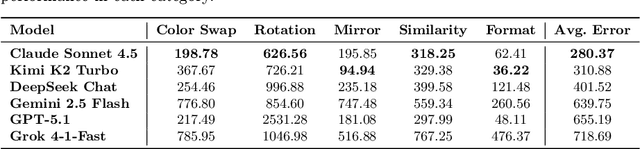
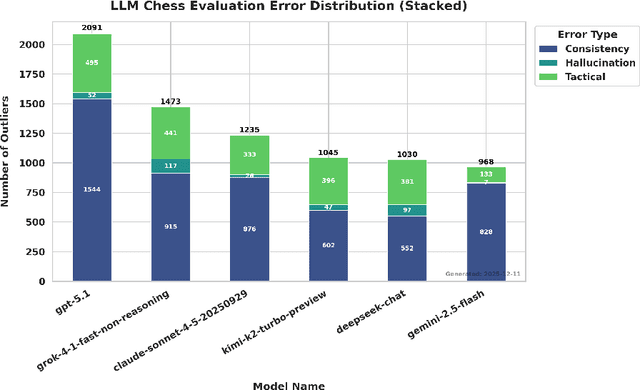
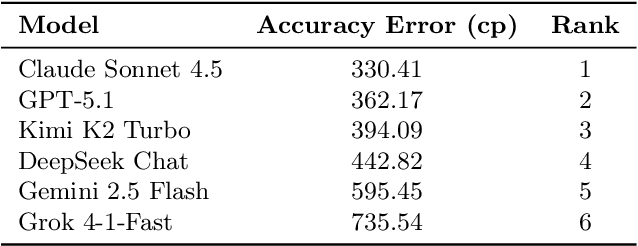
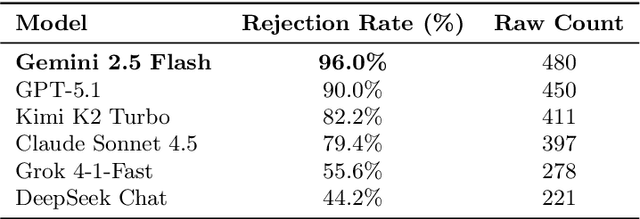
The evaluation of Large Language Models (LLMs) in complex reasoning domains typically relies on performance alignment with ground-truth oracles. In the domain of chess, this standard manifests as accuracy benchmarks against strong engines like Stockfish. However, high scalar accuracy does not necessarily imply robust conceptual understanding. This paper argues that standard accuracy metrics fail to distinguish between genuine geometric reasoning and the superficial memorization of canonical board states. To address this gap, we propose a Geometric Stability Framework, a novel evaluation methodology that rigorously tests model consistency under invariant transformations-including board rotation, mirror symmetry, color inversion, and format conversion. We applied this framework to a comparative analysis of six state-of-the-art LLMs including GPT-5.1, Claude Sonnet 4.5, and Kimi K2 Turbo, utilizing a dataset of approximately 3,000 positions. Our results reveal a significant Accuracy-Stability Paradox. While models such as GPT-5.1 achieve near-optimal accuracy on standard positions, they exhibit catastrophic degradation under geometric perturbation, specifically in rotation tasks where error rates surge by over 600%. This disparity suggests a reliance on pattern matching over abstract spatial logic. Conversely, Claude Sonnet 4.5 and Kimi K2 Turbo demonstrate superior dual robustness, maintaining high consistency across all transformation axes. Furthermore, we analyze the trade-off between helpfulness and safety, identifying Gemini 2.5 Flash as the leader in illegal state rejection (96.0%). We conclude that geometric stability provides an orthogonal and essential metric for AI evaluation, offering a necessary proxy for disentangling reasoning capabilities from data contamination and overfitting in large-scale models.
Tiny Model, Big Logic: Diversity-Driven Optimization Elicits Large-Model Reasoning Ability in VibeThinker-1.5B
Nov 09, 2025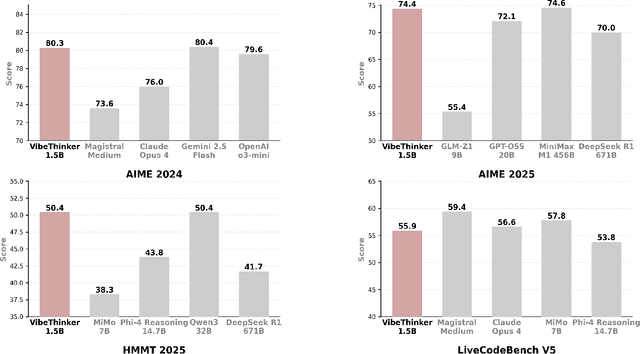

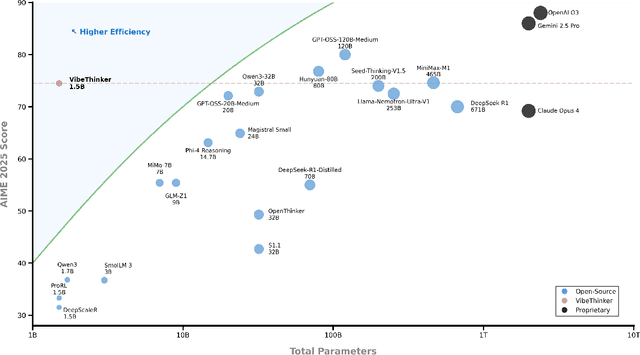
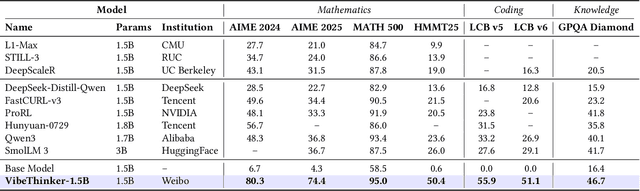
Challenging the prevailing consensus that small models inherently lack robust reasoning, this report introduces VibeThinker-1.5B, a 1.5B-parameter dense model developed via our Spectrum-to-Signal Principle (SSP). This challenges the prevailing approach of scaling model parameters to enhance capabilities, as seen in models like DeepSeek R1 (671B) and Kimi k2 (>1T). The SSP framework first employs a Two-Stage Diversity-Exploring Distillation (SFT) to generate a broad spectrum of solutions, followed by MaxEnt-Guided Policy Optimization (RL) to amplify the correct signal. With a total training cost of only $7,800, VibeThinker-1.5B demonstrates superior reasoning capabilities compared to closed-source models like Magistral Medium and Claude Opus 4, and performs on par with open-source models like GPT OSS-20B Medium. Remarkably, it surpasses the 400x larger DeepSeek R1 on three math benchmarks: AIME24 (80.3 vs. 79.8), AIME25 (74.4 vs. 70.0), and HMMT25 (50.4 vs. 41.7). This is a substantial improvement over its base model (6.7, 4.3, and 0.6, respectively). On LiveCodeBench V6, it scores 51.1, outperforming Magistral Medium's 50.3 and its base model's 0.0. These findings demonstrate that small models can achieve reasoning capabilities comparable to large models, drastically reducing training and inference costs and thereby democratizing advanced AI research.
ROSBag MCP Server: Analyzing Robot Data with LLMs for Agentic Embodied AI Applications
Nov 05, 2025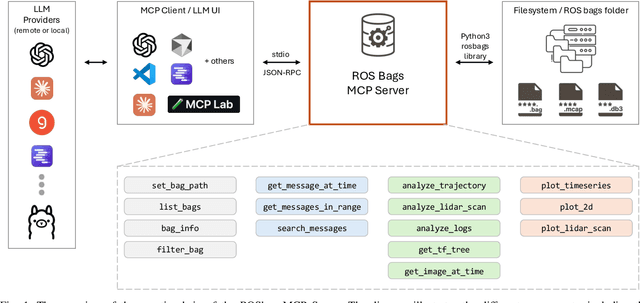
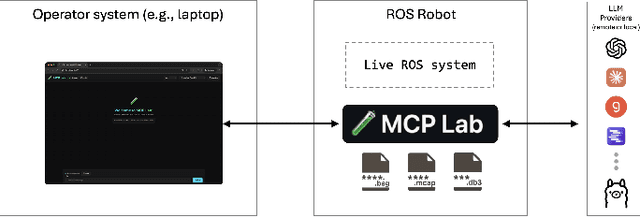
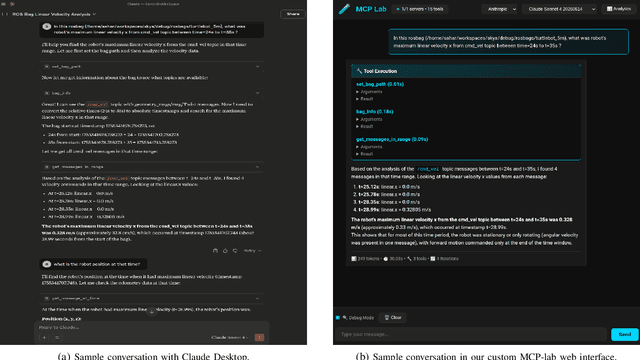

Agentic AI systems and Physical or Embodied AI systems have been two key research verticals at the forefront of Artificial Intelligence and Robotics, with Model Context Protocol (MCP) increasingly becoming a key component and enabler of agentic applications. However, the literature at the intersection of these verticals, i.e., Agentic Embodied AI, remains scarce. This paper introduces an MCP server for analyzing ROS and ROS 2 bags, allowing for analyzing, visualizing and processing robot data with natural language through LLMs and VLMs. We describe specific tooling built with robotics domain knowledge, with our initial release focused on mobile robotics and supporting natively the analysis of trajectories, laser scan data, transforms, or time series data. This is in addition to providing an interface to standard ROS 2 CLI tools ("ros2 bag list" or "ros2 bag info"), as well as the ability to filter bags with a subset of topics or trimmed in time. Coupled with the MCP server, we provide a lightweight UI that allows the benchmarking of the tooling with different LLMs, both proprietary (Anthropic, OpenAI) and open-source (through Groq). Our experimental results include the analysis of tool calling capabilities of eight different state-of-the-art LLM/VLM models, both proprietary and open-source, large and small. Our experiments indicate that there is a large divide in tool calling capabilities, with Kimi K2 and Claude Sonnet 4 demonstrating clearly superior performance. We also conclude that there are multiple factors affecting the success rates, from the tool description schema to the number of arguments, as well as the number of tools available to the models. The code is available with a permissive license at https://github.com/binabik-ai/mcp-rosbags.