 Add to Chrome
 Add to Firefox
 Add to Edge
Claim-Level Reliability Assessment for Efficient Test-Time Reasoning
Aug 12, 2026
We propose claim-level falsification as a principle for test-time scaling and instantiate it through Claim-Level Reliability Assessment (CLR), a training-free framework that reallocates test-time compute from additional solution sampling to targeted verification. Since whole-trace evaluation often obscures decisive errors due to signal dilution from routine tokens, CLR condenses each reasoning trace into a compact set of decision-critical claims, thereby isolating its logical anchors. Furthermore, recognizing the inherent difficulty of generating entirely correct solutions under fixed model capabilities, CLR shifts the focus to semantic falsification. This approach exploits a fundamental asymmetry between solution construction and claim refutation. Constructing a valid solution requires a flawless reasoning path, whereas refuting an incorrect claim requires identifying only a single decisive flaw. This targeted search for negative evidence systematically compresses the survival space of high-confidence incorrect traces, effectively suppressing erroneous consensus via nonlinear reliability scoring. Across four LLMs and four reasoning benchmarks under matched budgets, CLR generally improves upon pass@1 and self-consistency. On GPT-OSS-20B/CMIMC25, for instance, CLR exceeds pass@1 by 27.15 percentage-points and raises self-consistency accuracy from 77.50\% to 82.19\% with 37.0\% fewer tokens.

VibeThinker-3B: Exploring the Frontier of Verifiable Reasoning in Small Language Models
Jun 15, 2026This technical report introduces VibeThinker-3B, a compact dense model with 3B parameters developed to investigate how far verifiable reasoning can be pushed within a strictly small-model regime. Building upon the Spectrum-to-Signal post-training paradigm, we systematically enhance the model through an optimized pipeline that includes curriculum-based supervised fine-tuning, multi-domain reinforcement learning, and offline self-distillation. Experimental evaluations demonstrate that VibeThinker-3B achieves frontier-level performance on highly demanding verifiable tasks. Specifically, it attains a score of 94.3 on AIME26 (improving to 97.1 with claim-level test-time scaling), an 80.2 Pass@1 on LiveCodeBench v6, and exhibits strong out-of-distribution generalization with a 96.1\% acceptance rate on recent unseen LeetCode contests. This effectively places it in the performance band of first-tier reasoning systems, matching or exceeding flagship models that are orders of magnitude larger, such as DeepSeek V3.2, GLM-5, and Gemini 3 Pro. Furthermore, a score of 93.4 on IFEval confirms that this extreme reasoning enhancement does not compromise strict instruction controllability. Extending our previous 1.5B work, these findings motivate the Parametric Compression-Coverage Hypothesis, which views verifiable reasoning as compressible into compact reasoning cores, while open-domain knowledge and general-purpose competence require broad parameter coverage over facts, concepts, and long-tail scenarios. This perspective suggests that compact models are not merely deployment-efficient substitutes, but a complementary path toward frontier-level performance in parameter-dense capability regimes.
Tiny Model, Big Logic: Diversity-Driven Optimization Elicits Large-Model Reasoning Ability in VibeThinker-1.5B
Nov 09, 2025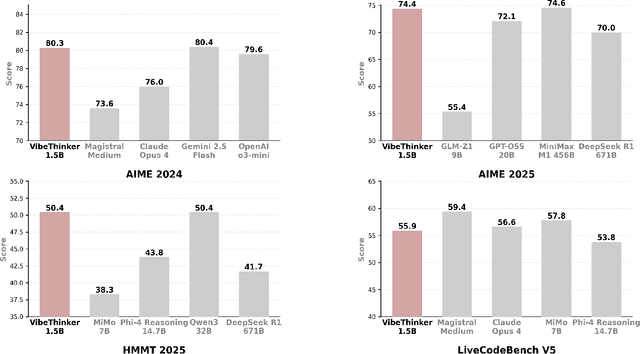

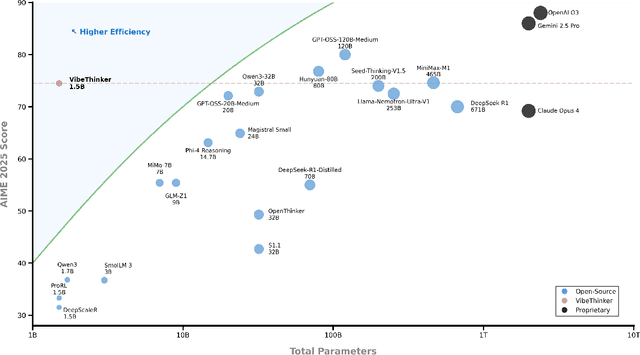
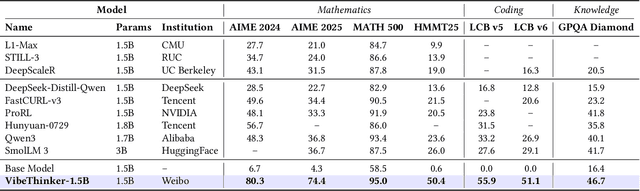
Challenging the prevailing consensus that small models inherently lack robust reasoning, this report introduces VibeThinker-1.5B, a 1.5B-parameter dense model developed via our Spectrum-to-Signal Principle (SSP). This challenges the prevailing approach of scaling model parameters to enhance capabilities, as seen in models like DeepSeek R1 (671B) and Kimi k2 (>1T). The SSP framework first employs a Two-Stage Diversity-Exploring Distillation (SFT) to generate a broad spectrum of solutions, followed by MaxEnt-Guided Policy Optimization (RL) to amplify the correct signal. With a total training cost of only $7,800, VibeThinker-1.5B demonstrates superior reasoning capabilities compared to closed-source models like Magistral Medium and Claude Opus 4, and performs on par with open-source models like GPT OSS-20B Medium. Remarkably, it surpasses the 400x larger DeepSeek R1 on three math benchmarks: AIME24 (80.3 vs. 79.8), AIME25 (74.4 vs. 70.0), and HMMT25 (50.4 vs. 41.7). This is a substantial improvement over its base model (6.7, 4.3, and 0.6, respectively). On LiveCodeBench V6, it scores 51.1, outperforming Magistral Medium's 50.3 and its base model's 0.0. These findings demonstrate that small models can achieve reasoning capabilities comparable to large models, drastically reducing training and inference costs and thereby democratizing advanced AI research.