 Add to Chrome
 Add to Firefox
 Add to Edge
Coding in a Bubble? Evaluating LLMs in Resolving Context Adaptation Bugs During Code Adaptation
Jan 10, 2026
Code adaptation is a fundamental but challenging task in software development, requiring developers to modify existing code for new contexts. A key challenge is to resolve Context Adaptation Bugs (CtxBugs), which occurs when code correct in its original context violates constraints in the target environment. Unlike isolated bugs, CtxBugs cannot be resolved through local fixes and require cross-context reasoning to identify semantic mismatches. Overlooking them may lead to critical failures in adaptation. Although Large Language Models (LLMs) show great potential in automating code-related tasks, their ability to resolve CtxBugs remains a significant and unexplored obstacle to their practical use in code adaptation. To bridge this gap, we propose CtxBugGen, a novel framework for generating CtxBugs to evaluate LLMs. Its core idea is to leverage LLMs' tendency to generate plausible but context-free code when contextual constraints are absent. The framework generates CtxBugs through a four-step process to ensure their relevance and validity: (1) Adaptation Task Selection, (2) Task-specific Perturbation,(3) LLM-based Variant Generation and (4) CtxBugs Identification. Based on the benchmark constructed by CtxBugGen, we conduct an empirical study with four state-of-the-art LLMs. Our results reveal their unsatisfactory performance in CtxBug resolution. The best performing LLM, Kimi-K2, achieves 55.93% on Pass@1 and resolves just 52.47% of CtxBugs. The presence of CtxBugs degrades LLMs' adaptation performance by up to 30%. Failure analysis indicates that LLMs often overlook CtxBugs and replicate them in their outputs. Our study highlights a critical weakness in LLMs' cross-context reasoning and emphasize the need for new methods to enhance their context awareness for reliable code adaptation.

MvKSR: Multi-view Knowledge-guided Scene Recovery for Hazy and Rainy Degradation
Jan 09, 2024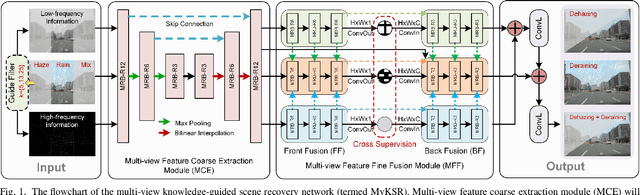
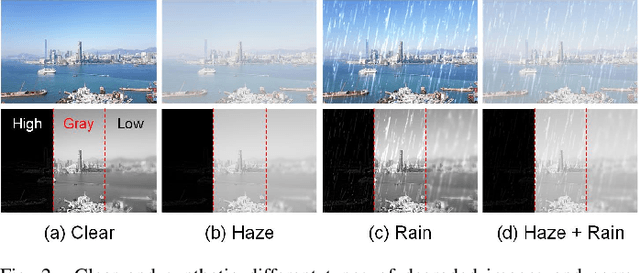
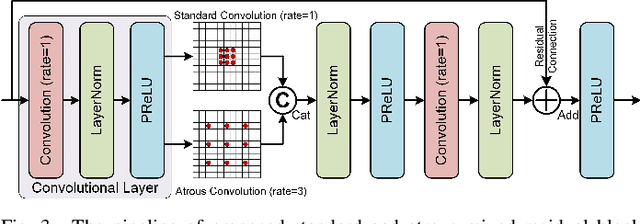

High-quality imaging is crucial for ensuring safety supervision and intelligent deployment in fields like transportation and industry. It enables precise and detailed monitoring of operations, facilitating timely detection of potential hazards and efficient management. However, adverse weather conditions, such as atmospheric haziness and precipitation, can have a significant impact on image quality. When the atmosphere contains dense haze or water droplets, the incident light scatters, leading to degraded captured images. This degradation is evident in the form of image blur and reduced contrast, increasing the likelihood of incorrect assessments and interpretations by intelligent imaging systems (IIS). To address the challenge of restoring degraded images in hazy and rainy conditions, this paper proposes a novel multi-view knowledge-guided scene recovery network (termed MvKSR). Specifically, guided filtering is performed on the degraded image to separate high/low-frequency components. Subsequently, an en-decoder-based multi-view feature coarse extraction module (MCE) is used to coarsely extract features from different views of the degraded image. The multi-view feature fine fusion module (MFF) will learn and infer the restoration of degraded images through mixed supervision under different views. Additionally, we suggest an atrous residual block to handle global restoration and local repair in hazy/rainy/mixed scenes. Extensive experimental results demonstrate that MvKSR outperforms other state-of-the-art methods in terms of efficiency and stability for restoring degraded scenarios in IIS.