 Add to Chrome
 Add to Firefox
 Add to Edge
Fine Grained Image Inpainting
Papers and Code
Agentic Retoucher for Text-To-Image Generation
Jan 08, 2026
Text-to-image (T2I) diffusion models such as SDXL and FLUX have achieved impressive photorealism, yet small-scale distortions remain pervasive in limbs, face, text and so on. Existing refinement approaches either perform costly iterative re-generation or rely on vision-language models (VLMs) with weak spatial grounding, leading to semantic drift and unreliable local edits. To close this gap, we propose Agentic Retoucher, a hierarchical decision-driven framework that reformulates post-generation correction as a human-like perception-reasoning-action loop. Specifically, we design (1) a perception agent that learns contextual saliency for fine-grained distortion localization under text-image consistency cues, (2) a reasoning agent that performs human-aligned inferential diagnosis via progressive preference alignment, and (3) an action agent that adaptively plans localized inpainting guided by user preference. This design integrates perceptual evidence, linguistic reasoning, and controllable correction into a unified, self-corrective decision process. To enable fine-grained supervision and quantitative evaluation, we further construct GenBlemish-27K, a dataset of 6K T2I images with 27K annotated artifact regions across 12 categories. Extensive experiments demonstrate that Agentic Retoucher consistently outperforms state-of-the-art methods in perceptual quality, distortion localization and human preference alignment, establishing a new paradigm for self-corrective and perceptually reliable T2I generation.

Guardians of the Hair: Rescuing Soft Boundaries in Depth, Stereo, and Novel Views
Jan 06, 2026Soft boundaries, like thin hairs, are commonly observed in natural and computer-generated imagery, but they remain challenging for 3D vision due to the ambiguous mixing of foreground and background cues. This paper introduces Guardians of the Hair (HairGuard), a framework designed to recover fine-grained soft boundary details in 3D vision tasks. Specifically, we first propose a novel data curation pipeline that leverages image matting datasets for training and design a depth fixer network to automatically identify soft boundary regions. With a gated residual module, the depth fixer refines depth precisely around soft boundaries while maintaining global depth quality, allowing plug-and-play integration with state-of-the-art depth models. For view synthesis, we perform depth-based forward warping to retain high-fidelity textures, followed by a generative scene painter that fills disoccluded regions and eliminates redundant background artifacts within soft boundaries. Finally, a color fuser adaptively combines warped and inpainted results to produce novel views with consistent geometry and fine-grained details. Extensive experiments demonstrate that HairGuard achieves state-of-the-art performance across monocular depth estimation, stereo image/video conversion, and novel view synthesis, with significant improvements in soft boundary regions.
RePlan: Reasoning-guided Region Planning for Complex Instruction-based Image Editing
Dec 18, 2025


Instruction-based image editing enables natural-language control over visual modifications, yet existing models falter under Instruction-Visual Complexity (IV-Complexity), where intricate instructions meet cluttered or ambiguous scenes. We introduce RePlan (Region-aligned Planning), a plan-then-execute framework that couples a vision-language planner with a diffusion editor. The planner decomposes instructions via step-by-step reasoning and explicitly grounds them to target regions; the editor then applies changes using a training-free attention-region injection mechanism, enabling precise, parallel multi-region edits without iterative inpainting. To strengthen planning, we apply GRPO-based reinforcement learning using 1K instruction-only examples, yielding substantial gains in reasoning fidelity and format reliability. We further present IV-Edit, a benchmark focused on fine-grained grounding and knowledge-intensive edits. Across IV-Complex settings, RePlan consistently outperforms strong baselines trained on far larger datasets, improving regional precision and overall fidelity. Our project page: https://replan-iv-edit.github.io
PaintFlow: A Unified Framework for Interactive Oil Paintings Editing and Generation
Dec 09, 2025Oil painting, as a high-level medium that blends human abstract thinking with artistic expression, poses substantial challenges for digital generation and editing due to its intricate brushstroke dynamics and stylized characteristics. Existing generation and editing techniques are often constrained by the distribution of training data and primarily focus on modifying real photographs. In this work, we introduce a unified multimodal framework for oil painting generation and editing. The proposed system allows users to incorporate reference images for precise semantic control, hand-drawn sketches for spatial structure alignment, and natural language prompts for high-level semantic guidance, while consistently maintaining a unified painting style across all outputs. Our method achieves interactive oil painting creation through three crucial technical advancements. First, we enhance the training stage with spatial alignment and semantic enhancement conditioning strategy, which map masks and sketches into spatial constraints, and encode contextual embedding from reference images and text into feature constraints, enabling object-level semantic alignment. Second, to overcome data scarcity, we propose a self-supervised style transfer pipeline based on Stroke-Based Rendering (SBR), which simulates the inpainting dynamics of oil painting restoration, converting real images into stylized oil paintings with preserved brushstroke textures to construct a large-scale paired training dataset. Finally, during inference, we integrate features using the AdaIN operator to ensure stylistic consistency. Extensive experiments demonstrate that our interactive system enables fine-grained editing while preserving the artistic qualities of oil paintings, achieving an unprecedented level of imagination realization in stylized oil paintings generation and editing.
UniADC: A Unified Framework for Anomaly Detection and Classification
Nov 10, 2025In this paper, we introduce the task of unified anomaly detection and classification, which aims to simultaneously detect anomalous regions in images and identify their specific categories. Existing methods typically treat anomaly detection and classification as separate tasks, thereby neglecting their inherent correlation, limiting information sharing, and resulting in suboptimal performance. To address this, we propose UniADC, a unified anomaly detection and classification model that can effectively perform both tasks with only a few or even no anomaly images. Specifically, UniADC consists of two key components: a training-free controllable inpainting network and a multi-task discriminator. The inpainting network can synthesize anomaly images of specific categories by repainting normal regions guided by anomaly priors, and can also repaint few-shot anomaly samples to augment the available anomaly data. The multi-task discriminator is then trained on these synthesized samples, enabling precise anomaly detection and classification by aligning fine-grained image features with anomaly-category embeddings. We conduct extensive experiments on three anomaly detection and classification datasets, including MVTec-FS, MTD, and WFDD, and the results demonstrate that UniADC consistently outperforms existing methods in anomaly detection, localization, and classification. The code is available at https://github.com/cnulab/UniADC.
GenTune: Toward Traceable Prompts to Improve Controllability of Image Refinement in Environment Design
Aug 21, 2025Environment designers in the entertainment industry create imaginative 2D and 3D scenes for games, films, and television, requiring both fine-grained control of specific details and consistent global coherence. Designers have increasingly integrated generative AI into their workflows, often relying on large language models (LLMs) to expand user prompts for text-to-image generation, then iteratively refining those prompts and applying inpainting. However, our formative study with 10 designers surfaced two key challenges: (1) the lengthy LLM-generated prompts make it difficult to understand and isolate the keywords that must be revised for specific visual elements; and (2) while inpainting supports localized edits, it can struggle with global consistency and correctness. Based on these insights, we present GenTune, an approach that enhances human--AI collaboration by clarifying how AI-generated prompts map to image content. Our GenTune system lets designers select any element in a generated image, trace it back to the corresponding prompt labels, and revise those labels to guide precise yet globally consistent image refinement. In a summative study with 20 designers, GenTune significantly improved prompt--image comprehension, refinement quality, and efficiency, and overall satisfaction (all $p < .01$) compared to current practice. A follow-up field study with two studios further demonstrated its effectiveness in real-world settings.
ObjFiller-3D: Consistent Multi-view 3D Inpainting via Video Diffusion Models
Aug 25, 20253D inpainting often relies on multi-view 2D image inpainting, where the inherent inconsistencies across different inpainted views can result in blurred textures, spatial discontinuities, and distracting visual artifacts. These inconsistencies pose significant challenges when striving for accurate and realistic 3D object completion, particularly in applications that demand high fidelity and structural coherence. To overcome these limitations, we propose ObjFiller-3D, a novel method designed for the completion and editing of high-quality and consistent 3D objects. Instead of employing a conventional 2D image inpainting model, our approach leverages a curated selection of state-of-the-art video editing model to fill in the masked regions of 3D objects. We analyze the representation gap between 3D and videos, and propose an adaptation of a video inpainting model for 3D scene inpainting. In addition, we introduce a reference-based 3D inpainting method to further enhance the quality of reconstruction. Experiments across diverse datasets show that compared to previous methods, ObjFiller-3D produces more faithful and fine-grained reconstructions (PSNR of 26.6 vs. NeRFiller (15.9) and LPIPS of 0.19 vs. Instant3dit (0.25)). Moreover, it demonstrates strong potential for practical deployment in real-world 3D editing applications. Project page: https://objfiller3d.github.io/ Code: https://github.com/objfiller3d/ObjFiller-3D .
Tooth-Diffusion: Guided 3D CBCT Synthesis with Fine-Grained Tooth Conditioning
Aug 19, 2025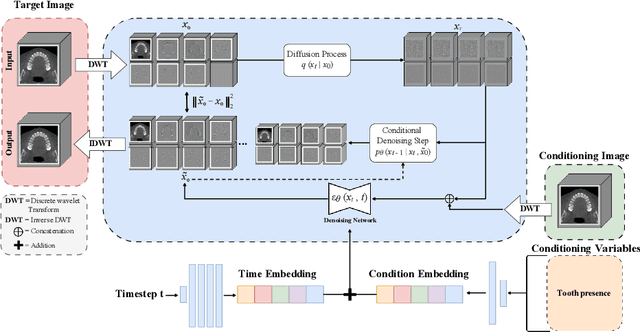
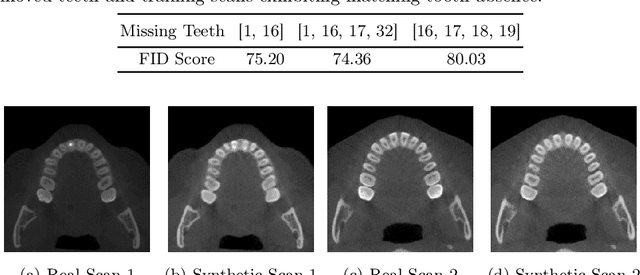
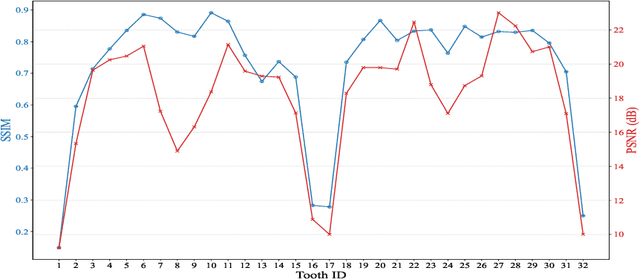
Despite the growing importance of dental CBCT scans for diagnosis and treatment planning, generating anatomically realistic scans with fine-grained control remains a challenge in medical image synthesis. In this work, we propose a novel conditional diffusion framework for 3D dental volume generation, guided by tooth-level binary attributes that allow precise control over tooth presence and configuration. Our approach integrates wavelet-based denoising diffusion, FiLM conditioning, and masked loss functions to focus learning on relevant anatomical structures. We evaluate the model across diverse tasks, such as tooth addition, removal, and full dentition synthesis, using both paired and distributional similarity metrics. Results show strong fidelity and generalization with low FID scores, robust inpainting performance, and SSIM values above 0.91 even on unseen scans. By enabling realistic, localized modification of dentition without rescanning, this work opens opportunities for surgical planning, patient communication, and targeted data augmentation in dental AI workflows. The codes are available at: https://github.com/djafar1/tooth-diffusion.
High-fidelity 3D Gaussian Inpainting: preserving multi-view consistency and photorealistic details
Jul 24, 2025Recent advancements in multi-view 3D reconstruction and novel-view synthesis, particularly through Neural Radiance Fields (NeRF) and 3D Gaussian Splatting (3DGS), have greatly enhanced the fidelity and efficiency of 3D content creation. However, inpainting 3D scenes remains a challenging task due to the inherent irregularity of 3D structures and the critical need for maintaining multi-view consistency. In this work, we propose a novel 3D Gaussian inpainting framework that reconstructs complete 3D scenes by leveraging sparse inpainted views. Our framework incorporates an automatic Mask Refinement Process and region-wise Uncertainty-guided Optimization. Specifically, we refine the inpainting mask using a series of operations, including Gaussian scene filtering and back-projection, enabling more accurate localization of occluded regions and realistic boundary restoration. Furthermore, our Uncertainty-guided Fine-grained Optimization strategy, which estimates the importance of each region across multi-view images during training, alleviates multi-view inconsistencies and enhances the fidelity of fine details in the inpainted results. Comprehensive experiments conducted on diverse datasets demonstrate that our approach outperforms existing state-of-the-art methods in both visual quality and view consistency.
Highly Compressed Tokenizer Can Generate Without Training
Jun 09, 2025Commonly used image tokenizers produce a 2D grid of spatially arranged tokens. In contrast, so-called 1D image tokenizers represent images as highly compressed one-dimensional sequences of as few as 32 discrete tokens. We find that the high degree of compression achieved by a 1D tokenizer with vector quantization enables image editing and generative capabilities through heuristic manipulation of tokens, demonstrating that even very crude manipulations -- such as copying and replacing tokens between latent representations of images -- enable fine-grained image editing by transferring appearance and semantic attributes. Motivated by the expressivity of the 1D tokenizer's latent space, we construct an image generation pipeline leveraging gradient-based test-time optimization of tokens with plug-and-play loss functions such as reconstruction or CLIP similarity. Our approach is demonstrated for inpainting and text-guided image editing use cases, and can generate diverse and realistic samples without requiring training of any generative model.