 Add to Chrome
 Add to Firefox
 Add to Edge
Differentiable Stroke Planning with Dual Parameterization for Efficient and High-Fidelity Painting Creation
Apr 03, 2026
In stroke-based rendering, search methods often get trapped in local minima due to discrete stroke placement, while differentiable optimizers lack structural awareness and produce unstructured layouts. To bridge this gap, we propose a dual representation that couples discrete polylines with continuous Bézier control points via a bidirectional mapping mechanism. This enables collaborative optimization: local gradients refine global stroke structures, while content-aware stroke proposals help escape poor local optima. Our representation further supports Gaussian-splatting-inspired initialization, enabling highly parallel stroke optimization across the image. Experiments show that our approach reduces the number of strokes by 30-50%, achieves more structurally coherent layouts, and improves reconstruction quality, while cutting optimization time by 30-40% compared to existing differentiable vectorization methods.

PaintFlow: A Unified Framework for Interactive Oil Paintings Editing and Generation
Dec 09, 2025Oil painting, as a high-level medium that blends human abstract thinking with artistic expression, poses substantial challenges for digital generation and editing due to its intricate brushstroke dynamics and stylized characteristics. Existing generation and editing techniques are often constrained by the distribution of training data and primarily focus on modifying real photographs. In this work, we introduce a unified multimodal framework for oil painting generation and editing. The proposed system allows users to incorporate reference images for precise semantic control, hand-drawn sketches for spatial structure alignment, and natural language prompts for high-level semantic guidance, while consistently maintaining a unified painting style across all outputs. Our method achieves interactive oil painting creation through three crucial technical advancements. First, we enhance the training stage with spatial alignment and semantic enhancement conditioning strategy, which map masks and sketches into spatial constraints, and encode contextual embedding from reference images and text into feature constraints, enabling object-level semantic alignment. Second, to overcome data scarcity, we propose a self-supervised style transfer pipeline based on Stroke-Based Rendering (SBR), which simulates the inpainting dynamics of oil painting restoration, converting real images into stylized oil paintings with preserved brushstroke textures to construct a large-scale paired training dataset. Finally, during inference, we integrate features using the AdaIN operator to ensure stylistic consistency. Extensive experiments demonstrate that our interactive system enables fine-grained editing while preserving the artistic qualities of oil paintings, achieving an unprecedented level of imagination realization in stylized oil paintings generation and editing.
AMR-Transformer: Enabling Efficient Long-range Interaction for Complex Neural Fluid Simulation
Mar 13, 2025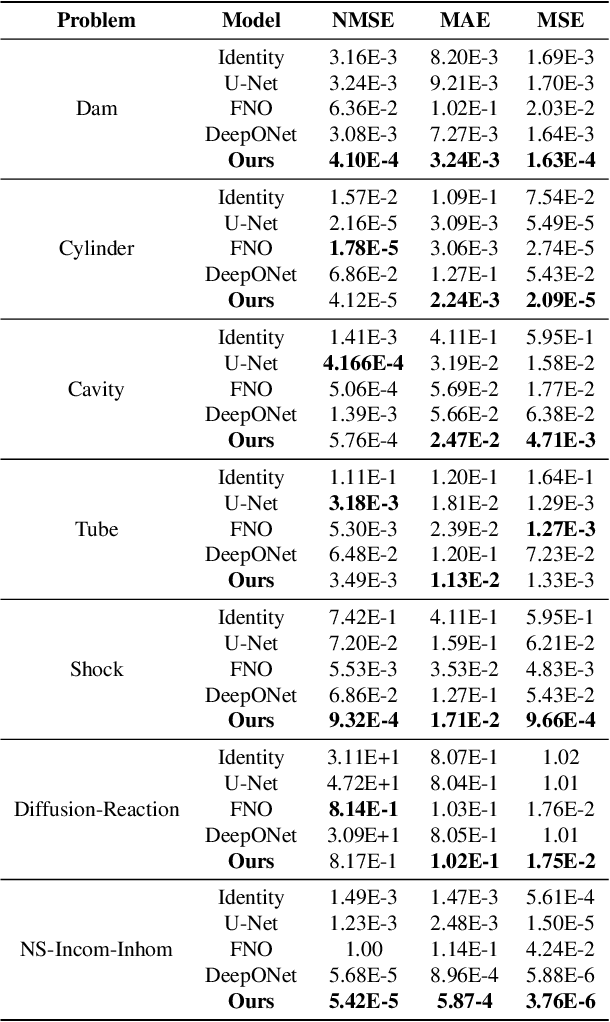
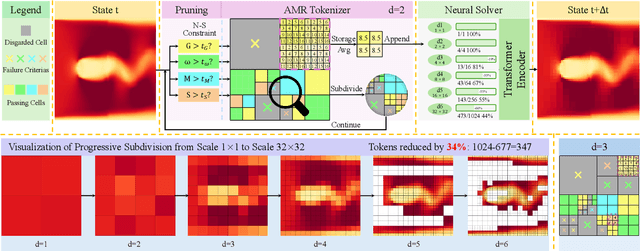
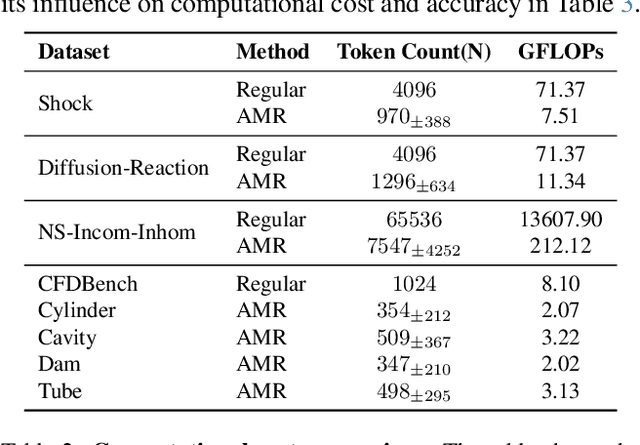
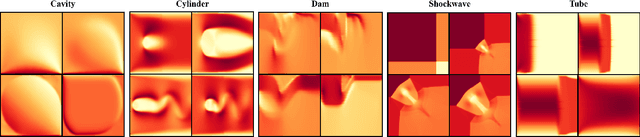
Accurately and efficiently simulating complex fluid dynamics is a challenging task that has traditionally relied on computationally intensive methods. Neural network-based approaches, such as convolutional and graph neural networks, have partially alleviated this burden by enabling efficient local feature extraction. However, they struggle to capture long-range dependencies due to limited receptive fields, and Transformer-based models, while providing global context, incur prohibitive computational costs. To tackle these challenges, we propose AMR-Transformer, an efficient and accurate neural CFD-solving pipeline that integrates a novel adaptive mesh refinement scheme with a Navier-Stokes constraint-aware fast pruning module. This design encourages long-range interactions between simulation cells and facilitates the modeling of global fluid wave patterns, such as turbulence and shockwaves. Experiments show that our approach achieves significant gains in efficiency while preserving critical details, making it suitable for high-resolution physical simulations with long-range dependencies. On CFDBench, PDEBench and a new shockwave dataset, our pipeline demonstrates up to an order-of-magnitude improvement in accuracy over baseline models. Additionally, compared to ViT, our approach achieves a reduction in FLOPs of up to 60 times.