 Add to Chrome
 Add to Firefox
 Add to Edge
Few-shot Image Recognition
Papers and Code
Seeing Radio: From Zero RF Priors to Explainable Modulation Recognition with Vision Language Models
Jan 19, 2026
The rise of vision language models (VLMs) paves a new path for radio frequency (RF) perception. Rather than designing task-specific neural receivers, we ask if VLMs can learn to recognize modulations when RF waveforms are expressed as images. In this work, we find that they can. In specific, in this paper, we introduce a practical pipeline for converting complex IQ streams into visually interpretable inputs, hence, enabling general-purpose VLMs to classify modulation schemes without changing their underlying design. Building on this, we construct an RF visual question answering (VQA) benchmark framework that covers 57 classes across major families of analog/digital modulations with three complementary image modes, namely, (i) short \emph{time-series} IQ segments represented as real/imaginary traces, (ii) magnitude-only \emph{spectrograms}, and (iii) \emph{joint} representations that pair spectrograms with a synchronized time-series waveforms. We design uniform zero-shot and few-shot prompts for both class-level and family-level evaluations. Our finetuned VLMs with these images achieve competitive accuracy of $90\%$ compared to $10\%$ of the base models. Furthermore, the fine-tuned VLMs show robust performance under noise and demonstrate high generalization performance to unseen modulation types, without relying on RF-domain priors or specialized architectures. The obtained results show that combining RF-to-image conversion with promptable VLMs provides a scalable and practical foundation for RF-aware AI systems in future 6G networks.

Evaluating the encoding competence of visual language models using uncommon actions
Jan 12, 2026We propose UAIT (Uncommon-sense Action Image-Text) dataset, a new evaluation benchmark designed to test the semantic understanding ability of visual language models (VLMs) in uncommon-sense action scenes. Unlike previous datasets that focus on common visual scenes with statistical frequency advantages, UAIT challenges models with grammatically reasonable but semantically counter-common sense image-text pairs. Such tasks require models to go beyond superficial pattern recognition and demonstrate a deep understanding of agent-patient relationships and physical feasibility. To build UAIT, we designed a semi-automated process to synthesize high-quality uncommon-sense image-text samples using large language models, few-shot prompt engineering, and text-to-image generation. Each sample is accompanied by a carefully designed multiple-choice question to test the model's competence in fine-grained reasoning. We evaluate multiple state-of-the-art visual language models and compare them with models based on contrastive learning. Experiments show that all models perform significantly worse than humans in semantic judgment, especially in distinguishing grammatical correctness from semantic rationality. Further experiments show that even the lightweight model can improve its accuracy after fine-tuning, demonstrating the great potential of directional adaptation. This study not only reveals the key weaknesses of VLMs, but also provides diagnostic tools and research directions for the development of robust models with real visual semantic reasoning capabilities.
Towards Computational Chinese Paleography
Jan 11, 2026Chinese paleography, the study of ancient Chinese writing, is undergoing a computational turn powered by artificial intelligence. This position paper charts the trajectory of this emerging field, arguing that it is evolving from automating isolated visual tasks to creating integrated digital ecosystems for scholarly research. We first map the landscape of digital resources, analyzing critical datasets for oracle bone, bronze, and bamboo slip scripts. The core of our analysis follows the field's methodological pipeline: from foundational visual processing (image restoration, character recognition), through contextual analysis (artifact rejoining, dating), to the advanced reasoning required for automated decipherment and human-AI collaboration. We examine the technological shift from classical computer vision to modern deep learning paradigms, including transformers and large multimodal models. Finally, we synthesize the field's core challenges -- notably data scarcity and a disconnect between current AI capabilities and the holistic nature of humanistic inquiry -- and advocate for a future research agenda focused on creating multimodal, few-shot, and human-centric systems to augment scholarly expertise.
PartImageNet++ Dataset: Enhancing Visual Models with High-Quality Part Annotations
Jan 04, 2026To address the scarcity of high-quality part annotations in existing datasets, we introduce PartImageNet++ (PIN++), a dataset that provides detailed part annotations for all categories in ImageNet-1K. With 100 annotated images per category, totaling 100K images, PIN++ represents the most comprehensive dataset covering a diverse range of object categories. Leveraging PIN++, we propose a Multi-scale Part-supervised recognition Model (MPM) for robust classification on ImageNet-1K. We first trained a part segmentation network using PIN++ and used it to generate pseudo part labels for the remaining unannotated images. MPM then integrated a conventional recognition architecture with auxiliary bypass layers, jointly supervised by both pseudo part labels and the original part annotations. Furthermore, we conducted extensive experiments on PIN++, including part segmentation, object segmentation, and few-shot learning, exploring various ways to leverage part annotations in downstream tasks. Experimental results demonstrated that our approach not only enhanced part-based models for robust object recognition but also established strong baselines for multiple downstream tasks, highlighting the potential of part annotations in improving model performance. The dataset and the code are available at https://github.com/LixiaoTHU/PartImageNetPP.
CPJ: Explainable Agricultural Pest Diagnosis via Caption-Prompt-Judge with LLM-Judged Refinement
Dec 31, 2025Accurate and interpretable crop disease diagnosis is essential for agricultural decision-making, yet existing methods often rely on costly supervised fine-tuning and perform poorly under domain shifts. We propose Caption--Prompt--Judge (CPJ), a training-free few-shot framework that enhances Agri-Pest VQA through structured, interpretable image captions. CPJ employs large vision-language models to generate multi-angle captions, refined iteratively via an LLM-as-Judge module, which then inform a dual-answer VQA process for both recognition and management responses. Evaluated on CDDMBench, CPJ significantly improves performance: using GPT-5-mini captions, GPT-5-Nano achieves \textbf{+22.7} pp in disease classification and \textbf{+19.5} points in QA score over no-caption baselines. The framework provides transparent, evidence-based reasoning, advancing robust and explainable agricultural diagnosis without fine-tuning. Our code and data are publicly available at: https://github.com/CPJ-Agricultural/CPJ-Agricultural-Diagnosis.
Context-Aware Pesticide Recommendation via Few-Shot Pest Recognition for Precision Agriculture
Jan 01, 2026Effective pest management is crucial for enhancing agricultural productivity, especially for crops such as sugarcane and wheat that are highly vulnerable to pest infestations. Traditional pest management methods depend heavily on manual field inspections and the use of chemical pesticides. These approaches are often costly, time-consuming, labor-intensive, and can have a negative impact on the environment. To overcome these challenges, this study presents a lightweight framework for pest detection and pesticide recommendation, designed for low-resource devices such as smartphones and drones, making it suitable for use by small and marginal farmers. The proposed framework includes two main components. The first is a Pest Detection Module that uses a compact, lightweight convolutional neural network (CNN) combined with prototypical meta-learning to accurately identify pests even when only a few training samples are available. The second is a Pesticide Recommendation Module that incorporates environmental factors like crop type and growth stage to suggest safe and eco-friendly pesticide recommendations. To train and evaluate our framework, a comprehensive pest image dataset was developed by combining multiple publicly available datasets. The final dataset contains samples with different viewing angles, pest sizes, and background conditions to ensure strong generalization. Experimental results show that the proposed lightweight CNN achieves high accuracy, comparable to state-of-the-art models, while significantly reducing computational complexity. The Decision Support System additionally improves pest management by reducing dependence on traditional chemical pesticides and encouraging sustainable practices, demonstrating its potential for real-time applications in precision agriculture.
Training-Free Dual Hyperbolic Adapters for Better Cross-Modal Reasoning
Dec 09, 2025Recent research in Vision-Language Models (VLMs) has significantly advanced our capabilities in cross-modal reasoning. However, existing methods suffer from performance degradation with domain changes or require substantial computational resources for fine-tuning in new domains. To address this issue, we develop a new adaptation method for large vision-language models, called \textit{Training-free Dual Hyperbolic Adapters} (T-DHA). We characterize the vision-language relationship between semantic concepts, which typically has a hierarchical tree structure, in the hyperbolic space instead of the traditional Euclidean space. Hyperbolic spaces exhibit exponential volume growth with radius, unlike the polynomial growth in Euclidean space. We find that this unique property is particularly effective for embedding hierarchical data structures using the Poincaré ball model, achieving significantly improved representation and discrimination power. Coupled with negative learning, it provides more accurate and robust classifications with fewer feature dimensions. Our extensive experimental results on various datasets demonstrate that the T-DHA method significantly outperforms existing state-of-the-art methods in few-shot image recognition and domain generalization tasks.
Few-Shot Learning of a Graph-Based Neural Network Model Without Backpropagation
Dec 20, 2025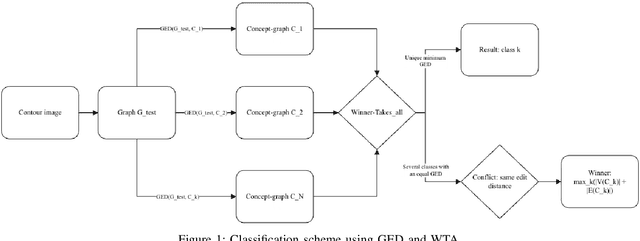
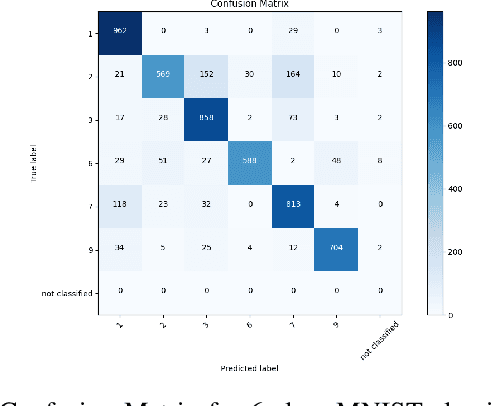
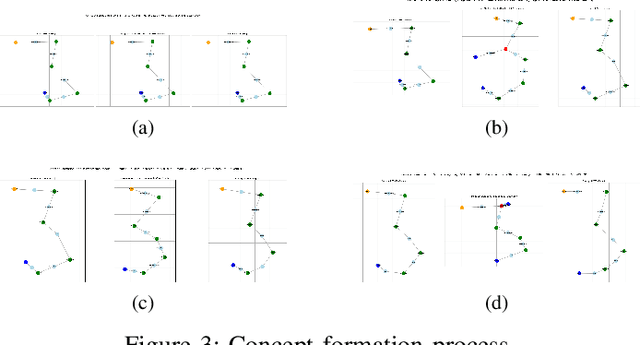
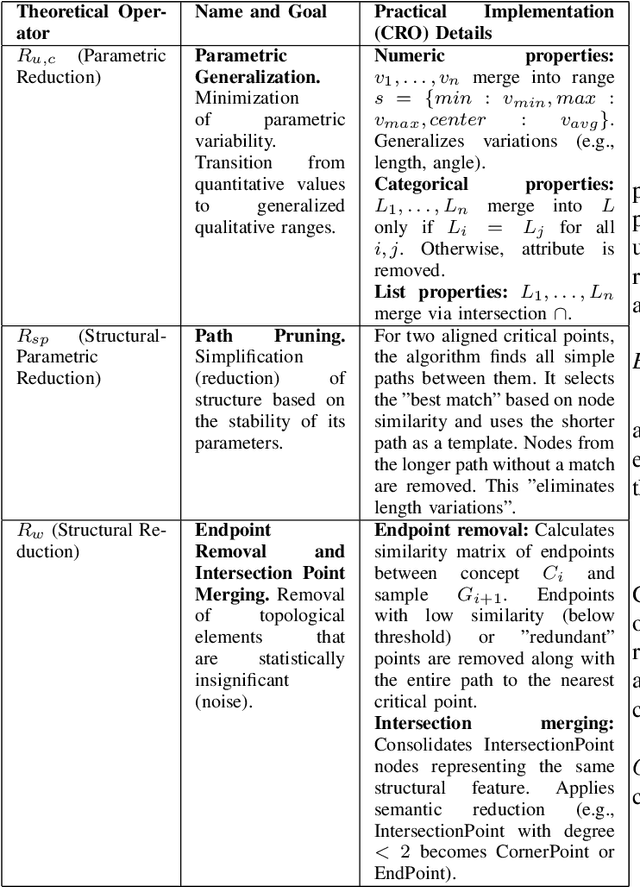
We propose a structural-graph approach to classifying contour images in a few-shot regime without using backpropagation. The core idea is to make structure the carrier of explanations: an image is encoded as an attributed graph (critical points and lines represented as nodes with geometric attributes), and generalization is achieved via the formation of concept attractors (class-level concept graphs). Purpose. To design and experimentally validate an architecture in which class concepts are formed from a handful of examples (5 - 6 per class) through structural and parametric reductions, providing transparent decisions and eliminating backpropagation. Methods. Contour vectorization is followed by constructing a bipartite graph (Point/Line as nodes) with normalized geometric attributes such as coordinates, length, angle, and direction; reductions include the elimination of unstable substructures or noise and the alignment of paths between critical points. Concepts are formed by iterative composition of samples, and classification is performed by selecting the best graph-to-concept match (using approximated GED). Results. On an MNIST subset with 5 - 6 base examples per class (single epoch), we obtain a consistent accuracy of around 82% with full traceability of decisions: misclassifications can be explained by explicit structural similarities. An indicative comparison with SVM, MLP, CNN, as well as metric and meta-learning baselines, is provided. The structural-graph scheme with concept attractors enables few-shot learning without backpropagation and offers built-in explanations through the explicit graph structure. Limitations concern the computational cost of GED and the quality of skeletonization; promising directions include classification-algorithm optimization, work with static scenes, and associative recognition.
Surely Large Multimodal Models (Don't) Excel in Visual Species Recognition?
Dec 10, 2025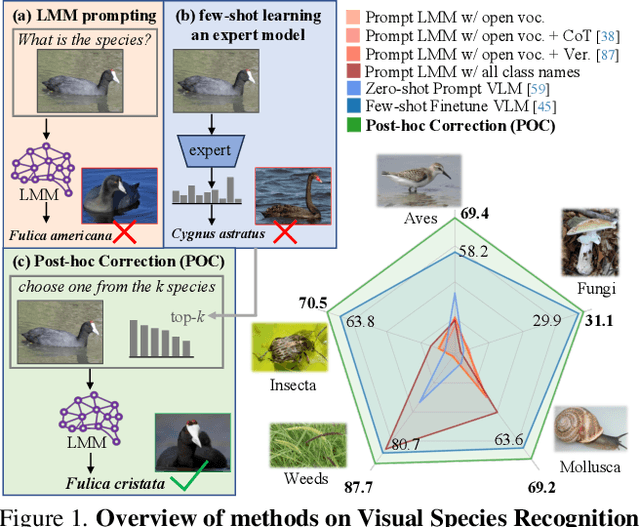
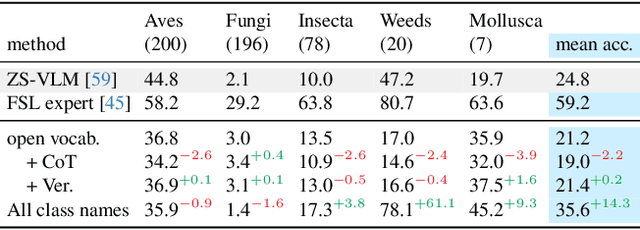

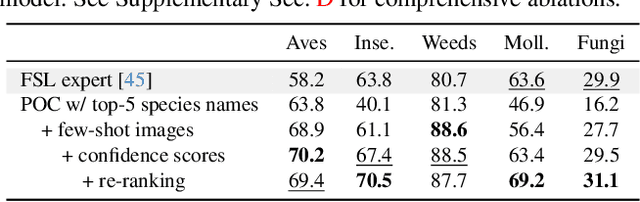
Visual Species Recognition (VSR) is pivotal to biodiversity assessment and conservation, evolution research, and ecology and ecosystem management. Training a machine-learned model for VSR typically requires vast amounts of annotated images. Yet, species-level annotation demands domain expertise, making it realistic for domain experts to annotate only a few examples. These limited labeled data motivate training an ''expert'' model via few-shot learning (FSL). Meanwhile, advanced Large Multimodal Models (LMMs) have demonstrated prominent performance on general recognition tasks. It is straightforward to ask whether LMMs excel in the highly specialized VSR task and whether they outshine FSL expert models. Somewhat surprisingly, we find that LMMs struggle in this task, despite using various established prompting techniques. LMMs even significantly underperform FSL expert models, which are as simple as finetuning a pretrained visual encoder on the few-shot images. However, our in-depth analysis reveals that LMMs can effectively post-hoc correct the expert models' incorrect predictions. Briefly, given a test image, when prompted with the top predictions from an FSL expert model, LMMs can recover the ground-truth label. Building on this insight, we derive a simple method called Post-hoc Correction (POC), which prompts an LMM to re-rank the expert model's top predictions using enriched prompts that include softmax confidence scores and few-shot visual examples. Across five challenging VSR benchmarks, POC outperforms prior art of FSL by +6.4% in accuracy without extra training, validation, or manual intervention. Importantly, POC generalizes to different pretrained backbones and LMMs, serving as a plug-and-play module to significantly enhance existing FSL methods.
Advancing Cache-Based Few-Shot Classification via Patch-Driven Relational Gated Graph Attention
Dec 13, 2025Few-shot image classification remains difficult under limited supervision and visual domain shift. Recent cache-based adaptation approaches (e.g., Tip-Adapter) address this challenge to some extent by learning lightweight residual adapters over frozen features, yet they still inherit CLIP's tendency to encode global, general-purpose representations that are not optimally discriminative to adapt the generalist to the specialist's domain in low-data regimes. We address this limitation with a novel patch-driven relational refinement that learns cache adapter weights from intra-image patch dependencies rather than treating an image embedding as a monolithic vector. Specifically, we introduce a relational gated graph attention network that constructs a patch graph and performs edge-aware attention to emphasize informative inter-patch interactions, producing context-enriched patch embeddings. A learnable multi-aggregation pooling then composes these into compact, task-discriminative representations that better align cache keys with the target few-shot classes. Crucially, the proposed graph refinement is used only during training to distil relational structure into the cache, incurring no additional inference cost beyond standard cache lookup. Final predictions are obtained by a residual fusion of cache similarity scores with CLIP zero-shot logits. Extensive evaluations on 11 benchmarks show consistent gains over state-of-the-art CLIP adapter and cache-based baselines while preserving zero-shot efficiency. We further validate battlefield relevance by introducing an Injured vs. Uninjured Soldier dataset for casualty recognition. It is motivated by the operational need to support triage decisions within the "platinum minutes" and the broader "golden hour" window in time-critical UAV-driven search-and-rescue and combat casualty care.