 Add to Chrome
 Add to Firefox
 Add to Edge
Evolving Contextual Safety in Multi-Modal Large Language Models via Inference-Time Self-Reflective Memory
Mar 16, 2026
Multi-modal Large Language Models (MLLMs) have achieved remarkable performance across a wide range of visual reasoning tasks, yet their vulnerability to safety risks remains a pressing concern. While prior research primarily focuses on jailbreak defenses that detect and refuse explicitly unsafe inputs, such approaches often overlook contextual safety, which requires models to distinguish subtle contextual differences between scenarios that may appear similar but diverge significantly in safety intent. In this work, we present MM-SafetyBench++, a carefully curated benchmark designed for contextual safety evaluation. Specifically, for each unsafe image-text pair, we construct a corresponding safe counterpart through minimal modifications that flip the user intent while preserving the underlying contextual meaning, enabling controlled evaluation of whether models can adapt their safety behaviors based on contextual understanding. Further, we introduce EchoSafe, a training-free framework that maintains a self-reflective memory bank to accumulate and retrieve safety insights from prior interactions. By integrating relevant past experiences into current prompts, EchoSafe enables context-aware reasoning and continual evolution of safety behavior during inference. Extensive experiments on various multi-modal safety benchmarks demonstrate that EchoSafe consistently achieves superior performance, establishing a strong baseline for advancing contextual safety in MLLMs. All benchmark data and code are available at https://echosafe-mllm.github.io.

Training-Free Dual Hyperbolic Adapters for Better Cross-Modal Reasoning
Dec 09, 2025Recent research in Vision-Language Models (VLMs) has significantly advanced our capabilities in cross-modal reasoning. However, existing methods suffer from performance degradation with domain changes or require substantial computational resources for fine-tuning in new domains. To address this issue, we develop a new adaptation method for large vision-language models, called \textit{Training-free Dual Hyperbolic Adapters} (T-DHA). We characterize the vision-language relationship between semantic concepts, which typically has a hierarchical tree structure, in the hyperbolic space instead of the traditional Euclidean space. Hyperbolic spaces exhibit exponential volume growth with radius, unlike the polynomial growth in Euclidean space. We find that this unique property is particularly effective for embedding hierarchical data structures using the Poincaré ball model, achieving significantly improved representation and discrimination power. Coupled with negative learning, it provides more accurate and robust classifications with fewer feature dimensions. Our extensive experimental results on various datasets demonstrate that the T-DHA method significantly outperforms existing state-of-the-art methods in few-shot image recognition and domain generalization tasks.
Unsupervised Real-World Super-Resolution via Rectified Flow Degradation Modelling
Aug 10, 2025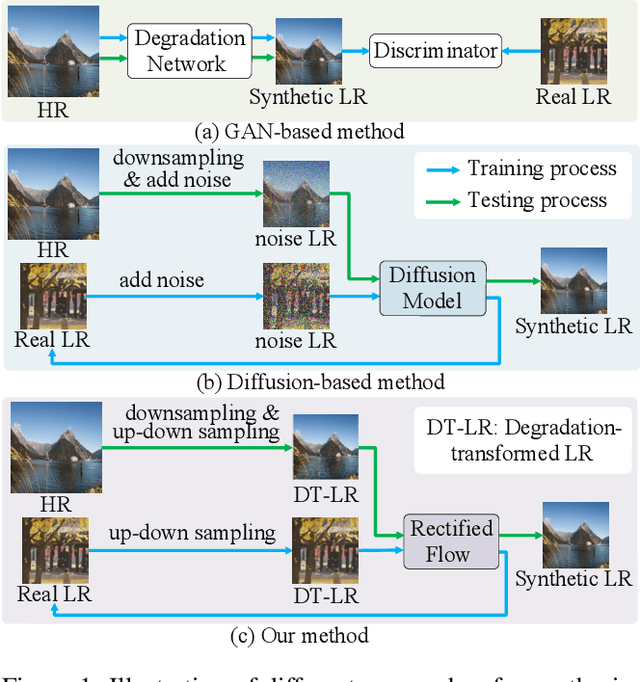
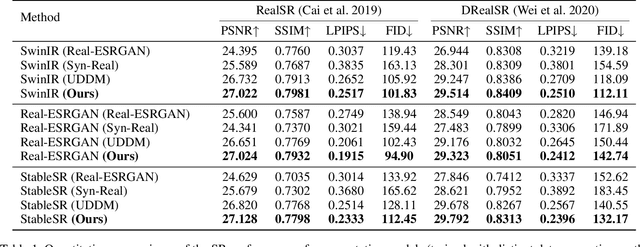
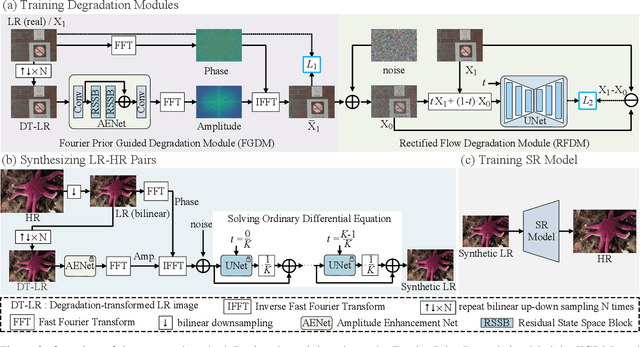
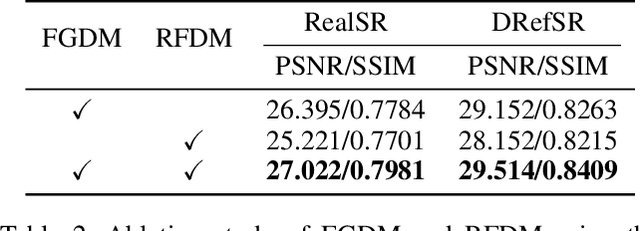
Unsupervised real-world super-resolution (SR) faces critical challenges due to the complex, unknown degradation distributions in practical scenarios. Existing methods struggle to generalize from synthetic low-resolution (LR) and high-resolution (HR) image pairs to real-world data due to a significant domain gap. In this paper, we propose an unsupervised real-world SR method based on rectified flow to effectively capture and model real-world degradation, synthesizing LR-HR training pairs with realistic degradation. Specifically, given unpaired LR and HR images, we propose a novel Rectified Flow Degradation Module (RFDM) that introduces degradation-transformed LR (DT-LR) images as intermediaries. By modeling the degradation trajectory in a continuous and invertible manner, RFDM better captures real-world degradation and enhances the realism of generated LR images. Additionally, we propose a Fourier Prior Guided Degradation Module (FGDM) that leverages structural information embedded in Fourier phase components to ensure more precise modeling of real-world degradation. Finally, the LR images are processed by both FGDM and RFDM, producing final synthetic LR images with real-world degradation. The synthetic LR images are paired with the given HR images to train the off-the-shelf SR networks. Extensive experiments on real-world datasets demonstrate that our method significantly enhances the performance of existing SR approaches in real-world scenarios.
Similarity Matters: A Novel Depth-guided Network for Image Restoration and A New Dataset
Aug 10, 2025Image restoration has seen substantial progress in recent years. However, existing methods often neglect depth information, which hurts similarity matching, results in attention distractions in shallow depth-of-field (DoF) scenarios, and excessive enhancement of background content in deep DoF settings. To overcome these limitations, we propose a novel Depth-Guided Network (DGN) for image restoration, together with a novel large-scale high-resolution dataset. Specifically, the network consists of two interactive branches: a depth estimation branch that provides structural guidance, and an image restoration branch that performs the core restoration task. In addition, the image restoration branch exploits intra-object similarity through progressive window-based self-attention and captures inter-object similarity via sparse non-local attention. Through joint training, depth features contribute to improved restoration quality, while the enhanced visual features from the restoration branch in turn help refine depth estimation. Notably, we also introduce a new dataset for training and evaluation, consisting of 9,205 high-resolution images from 403 plant species, with diverse depth and texture variations. Extensive experiments show that our method achieves state-of-the-art performance on several standard benchmarks and generalizes well to unseen plant images, demonstrating its effectiveness and robustness.
Cross-Modal Few-Shot Learning with Second-Order Neural Ordinary Differential Equations
Dec 20, 2024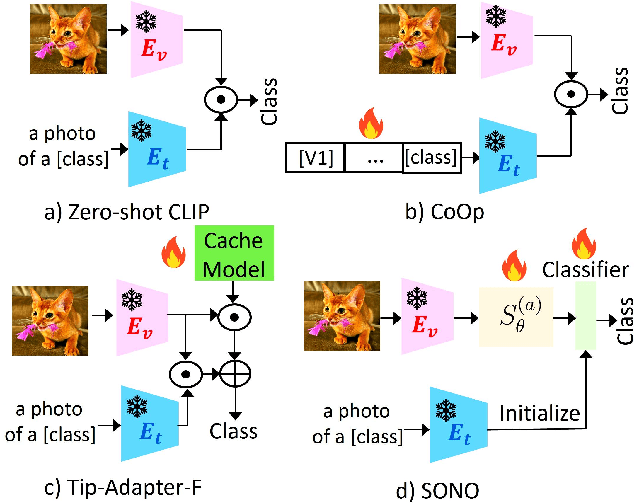
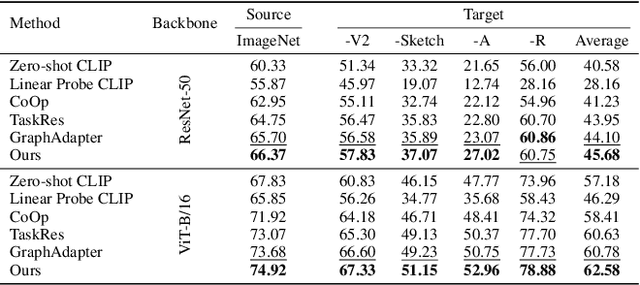
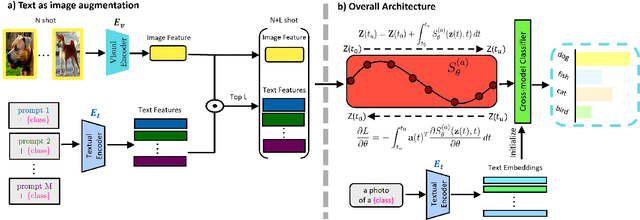

We introduce SONO, a novel method leveraging Second-Order Neural Ordinary Differential Equations (Second-Order NODEs) to enhance cross-modal few-shot learning. By employing a simple yet effective architecture consisting of a Second-Order NODEs model paired with a cross-modal classifier, SONO addresses the significant challenge of overfitting, which is common in few-shot scenarios due to limited training examples. Our second-order approach can approximate a broader class of functions, enhancing the model's expressive power and feature generalization capabilities. We initialize our cross-modal classifier with text embeddings derived from class-relevant prompts, streamlining training efficiency by avoiding the need for frequent text encoder processing. Additionally, we utilize text-based image augmentation, exploiting CLIP's robust image-text correlation to enrich training data significantly. Extensive experiments across multiple datasets demonstrate that SONO outperforms existing state-of-the-art methods in few-shot learning performance.