 Add to Chrome
 Add to Firefox
 Add to Edge
Solving Semi-Supervised Few-Shot Learning from an Auto-Annotation Perspective
Dec 11, 2025
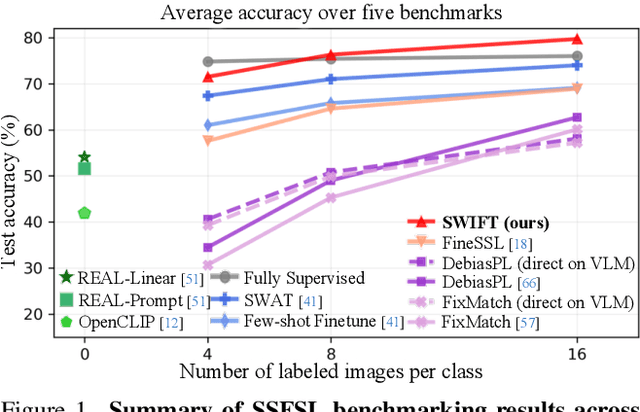
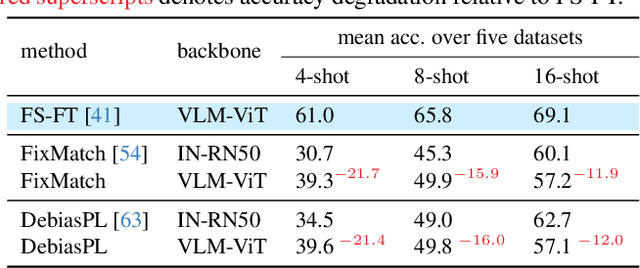
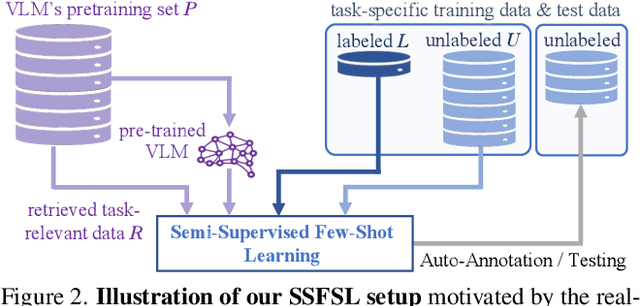
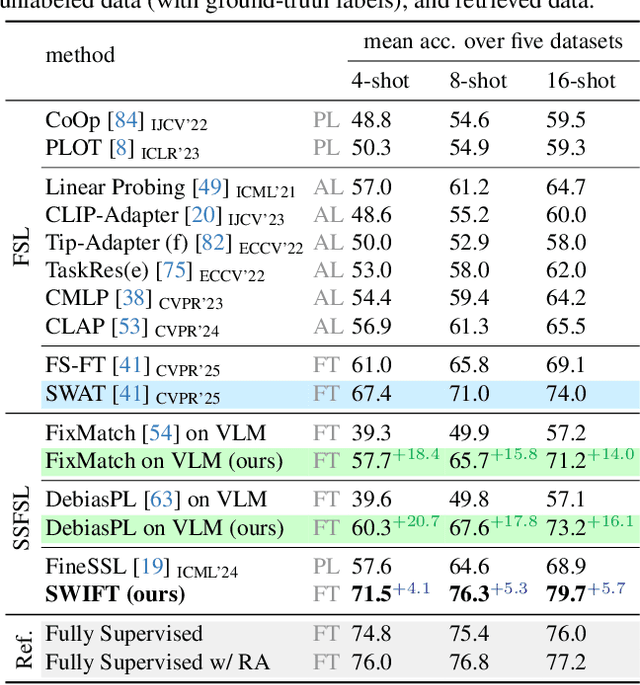
Semi-supervised few-shot learning (SSFSL) formulates real-world applications like ''auto-annotation'', as it aims to learn a model over a few labeled and abundant unlabeled examples to annotate the unlabeled ones. Despite the availability of powerful open-source Vision-Language Models (VLMs) and their pretraining data, the SSFSL literature largely neglects these open-source resources. In contrast, the related area few-shot learning (FSL) has already exploited them to boost performance. Arguably, to achieve auto-annotation in the real world, SSFSL should leverage such open-source resources. To this end, we start by applying established SSL methods to finetune a VLM. Counterintuitively, they significantly underperform FSL baselines. Our in-depth analysis reveals the root cause: VLMs produce rather ''flat'' distributions of softmax probabilities. This results in zero utilization of unlabeled data and weak supervision signals. We address this issue with embarrassingly simple techniques: classifier initialization and temperature tuning. They jointly increase the confidence scores of pseudo-labels, improving the utilization rate of unlabeled data, and strengthening supervision signals. Building on this, we propose: Stage-Wise Finetuning with Temperature Tuning (SWIFT), which enables existing SSL methods to effectively finetune a VLM on limited labeled data, abundant unlabeled data, and task-relevant but noisy data retrieved from the VLM's pretraining set. Extensive experiments on five SSFSL benchmarks show that SWIFT outperforms recent FSL and SSL methods by $\sim$5 accuracy points. SWIFT even rivals supervised learning, which finetunes VLMs with the unlabeled data being labeled with ground truth!

Surely Large Multimodal Models (Don't) Excel in Visual Species Recognition?
Dec 10, 2025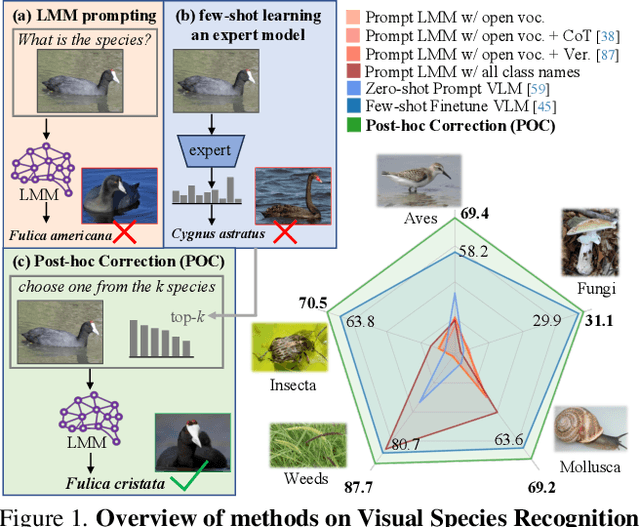
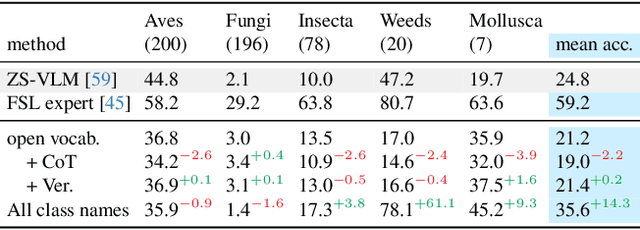

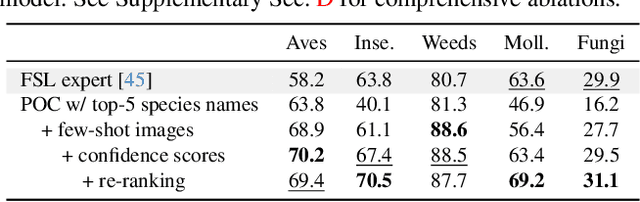
Visual Species Recognition (VSR) is pivotal to biodiversity assessment and conservation, evolution research, and ecology and ecosystem management. Training a machine-learned model for VSR typically requires vast amounts of annotated images. Yet, species-level annotation demands domain expertise, making it realistic for domain experts to annotate only a few examples. These limited labeled data motivate training an ''expert'' model via few-shot learning (FSL). Meanwhile, advanced Large Multimodal Models (LMMs) have demonstrated prominent performance on general recognition tasks. It is straightforward to ask whether LMMs excel in the highly specialized VSR task and whether they outshine FSL expert models. Somewhat surprisingly, we find that LMMs struggle in this task, despite using various established prompting techniques. LMMs even significantly underperform FSL expert models, which are as simple as finetuning a pretrained visual encoder on the few-shot images. However, our in-depth analysis reveals that LMMs can effectively post-hoc correct the expert models' incorrect predictions. Briefly, given a test image, when prompted with the top predictions from an FSL expert model, LMMs can recover the ground-truth label. Building on this insight, we derive a simple method called Post-hoc Correction (POC), which prompts an LMM to re-rank the expert model's top predictions using enriched prompts that include softmax confidence scores and few-shot visual examples. Across five challenging VSR benchmarks, POC outperforms prior art of FSL by +6.4% in accuracy without extra training, validation, or manual intervention. Importantly, POC generalizes to different pretrained backbones and LMMs, serving as a plug-and-play module to significantly enhance existing FSL methods.
Complex LLM Planning via Automated Heuristics Discovery
Feb 26, 2025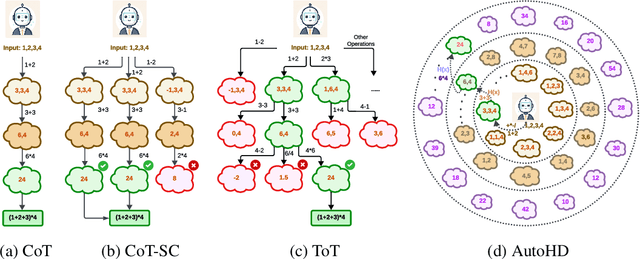
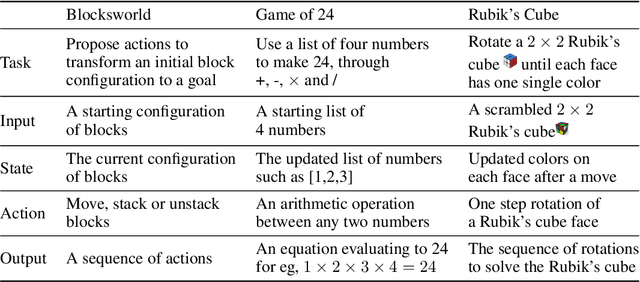
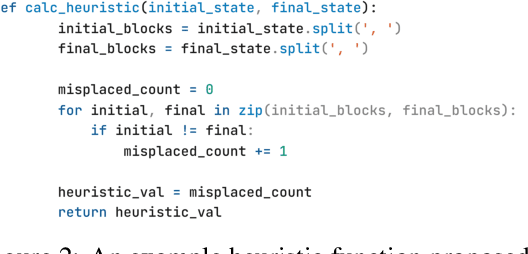
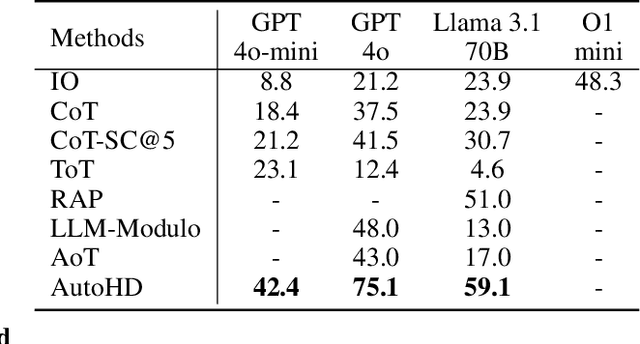
We consider enhancing large language models (LLMs) for complex planning tasks. While existing methods allow LLMs to explore intermediate steps to make plans, they either depend on unreliable self-verification or external verifiers to evaluate these steps, which demand significant data and computations. Here, we propose automated heuristics discovery (AutoHD), a novel approach that enables LLMs to explicitly generate heuristic functions to guide inference-time search, allowing accurate evaluation of intermediate states. These heuristic functions are further refined through a heuristic evolution process, improving their robustness and effectiveness. Our proposed method requires no additional model training or fine-tuning, and the explicit definition of heuristic functions generated by the LLMs provides interpretability and insights into the reasoning process. Extensive experiments across diverse benchmarks demonstrate significant gains over multiple baselines, including nearly twice the accuracy on some datasets, establishing our approach as a reliable and interpretable solution for complex planning tasks.