 Add to Chrome
 Add to Firefox
 Add to Edge
PartImageNet++ Dataset: Enhancing Visual Models with High-Quality Part Annotations
Jan 04, 2026
To address the scarcity of high-quality part annotations in existing datasets, we introduce PartImageNet++ (PIN++), a dataset that provides detailed part annotations for all categories in ImageNet-1K. With 100 annotated images per category, totaling 100K images, PIN++ represents the most comprehensive dataset covering a diverse range of object categories. Leveraging PIN++, we propose a Multi-scale Part-supervised recognition Model (MPM) for robust classification on ImageNet-1K. We first trained a part segmentation network using PIN++ and used it to generate pseudo part labels for the remaining unannotated images. MPM then integrated a conventional recognition architecture with auxiliary bypass layers, jointly supervised by both pseudo part labels and the original part annotations. Furthermore, we conducted extensive experiments on PIN++, including part segmentation, object segmentation, and few-shot learning, exploring various ways to leverage part annotations in downstream tasks. Experimental results demonstrated that our approach not only enhanced part-based models for robust object recognition but also established strong baselines for multiple downstream tasks, highlighting the potential of part annotations in improving model performance. The dataset and the code are available at https://github.com/LixiaoTHU/PartImageNetPP.

PartImageNet++ Dataset: Scaling up Part-based Models for Robust Recognition
Jul 15, 2024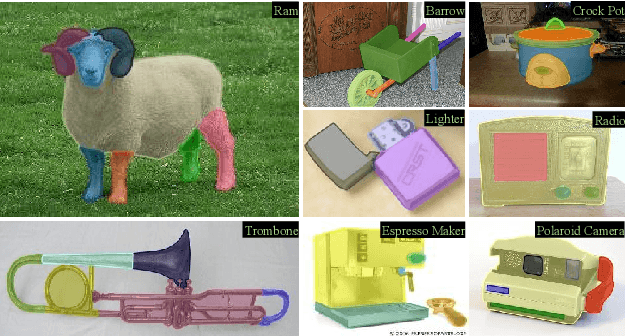
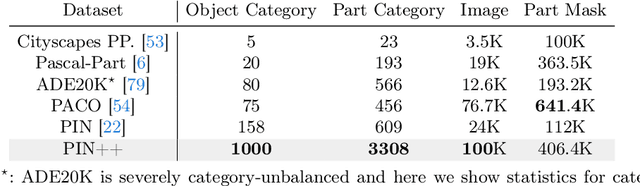
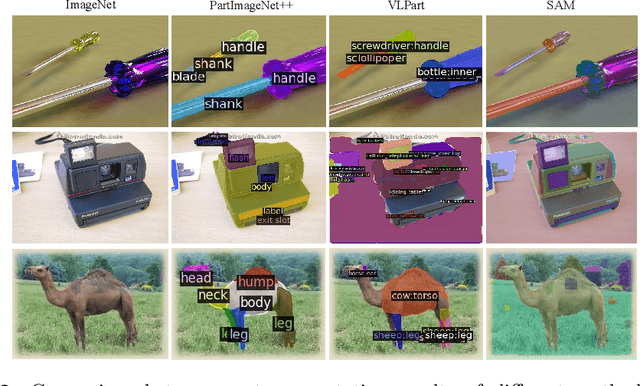
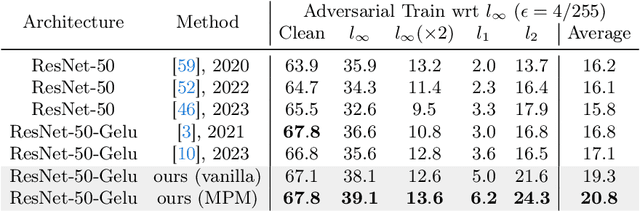
Deep learning-based object recognition systems can be easily fooled by various adversarial perturbations. One reason for the weak robustness may be that they do not have part-based inductive bias like the human recognition process. Motivated by this, several part-based recognition models have been proposed to improve the adversarial robustness of recognition. However, due to the lack of part annotations, the effectiveness of these methods is only validated on small-scale nonstandard datasets. In this work, we propose PIN++, short for PartImageNet++, a dataset providing high-quality part segmentation annotations for all categories of ImageNet-1K (IN-1K). With these annotations, we build part-based methods directly on the standard IN-1K dataset for robust recognition. Different from previous two-stage part-based models, we propose a Multi-scale Part-supervised Model (MPM), to learn a robust representation with part annotations. Experiments show that MPM yielded better adversarial robustness on the large-scale IN-1K over strong baselines across various attack settings. Furthermore, MPM achieved improved robustness on common corruptions and several out-of-distribution datasets. The dataset, together with these results, enables and encourages researchers to explore the potential of part-based models in more real applications.