 Add to Chrome
 Add to Firefox
 Add to Edge
Fine-Grained Action Recognition with Cross-Attentive Latent Sparse Experts
Aug 14, 2026
Fine-grained human action recognition (FHAR) must distinguish visually similar actions that differ mainly in body configuration, timing, or local appearance. RGB representations retain visual context but often suppress joint-level geometry, whereas skeleton representations encode kinematics but discard dense spatial detail. We introduce FineX, which factorizes fine-grained cues into RGB appearance, pose heatmap geometry, and skeletal-graph topology. Pairwise cross-attention enables symmetric, stream-preserving information exchange, followed by a streamwise latent sparse Mixture-of-Experts that routes each representation to a content-dependent subset of shared experts, regularized by a load-balancing objective. FineX achieves state-of-the-art results on Gym99, Gym288, and Diving48. On the long-tailed Gym288, it raises mean class accuracy from 68.6% to 76.2% (+7.6 points) without textual supervision or large-scale vision-language pre-training, demonstrating the benefit of structured visual-pose-graph fusion and conditional expert refinement for FHAR.

Advancing Cache-Based Few-Shot Classification via Patch-Driven Relational Gated Graph Attention
Dec 13, 2025Few-shot image classification remains difficult under limited supervision and visual domain shift. Recent cache-based adaptation approaches (e.g., Tip-Adapter) address this challenge to some extent by learning lightweight residual adapters over frozen features, yet they still inherit CLIP's tendency to encode global, general-purpose representations that are not optimally discriminative to adapt the generalist to the specialist's domain in low-data regimes. We address this limitation with a novel patch-driven relational refinement that learns cache adapter weights from intra-image patch dependencies rather than treating an image embedding as a monolithic vector. Specifically, we introduce a relational gated graph attention network that constructs a patch graph and performs edge-aware attention to emphasize informative inter-patch interactions, producing context-enriched patch embeddings. A learnable multi-aggregation pooling then composes these into compact, task-discriminative representations that better align cache keys with the target few-shot classes. Crucially, the proposed graph refinement is used only during training to distil relational structure into the cache, incurring no additional inference cost beyond standard cache lookup. Final predictions are obtained by a residual fusion of cache similarity scores with CLIP zero-shot logits. Extensive evaluations on 11 benchmarks show consistent gains over state-of-the-art CLIP adapter and cache-based baselines while preserving zero-shot efficiency. We further validate battlefield relevance by introducing an Injured vs. Uninjured Soldier dataset for casualty recognition. It is motivated by the operational need to support triage decisions within the "platinum minutes" and the broader "golden hour" window in time-critical UAV-driven search-and-rescue and combat casualty care.
Design of a Very Compact CNN Classifier for Online Handwritten Chinese Character Recognition Using DropWeight and Global Pooling
May 15, 2017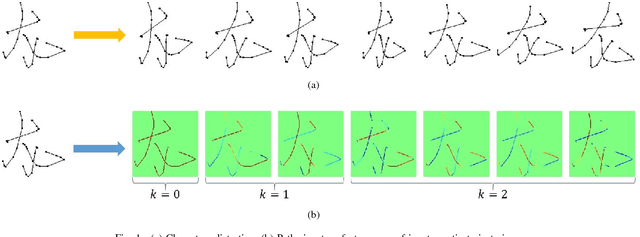
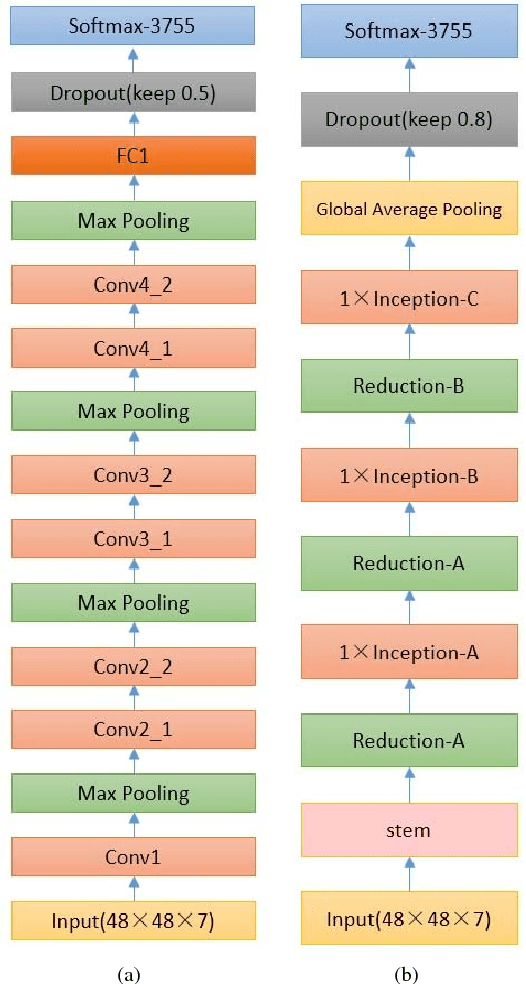
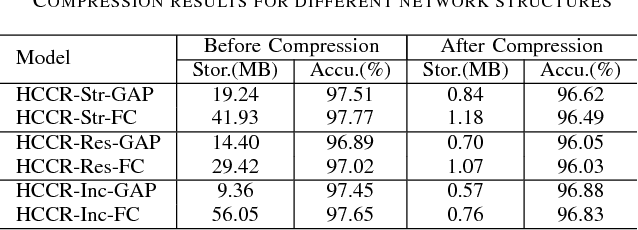
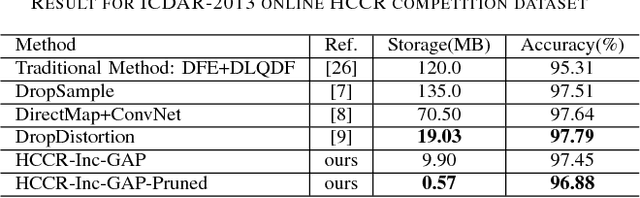
Currently, owing to the ubiquity of mobile devices, online handwritten Chinese character recognition (HCCR) has become one of the suitable choice for feeding input to cell phones and tablet devices. Over the past few years, larger and deeper convolutional neural networks (CNNs) have extensively been employed for improving character recognition performance. However, its substantial storage requirement is a significant obstacle in deploying such networks into portable electronic devices. To circumvent this problem, we propose a novel technique called DropWeight for pruning redundant connections in the CNN architecture. It is revealed that the proposed method not only treats streamlined architectures such as AlexNet and VGGNet well but also exhibits remarkable performance for deep residual network and inception network. We also demonstrate that global pooling is a better choice for building very compact online HCCR systems. Experiments were performed on the ICDAR-2013 online HCCR competition dataset using our proposed network, and it is found that the proposed approach requires only 0.57 MB for storage, whereas state-of-the-art CNN-based methods require up to 135 MB; meanwhile the performance is decreased only by 0.91%.