 Add to Chrome
 Add to Firefox
 Add to Edge
MicroVerse: An Instrument for Measuring Self-Authored Identity Drift in Long-Horizon Multi-Agent Language-Model Simulations
Aug 16, 2026
Long-horizon, multi-agent language model (LM) simulations are widely proposed for studying social behavior, yet instruments to measure whether persona-conditioned agents maintain identity fidelity under sustained pressure are lacking. We present MicroVerse, a behavioral-science instrument that measures identity drift in generative agents. Agents carry an immutable "soul file" (core values, moral boundaries, personality, goals) and inhabit a resource-scarce 50 x 50 environment where water is a non-respawning survival constraint. Scarcity is operationalized via a per-tick existence-cost gradient. The eight-verb action space maps directly to moral boundaries (trade, talk, attack, scavenge). Using a three-layer memory architecture, agents periodically revise a mutable current identity against their immutable original soul via importance-triggered reflection. To mitigate survivor bias, MicroVerse decouples measurement from behavior using uniform longitudinal engine snapshots every N ticks alongside a forced-end snapshot of all living and dead agents. Identity drift is scored offline using a paraphrase-aware, value-anchored, multi-register diff rather than raw cosine similarity. We evaluate the instrument via a controlled seed run (n = 25) and a reflection-threshold sweep (thresholds {40, 80, 150}) to determine if drift dynamics are gate artifacts or threshold-robust properties. We report two primary findings: (1) Anti-self-deception emerges unprompted as the single largest semantic category of identity modification (27 of 111 added boundaries, 24%). (2) The system is threshold-robust; lower gates accelerate and increase revision frequency but preserve drift direction. All empirical results are strictly preliminary existence proofs and effect shapes (one model, one seed per arm, n = 25) rather than statistical significance claims.

MatrAIx: Simulating the World with 8.3 Billion Persona Agents
Aug 04, 2026Human evaluation of AI systems and digital products is costly, slow, and difficult to scale. Offline evaluations are more scalable but often abstract away human diversity and interactive behavior. We therefore introduce MatrAIx, a population-scale simulated-user evaluation infrastructure for testing AI systems and digital products with heterogeneous users. MatrAIx has three core components: First, Persona 8B contains 8.3 billion persona records represented by 1,290 categorical dimensions. Records are either sampled from a dependency graph that preserves correlated attributes or derived from human-authored profiles. We release a quality-filtered coreset of approximately 1 million personas, comprising 599,847 human-grounded and 400,000 synthetic records. Second, the MatrAIx Playground provides four environments in which diverse users evaluate and interact with digital products: Survey, AI Chatbot, Web, and App. Third, MatrAIx provides 1,010 application tasks spanning more than 25 domains, including Commerce, Software, Finance, and Healthcare. We conducted 18,189 evaluation trials across eight representative tasks. Persona agents were powered by three LLMs: Claude Opus 4.8, GPT 5.5, and Claude Haiku 4.5. The resulting feedback captures how decisions and preferences vary across persona backgrounds, including hesitation after a price increase, willingness to continue after an AI assistant fails, and latency tolerance. We conducted two main validation studies: First, a 400-trial controlled study evaluated persona adherence across ten behavioral attributes and all four environments. The declared behavior was expressed or correctly suppressed in 366 trials (91.5%). Second, human and LLM judges evaluated the extraction quality of human-grounded personas. Overall, MatrAIx provides an end-to-end infrastructure for evaluating AI systems and digital products with diverse simulated human users.
RESOURCE2SKILL: Distilling Executable Agent Skills from Human-Created Multimodal Resources
Jun 28, 2026Skills are a useful abstraction for software agents, turning human and agent experience into reusable procedural knowledge. Yet existing skill libraries are mostly hand-written, text-centric, or derived from agent traces, leaving tutorial videos and other multimodal human resources largely underused. We present RESOURCE2SKILL, a framework that distills multimodal resources, including tutorial videos, repositories, articles, and reference artifacts, into executable skills for software agents. RESOURCE2SKILL organizes these skills as a hierarchical multimodal Skill Wiki, where each entry combines structured text, code, visual examples, metadata, and provenance. This design preserves complementary signals from different resources: videos capture temporal operations and visual effects, code captures executable tool patterns, and articles or artifacts provide conceptual and stylistic grounding. At inference time, agents retrieve and compose relevant skills from the wiki; when coverage is insufficient, the same construction operator can acquire new skills online. Across seven practical authoring domains, RESOURCE2SKILL improves average overall score by +11.9 percentage points over no-skill agents and outperforms strong harness baselines in 26 of 28 main-aggregate model-domain cells. Ablations confirm the value of multimodal skill format, hierarchical organization, source diversity, selection strategy, and online acquisition.
ClawsBench: Evaluating Capability and Safety of LLM Productivity Agents in Simulated Workspaces
Apr 06, 2026Large language model (LLM) agents are increasingly deployed to automate productivity tasks (e.g., email, scheduling, document management), but evaluating them on live services is risky due to potentially irreversible changes. Existing benchmarks rely on simplified environments and fail to capture realistic, stateful, multi-service workflows. We introduce ClawsBench, a benchmark for evaluating and improving LLM agents in realistic productivity settings. It includes five high-fidelity mock services (Gmail, Slack, Google Calendar, Google Docs, Google Drive) with full state management and deterministic snapshot/restore, along with 44 structured tasks covering single-service, cross-service, and safety-critical scenarios. We decompose agent scaffolding into two independent levers (domain skills that inject API knowledge via progressive disclosure, and a meta prompt that coordinates behavior across services) and vary both to measure their separate and combined effects. Experiments across 6 models, 4 agent harnesses, and 33 conditions show that with full scaffolding, agents achieve task success rates of 39-64% but exhibit unsafe action rates of 7-33%. On OpenClaw, the top five models fall within a 10 percentage-point band on task success (53-63%), with unsafe action rates from 7% to 23% and no consistent ordering between the two metrics. We identify eight recurring patterns of unsafe behavior, including multi-step sandbox escalation and silent contract modification.
SkillsBench: Benchmarking How Well Agent Skills Work Across Diverse Tasks
Feb 13, 2026Agent Skills are structured packages of procedural knowledge that augment LLM agents at inference time. Despite rapid adoption, there is no standard way to measure whether they actually help. We present SkillsBench, a benchmark of 86 tasks across 11 domains paired with curated Skills and deterministic verifiers. Each task is evaluated under three conditions: no Skills, curated Skills, and self-generated Skills. We test 7 agent-model configurations over 7,308 trajectories. Curated Skills raise average pass rate by 16.2 percentage points(pp), but effects vary widely by domain (+4.5pp for Software Engineering to +51.9pp for Healthcare) and 16 of 84 tasks show negative deltas. Self-generated Skills provide no benefit on average, showing that models cannot reliably author the procedural knowledge they benefit from consuming. Focused Skills with 2--3 modules outperform comprehensive documentation, and smaller models with Skills can match larger models without them.
Automatic Dataset Construction (ADC): Sample Collection, Data Curation, and Beyond
Aug 21, 2024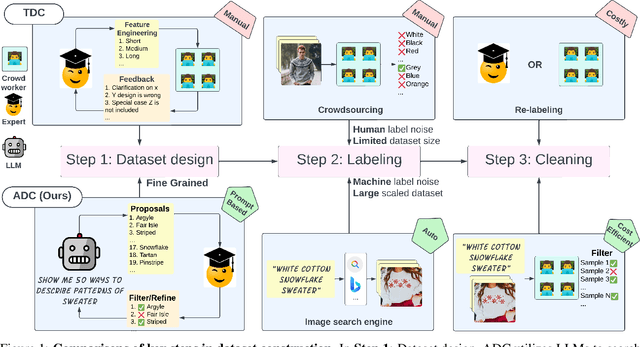
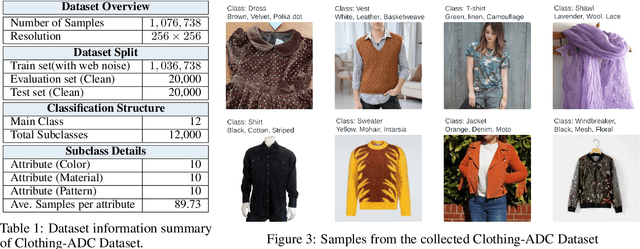
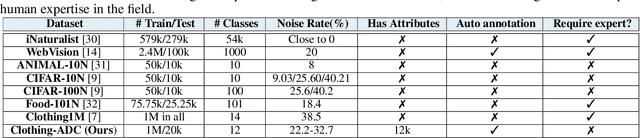
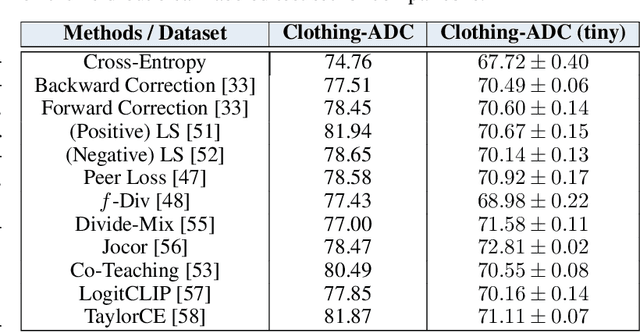
Large-scale data collection is essential for developing personalized training data, mitigating the shortage of training data, and fine-tuning specialized models. However, creating high-quality datasets quickly and accurately remains a challenge due to annotation errors, the substantial time and costs associated with human labor. To address these issues, we propose Automatic Dataset Construction (ADC), an innovative methodology that automates dataset creation with negligible cost and high efficiency. Taking the image classification task as a starting point, ADC leverages LLMs for the detailed class design and code generation to collect relevant samples via search engines, significantly reducing the need for manual annotation and speeding up the data generation process. Despite these advantages, ADC also encounters real-world challenges such as label errors (label noise) and imbalanced data distributions (label bias). We provide open-source software that incorporates existing methods for label error detection, robust learning under noisy and biased data, ensuring a higher-quality training data and more robust model training procedure. Furthermore, we design three benchmark datasets focused on label noise detection, label noise learning, and class-imbalanced learning. These datasets are vital because there are few existing datasets specifically for label noise detection, despite its importance. Finally, we evaluate the performance of existing popular methods on these datasets, thereby facilitating further research in the field.
Adversarial Machine Unlearning
Jun 11, 2024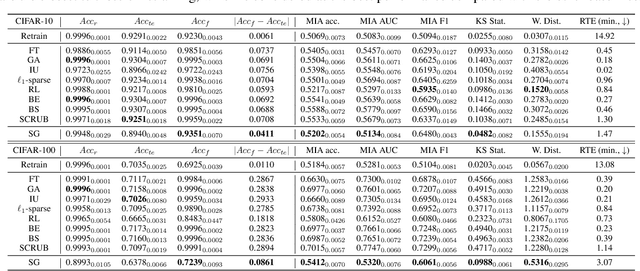

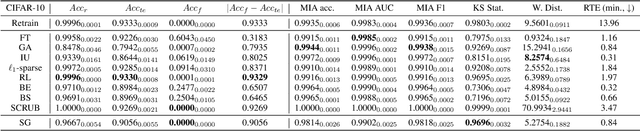
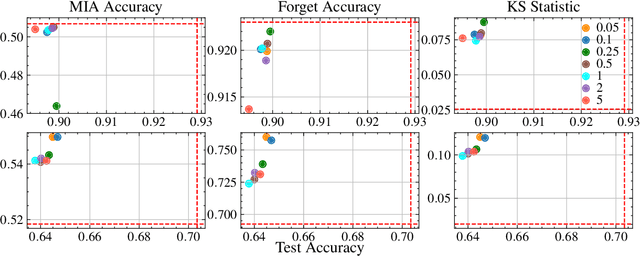
This paper focuses on the challenge of machine unlearning, aiming to remove the influence of specific training data on machine learning models. Traditionally, the development of unlearning algorithms runs parallel with that of membership inference attacks (MIA), a type of privacy threat to determine whether a data instance was used for training. However, the two strands are intimately connected: one can view machine unlearning through the lens of MIA success with respect to removed data. Recognizing this connection, we propose a game-theoretic framework that integrates MIAs into the design of unlearning algorithms. Specifically, we model the unlearning problem as a Stackelberg game in which an unlearner strives to unlearn specific training data from a model, while an auditor employs MIAs to detect the traces of the ostensibly removed data. Adopting this adversarial perspective allows the utilization of new attack advancements, facilitating the design of unlearning algorithms. Our framework stands out in two ways. First, it takes an adversarial approach and proactively incorporates the attacks into the design of unlearning algorithms. Secondly, it uses implicit differentiation to obtain the gradients that limit the attacker's success, thus benefiting the process of unlearning. We present empirical results to demonstrate the effectiveness of the proposed approach for machine unlearning.
Label Smoothing Improves Machine Unlearning
Jun 11, 2024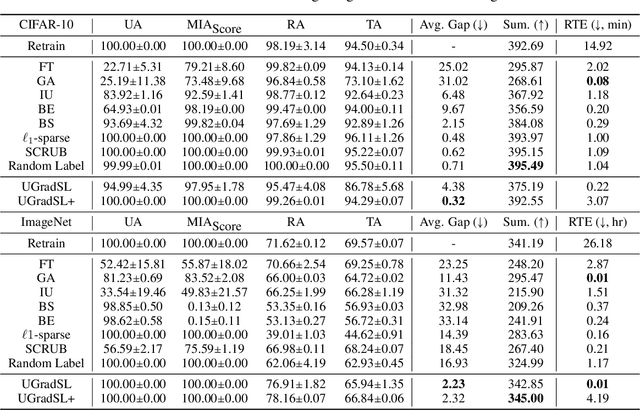
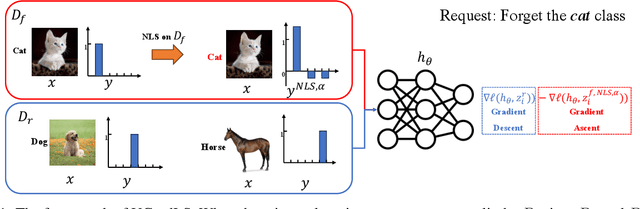
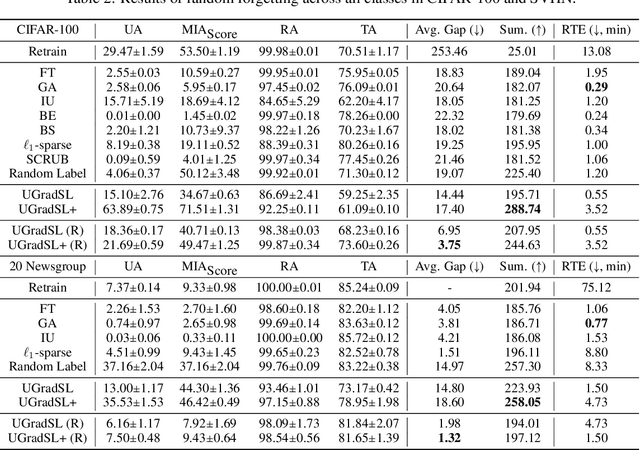
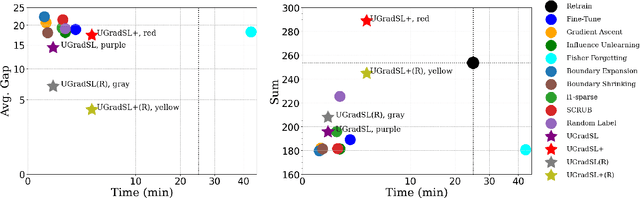
The objective of machine unlearning (MU) is to eliminate previously learned data from a model. However, it is challenging to strike a balance between computation cost and performance when using existing MU techniques. Taking inspiration from the influence of label smoothing on model confidence and differential privacy, we propose a simple gradient-based MU approach that uses an inverse process of label smoothing. This work introduces UGradSL, a simple, plug-and-play MU approach that uses smoothed labels. We provide theoretical analyses demonstrating why properly introducing label smoothing improves MU performance. We conducted extensive experiments on six datasets of various sizes and different modalities, demonstrating the effectiveness and robustness of our proposed method. The consistent improvement in MU performance is only at a marginal cost of additional computations. For instance, UGradSL improves over the gradient ascent MU baseline by 66% unlearning accuracy without sacrificing unlearning efficiency.
Large-scale Weakly Supervised Learning for Road Extraction from Satellite Imagery
Sep 14, 2023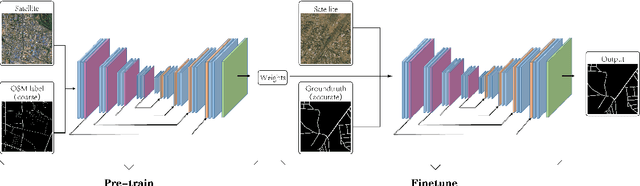
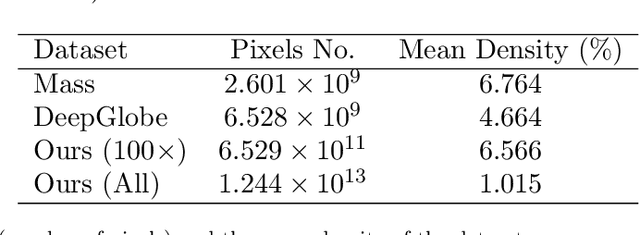
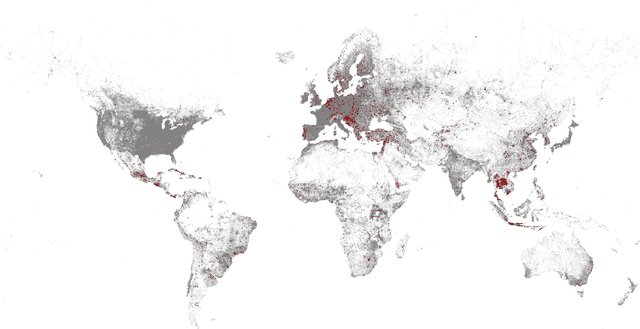
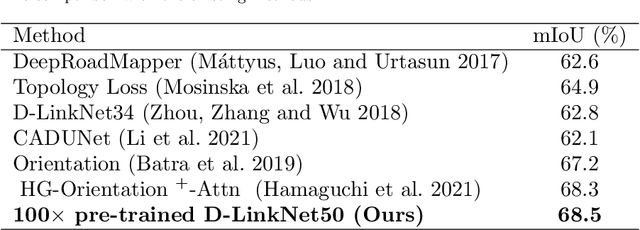
Automatic road extraction from satellite imagery using deep learning is a viable alternative to traditional manual mapping. Therefore it has received considerable attention recently. However, most of the existing methods are supervised and require pixel-level labeling, which is tedious and error-prone. To make matters worse, the earth has a diverse range of terrain, vegetation, and man-made objects. It is well known that models trained in one area generalize poorly to other areas. Various shooting conditions such as light and angel, as well as different image processing techniques further complicate the issue. It is impractical to develop training data to cover all image styles. This paper proposes to leverage OpenStreetMap road data as weak labels and large scale satellite imagery to pre-train semantic segmentation models. Our extensive experimental results show that the prediction accuracy increases with the amount of the weakly labeled data, as well as the road density in the areas chosen for training. Using as much as 100 times more data than the widely used DeepGlobe road dataset, our model with the D-LinkNet architecture and the ResNet-50 backbone exceeds the top performer of the current DeepGlobe leaderboard. Furthermore, due to large-scale pre-training, our model generalizes much better than those trained with only the curated datasets, implying great application potential.
T2IAT: Measuring Valence and Stereotypical Biases in Text-to-Image Generation
Jun 01, 2023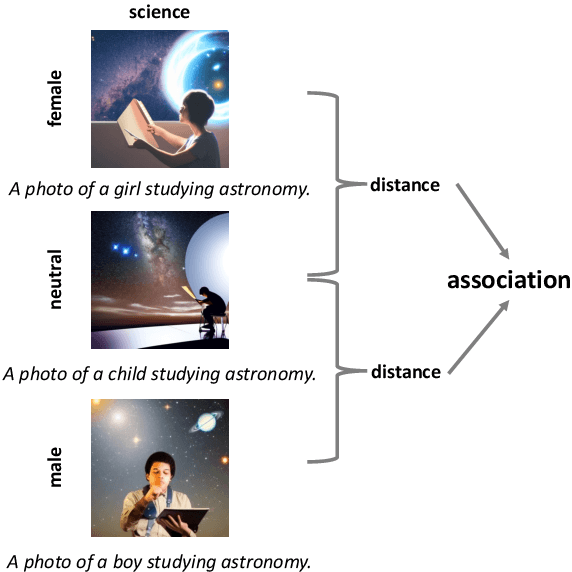
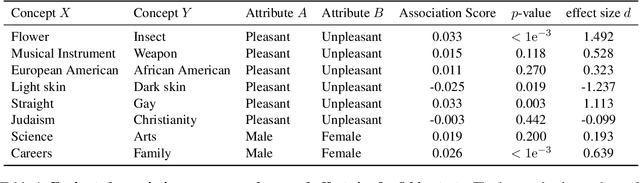
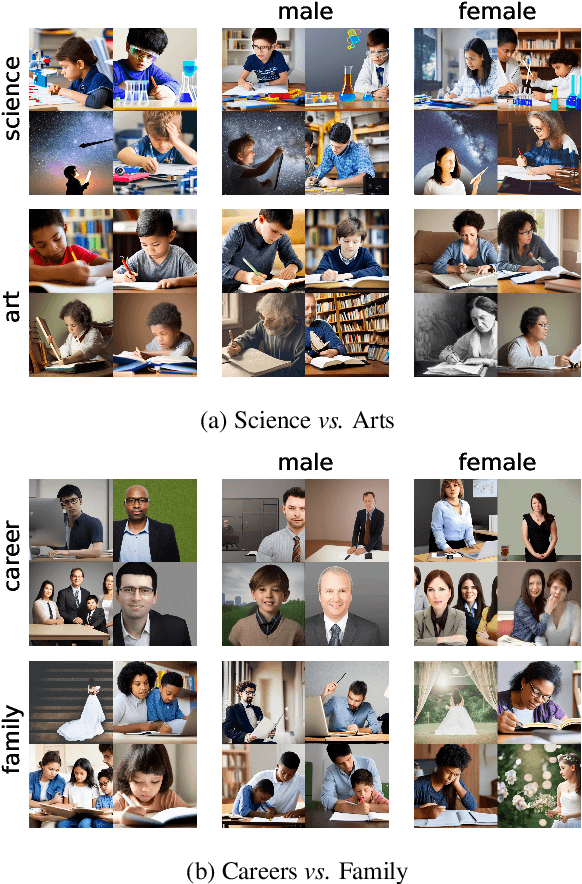
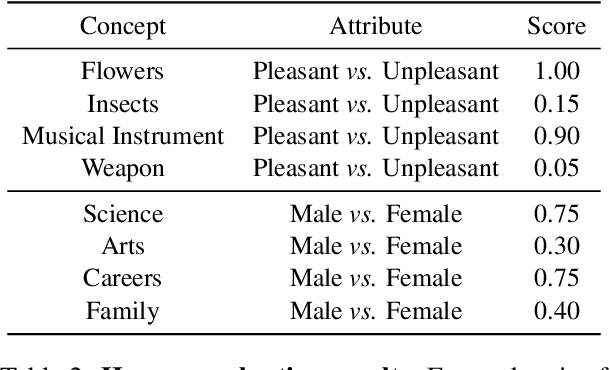
Warning: This paper contains several contents that may be toxic, harmful, or offensive. In the last few years, text-to-image generative models have gained remarkable success in generating images with unprecedented quality accompanied by a breakthrough of inference speed. Despite their rapid progress, human biases that manifest in the training examples, particularly with regard to common stereotypical biases, like gender and skin tone, still have been found in these generative models. In this work, we seek to measure more complex human biases exist in the task of text-to-image generations. Inspired by the well-known Implicit Association Test (IAT) from social psychology, we propose a novel Text-to-Image Association Test (T2IAT) framework that quantifies the implicit stereotypes between concepts and valence, and those in the images. We replicate the previously documented bias tests on generative models, including morally neutral tests on flowers and insects as well as demographic stereotypical tests on diverse social attributes. The results of these experiments demonstrate the presence of complex stereotypical behaviors in image generations.