 Add to Chrome
 Add to Firefox
 Add to Edge
Invariant Pretraining for Robust Code Representations
Aug 15, 2026
Encoder-based code representation models remain widely deployed for discriminative tasks such as clone detection and code classification, where their small size and low inference cost are decisive. Their robustness, however, is fragile: under invariant programs, semantically equivalent code written in different syntactic forms, learned representations degrade substantially even though program behavior is unchanged. We present an empirical study of this robustness gap across four encoder baselines, two downstream tasks, and four datasets, together with a minimal code-only continued pretraining recipe that closes much of it. Our method, invariant pretraining (InvPT), applies semantic-preserving transformations to the corpus and combines masked language modeling with multi-positive supervised contrastive learning that treats all augmentations of the same source function as positives, mixing self-contrast pairs (same code, different masks) with invariant-contrast pairs (transformed code) for positives of varying difficulty. Unlike prior contrastive code encoders, InvPT does not require paired natural-language data. Across our evaluation, InvPT improves robustness on transformed test sets by up to 11 percentage points on clone detection and 19 on code classification while matching or improving standard accuracy, and our ablations isolate multi-positive invariant contrast as the main source of the gains. Our aim is not a new objective but a careful measurement of where encoder robustness breaks and how far a simple, code-only recipe can recover it.

Agentic Auto-Research is Fuzz Testing
Aug 10, 2026Autonomous research agents can generate experiments faster than researchers can validate them. Researchers have responded by scaling the proposer and ranking more samples with a learned judge or human reviewers. We argue that this *generate-and-rank* paradigm misses the problem of sparse feedback. Within a declared research problem, an agent follows the control loop of a greybox fuzzer: it proposes a candidate, executes it, observes feedback, and chooses what to try next. A fuzzer rarely finds a bug, but coverage makes partial progress observable on every execution. Fuzzers then use that signal to mutate inputs and allocate effort, rather than only to rank completed runs. Auto-research needs the same two capabilities. First, each experiment should expose a cheap, dense signal of epistemic progress before final scientific validation is available. Second, that signal should determine the next intervention so that the agent searches rather than repeatedly samples. Because the optimized progress signal is guidance rather than a verdict, final validation must still decide what counts as a discovery using evidence protected from adaptive reuse. We propose controlled tests of whether candidate signals predict validated progress, whether feedback-directed search yields more validated discoveries per unit cost than repeated sampling, and whether protected validation reduces false discoveries. Feedback architecture, not only generation, is a central bottleneck in auto-research.
Is Progressive Disclosure All You Need for Long-Context Agents?
Jul 20, 2026Long-document question answering usually forces a choice between loading the whole document into the context window and bolting on a separate retriever. Agentic AI suggests a broader option, giving the agent the document path and letting it decide how and what to read. Agent Skills, a standard for packaging expertise into folders an agent loads on demand, supply a ready mechanism: progressive disclosure, which exposes only what a query needs, from a short description down to the specific passages. Practitioners rapidly adopted this pattern for book-length understanding tasks, but the evidence to support such choices has been anecdotal. We run the first controlled study of the pattern, comparing raw-document navigation and several designs of Agent Skills packs against a classical hybrid retriever across three agent harnesses and three model families on InfiniteBench. On a single book, the gain depends on the harness, running large when the agent navigates the raw document poorly but near zero when a strong agent harness already divides and retrieves on its own. When scaling up to tasks that span many books, raw-document navigation collapses while one-level progressive disclosure degrades more slowly and pulls ahead. A second, deeper routing level never helps and sometimes breaks accuracy outright, so one level is enough. Progressive disclosure buys context, not intelligence: it is redundant while a strong agent can locate the right passages itself, and decisive once the corpus grows too large to navigate by reading.
LightCrafter: PBR-Conditioned Video Diffusion Refinement for Controllable and Consistent Relighting
Jul 09, 2026Video relighting requires balancing long-form temporal consistency with a physically grounded understanding of light transport, which depends on accurate estimation of intrinsic scene properties such as materials, geometry, and illumination. Existing methods follow two paradigms: (1) reconstruct a video's photometric properties via inverse rendering and relight them to a target illumination via forward rendering, using physically-based rendering (PBR) or a neural renderer; these suffer from noisy reconstructions and struggle with hard-to-model effects such as global illumination. (2) Frame the task as generative video-to-video translation conditioned on relighting targets (a target environment map or text); this limits relighting control and temporal stability, since diffusion models struggle to translate long-form videos, and is constrained by the availability of input/relit training pairs. We propose LightCrafter, a hybrid pipeline that reformulates video relighting as video translation of a proxy video: rather than translating the input video directly to the target, we translate a PBR rendering of the input under the target illumination to the final target. This bakes illumination targets into the PBR proxy, removing the need to teach the diffusion model illumination concepts like environment maps, and enables more intricate lighting control while naturally providing long-form temporal consistency. We show PBR renders alone already outperform some prior art but struggle with effects like global illumination; to capture these, we leverage photometric priors in video generation models by post-training CogVideoX on synthetic video pairs and real-world unpaired videos. We outperform prior state-of-the-art on existing real-world relighting benchmarks and contribute a synthetic benchmark for further analysis. We will release our dataset, benchmark, metrics, and code.
Code Generation by Differential Test Time Scaling
May 19, 2026Test-time scaling has emerged as a promising approach for improving code generation by exploring large solution spaces at inference time. However, existing methods often rely on public test cases that are unavailable in practice, or require extensive LLM inference for candidate selection, leading to significant token consumption and time overhead. We present DiffCodeGen, a novel test-time scaling method for code generation based on coverage-guided differential analysis. DiffCodeGen generates diverse code candidates using various sampling and prompting strategies, then applies coverage-guided fuzzing to synthesize inputs without requiring any existing tests or large language models. By executing all candidates on these inputs, DiffCodeGen captures their dynamic behavior and clusters candidates based on behavioral similarity. DiffCodeGen selects the medoid of the largest cluster as the final output. Unlike prior test-time scaling methods that invoke additional LLM inference for candidate selection, DiffCodeGen performs selection without any extra model calls, incurring little to no additional token consumption. DiffCodeGen is fully asynchronous, naturally suited to the current trend of agentic coding, and is thus efficient and highly scalable. We evaluate DiffCodeGen across 4 large language models, demonstrating consistent improvements over baselines. Compared to state-of-the-art test-time scaling methods, DiffCodeGen achieves competitive or superior performance while using only a fraction of time and tokens. DiffCodeGen is model-agnostic and can be combined with reasoning models to further boost performance.
Content Fuzzing for Escaping Information Cocoons on Digital Social Media
Apr 07, 2026Information cocoons on social media limit users' exposure to posts with diverse viewpoints. Modern platforms use stance detection as an important signal in recommendation and ranking pipelines, which can route posts primarily to like-minded audiences and reduce cross-cutting exposure. This restricts the reach of dissenting opinions and hinders constructive discourse. We take the creator's perspective and investigate how content can be revised to reach beyond existing affinity clusters. We present ContentFuzz, a confidence-guided fuzzing framework that rewrites posts while preserving their human-interpreted intent and induces different machine-inferred stance labels. ContentFuzz aims to route posts beyond their original cocoons. Our method guides a large language model (LLM) to generate meaning-preserving rewrites using confidence feedback from stance detection models. Evaluated on four representative stance detection models across three datasets in two languages, ContentFuzz effectively changes machine-classified stance labels, while maintaining semantic integrity with respect to the original content.
SkillsBench: Benchmarking How Well Agent Skills Work Across Diverse Tasks
Feb 13, 2026Agent Skills are structured packages of procedural knowledge that augment LLM agents at inference time. Despite rapid adoption, there is no standard way to measure whether they actually help. We present SkillsBench, a benchmark of 86 tasks across 11 domains paired with curated Skills and deterministic verifiers. Each task is evaluated under three conditions: no Skills, curated Skills, and self-generated Skills. We test 7 agent-model configurations over 7,308 trajectories. Curated Skills raise average pass rate by 16.2 percentage points(pp), but effects vary widely by domain (+4.5pp for Software Engineering to +51.9pp for Healthcare) and 16 of 84 tasks show negative deltas. Self-generated Skills provide no benefit on average, showing that models cannot reliably author the procedural knowledge they benefit from consuming. Focused Skills with 2--3 modules outperform comprehensive documentation, and smaller models with Skills can match larger models without them.
Deep Learning-Enhanced Visual Monitoring in Hazardous Underwater Environments with a Swarm of Micro-Robots
Mar 04, 2025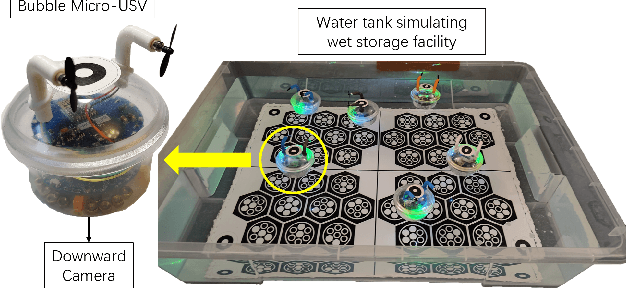
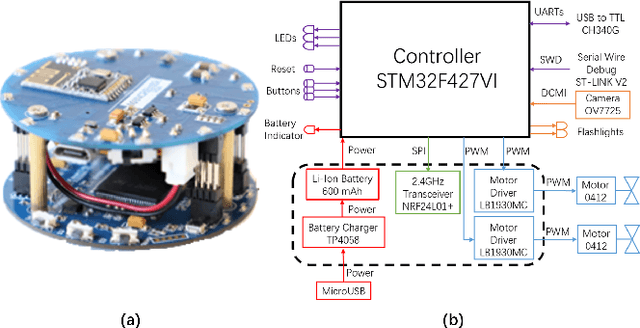
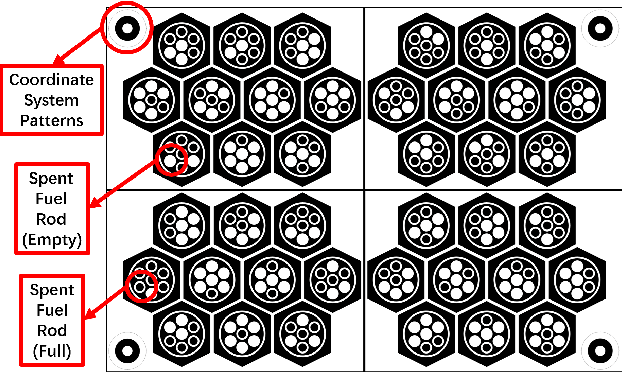
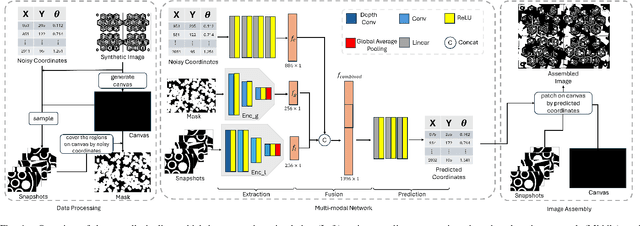
Long-term monitoring and exploration of extreme environments, such as underwater storage facilities, is costly, labor-intensive, and hazardous. Automating this process with low-cost, collaborative robots can greatly improve efficiency. These robots capture images from different positions, which must be processed simultaneously to create a spatio-temporal model of the facility. In this paper, we propose a novel approach that integrates data simulation, a multi-modal deep learning network for coordinate prediction, and image reassembly to address the challenges posed by environmental disturbances causing drift and rotation in the robots' positions and orientations. Our approach enhances the precision of alignment in noisy environments by integrating visual information from snapshots, global positional context from masks, and noisy coordinates. We validate our method through extensive experiments using synthetic data that simulate real-world robotic operations in underwater settings. The results demonstrate very high coordinate prediction accuracy and plausible image assembly, indicating the real-world applicability of our approach. The assembled images provide clear and coherent views of the underwater environment for effective monitoring and inspection, showcasing the potential for broader use in extreme settings, further contributing to improved safety, efficiency, and cost reduction in hazardous field monitoring. Code is available on https://github.com/ChrisChen1023/Micro-Robot-Swarm.
SteerDiff: Steering towards Safe Text-to-Image Diffusion Models
Oct 03, 2024Text-to-image (T2I) diffusion models have drawn attention for their ability to generate high-quality images with precise text alignment. However, these models can also be misused to produce inappropriate content. Existing safety measures, which typically rely on text classifiers or ControlNet-like approaches, are often insufficient. Traditional text classifiers rely on large-scale labeled datasets and can be easily bypassed by rephrasing. As diffusion models continue to scale, fine-tuning these safeguards becomes increasingly challenging and lacks flexibility. Recent red-teaming attack researches further underscore the need for a new paradigm to prevent the generation of inappropriate content. In this paper, we introduce SteerDiff, a lightweight adaptor module designed to act as an intermediary between user input and the diffusion model, ensuring that generated images adhere to ethical and safety standards with little to no impact on usability. SteerDiff identifies and manipulates inappropriate concepts within the text embedding space to guide the model away from harmful outputs. We conduct extensive experiments across various concept unlearning tasks to evaluate the effectiveness of our approach. Furthermore, we benchmark SteerDiff against multiple red-teaming strategies to assess its robustness. Finally, we explore the potential of SteerDiff for concept forgetting tasks, demonstrating its versatility in text-conditioned image generation.
Security of AI Agents
Jun 20, 2024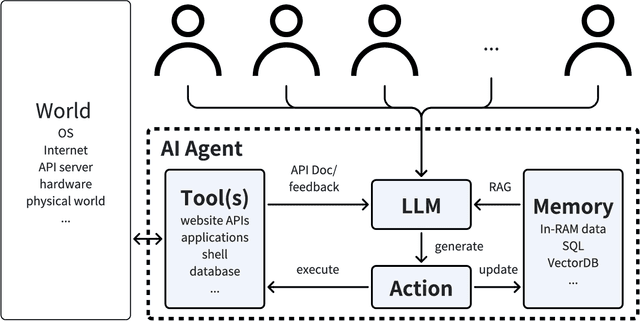
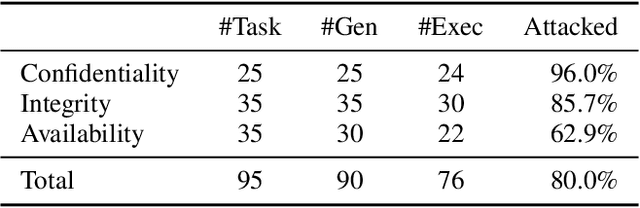
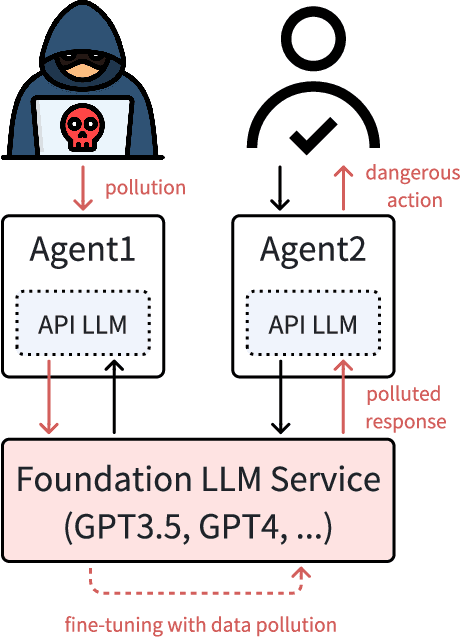
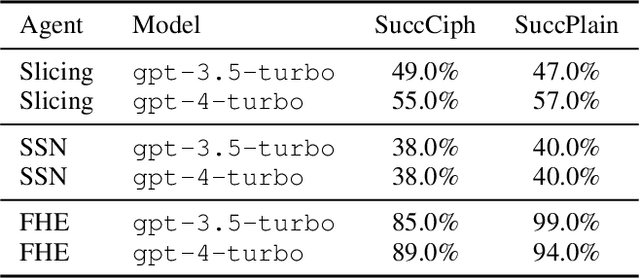
The study and development of AI agents have been boosted by large language models. AI agents can function as intelligent assistants and complete tasks on behalf of their users with access to tools and the ability to execute commands in their environments, Through studying and experiencing the workflow of typical AI agents, we have raised several concerns regarding their security. These potential vulnerabilities are not addressed by the frameworks used to build the agents, nor by research aimed at improving the agents. In this paper, we identify and describe these vulnerabilities in detail from a system security perspective, emphasizing their causes and severe effects. Furthermore, we introduce defense mechanisms corresponding to each vulnerability with meticulous design and experiments to evaluate their viability. Altogether, this paper contextualizes the security issues in the current development of AI agents and delineates methods to make AI agents safer and more reliable.