 Add to Chrome
 Add to Firefox
 Add to Edge
HiComm: Hierarchical Communication for Multi-agent Reinforcement Learning
Jul 01, 2026
Cooperative multi-agent reinforcement learning (MARL) often relies on communication to mitigate partial observability, yet most existing protocols treat messages as flat dense vectors detached from the structure of the observations they summarize. This design overlooks an important source of inductive bias in many cooperative environments, where observations naturally follow a hierarchy such as groups and entities. We propose \textsc{HiComm}, a plug-in communication module that grounds messages in the sender's hierarchical observation. \textsc{HiComm} is receiver-driven: the receiver issues a query, and the hierarchy is resolved through a three-stage decoding process that first selects a group, then a sender, and then an entity within that group, returning the corresponding feature slice as the message. This converts communication from unstructured vector transmission into structured information retrieval over the sender's observation hierarchy. We instantiate this mechanism with Straight-Through Gumbel-Softmax for differentiable discrete selection and a lightweight shared projection design that attaches to standard MARL pipelines. Experiments across cooperative MARL tasks with different observation structures and coordination demands show that \textsc{HiComm} matches or outperforms representative learned communication baselines while reducing communication volume by up to $23\times$ per receiver per episode.

PreUnlearn: Auditing Collateral Knowledge Damage Before Large Language Model Unlearning
Jun 16, 2026Machine unlearning for large language models (LLMs) aims to remove specified knowledge while preserving the rest of the model's capabilities. However, the boundary between knowledge to forget and knowledge to retain is often unclear, since related and even distant information may be entangled in the model. In this paper, we study LLM unlearning from a data-centric perspective and measure how unlearning effects propagate from the forget set to same-domain and distant-domain knowledge. We find a consistent decay pattern: collateral damage is strongest near the forget set, weakens with semantic distance, but does not disappear at domain boundaries. We further ask whether such damage can be audited before unlearning is executed. We formulate forget-set auditing as a pre-unlearning prediction task and analyze which data features are most predictive of downstream damage. Our results show that interaction features between the forget set and evaluation set provide the strongest signals, suggesting that collateral damage is partly reflected in data geometry before model updates occur. These findings position forget-set auditing as an early warning tool for identifying risky unlearning runs and designing more reliable unlearning procedures.
Inference Time Optimization with Confidence Dynamics
May 24, 2026Inference time optimization techniques, such as repeated sampling, have significantly advanced the reasoning capabilities of Large Language Models (LLMs). However, the critical role of model uncertainty remains largely underexplored in these optimization strategies. In this paper, we investigate the dynamics of confidence along reasoning trajectories and for first time reveal a surprising and unique pattern: correct answer traces tend to exhibit confidence improvement over time (positive confidence gain), while incorrect traces show attenuated or declining confidence as reasoning proceeds. Based on this observation, we propose Confidence Dynamic Gain (CDG) based voting, which incorporates how the confidence trajectory of the response evolves along the reasoning chain. Experiments across four open-source architectures (DeepSeek-R1, gpt-oss, Gemma-3, Qwen-QwQ) on the AIME24/25, HMMT25, and BRUMO25 benchmarks demonstrate that CDG yields a significant performance boost over baselines. These results demonstrate that our method provides a robust discriminative signal for improving answer selection in LLM reasoning. We also provide theoretical insights for this phenomenon. Code will be released at https://github.com/Accenture/CDG.git.
Show, Don't Tell: Detecting Novel Objects by Watching Human Videos
Mar 13, 2026How can a robot quickly identify and recognize new objects shown to it during a human demonstration? Existing closed-set object detectors frequently fail at this because the objects are out-of-distribution. While open-set detectors (e.g., VLMs) sometimes succeed, they often require expensive and tedious human-in-the-loop prompt engineering to uniquely recognize novel object instances. In this paper, we present a self-supervised system that eliminates the need for tedious language descriptions and expensive prompt engineering by training a bespoke object detector on an automatically created dataset, supervised by the human demonstration itself. In our approach, "Show, Don't Tell," we show the detector the specific objects of interest during the demonstration, rather than telling the detector about these objects via complex language descriptions. By bypassing language altogether, this paradigm enables us to quickly train bespoke detectors tailored to the relevant objects observed in human task demonstrations. We develop an integrated on-robot system to deploy our "Show, Don't Tell" paradigm of automatic dataset creation and novel object-detection on a real-world robot. Empirical results demonstrate that our pipeline significantly outperforms state-of-the-art detection and recognition methods for manipulated objects, leading to improved task completion for the robot.
Deciphering GunType Hierarchy through Acoustic Analysis of Gunshot Recordings
Jun 25, 2025The escalating rates of gun-related violence and mass shootings represent a significant threat to public safety. Timely and accurate information for law enforcement agencies is crucial in mitigating these incidents. Current commercial gunshot detection systems, while effective, often come with prohibitive costs. This research explores a cost-effective alternative by leveraging acoustic analysis of gunshot recordings, potentially obtainable from ubiquitous devices like cell phones, to not only detect gunshots but also classify the type of firearm used. This paper details a study on deciphering gun type hierarchies using a curated dataset of 3459 recordings. We investigate the fundamental acoustic characteristics of gunshots, including muzzle blasts and shockwaves, which vary based on firearm type, ammunition, and shooting direction. We propose and evaluate machine learning frameworks, including Support Vector Machines (SVMs) as a baseline and a more advanced Convolutional Neural Network (CNN) architecture for joint gunshot detection and gun type classification. Results indicate that our deep learning approach achieves a mean average precision (mAP) of 0.58 on clean labeled data, outperforming the SVM baseline (mAP 0.39). Challenges related to data quality, environmental noise, and the generalization capabilities when using noisy web-sourced data (mAP 0.35) are also discussed. The long-term vision is to develop a highly accurate, real-time system deployable on common recording devices, significantly reducing detection costs and providing critical intelligence to first responders.
Did You Hear That? Introducing AADG: A Framework for Generating Benchmark Data in Audio Anomaly Detection
Oct 04, 2024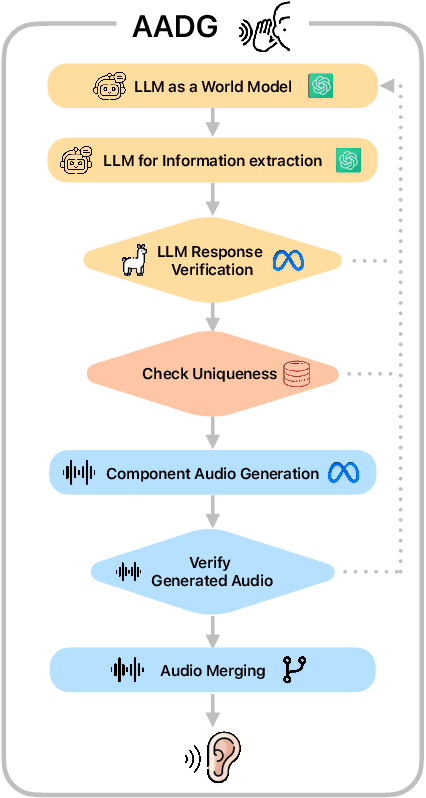
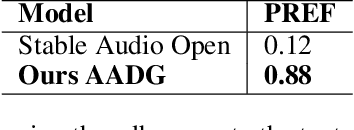
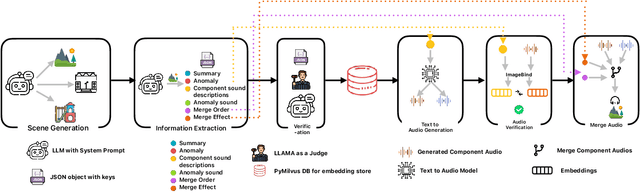
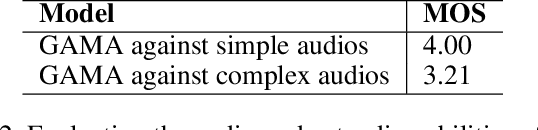
We introduce a novel, general-purpose audio generation framework specifically designed for anomaly detection and localization. Unlike existing datasets that predominantly focus on industrial and machine-related sounds, our framework focuses a broader range of environments, particularly useful in real-world scenarios where only audio data are available, such as in video-derived or telephonic audio. To generate such data, we propose a new method inspired by the LLM-Modulo framework, which leverages large language models(LLMs) as world models to simulate such real-world scenarios. This tool is modular allowing a plug-and-play approach. It operates by first using LLMs to predict plausible real-world scenarios. An LLM further extracts the constituent sounds, the order and the way in which these should be merged to create coherent wholes. Much like the LLM-Modulo framework, we include rigorous verification of each output stage, ensuring the reliability of the generated data. The data produced using the framework serves as a benchmark for anomaly detection applications, potentially enhancing the performance of models trained on audio data, particularly in handling out-of-distribution cases. Our contributions thus fill a critical void in audio anomaly detection resources and provide a scalable tool for generating diverse, realistic audio data.
Automatic Dataset Construction (ADC): Sample Collection, Data Curation, and Beyond
Aug 21, 2024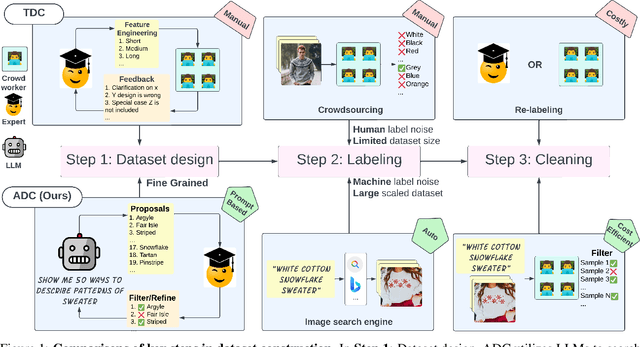
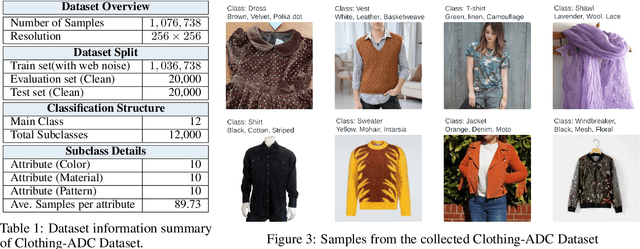
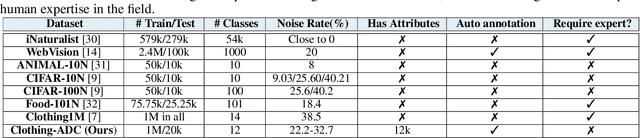
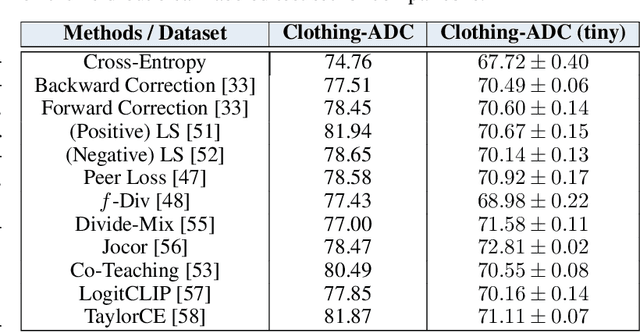
Large-scale data collection is essential for developing personalized training data, mitigating the shortage of training data, and fine-tuning specialized models. However, creating high-quality datasets quickly and accurately remains a challenge due to annotation errors, the substantial time and costs associated with human labor. To address these issues, we propose Automatic Dataset Construction (ADC), an innovative methodology that automates dataset creation with negligible cost and high efficiency. Taking the image classification task as a starting point, ADC leverages LLMs for the detailed class design and code generation to collect relevant samples via search engines, significantly reducing the need for manual annotation and speeding up the data generation process. Despite these advantages, ADC also encounters real-world challenges such as label errors (label noise) and imbalanced data distributions (label bias). We provide open-source software that incorporates existing methods for label error detection, robust learning under noisy and biased data, ensuring a higher-quality training data and more robust model training procedure. Furthermore, we design three benchmark datasets focused on label noise detection, label noise learning, and class-imbalanced learning. These datasets are vital because there are few existing datasets specifically for label noise detection, despite its importance. Finally, we evaluate the performance of existing popular methods on these datasets, thereby facilitating further research in the field.
A Multi-Agent Reinforcement Learning Framework for Evaluating the U.S. Ending the HIV Epidemic Plan
Nov 06, 2023Human immunodeficiency virus (HIV) is a major public health concern in the United States, with about 1.2 million people living with HIV and 35,000 newly infected each year. There are considerable geographical disparities in HIV burden and care access across the U.S. The 2019 Ending the HIV Epidemic (EHE) initiative aims to reduce new infections by 90% by 2030, by improving coverage of diagnoses, treatment, and prevention interventions and prioritizing jurisdictions with high HIV prevalence. Identifying optimal scale-up of intervention combinations will help inform resource allocation. Existing HIV decision analytic models either evaluate specific cities or the overall national population, thus overlooking jurisdictional interactions or differences. In this paper, we propose a multi-agent reinforcement learning (MARL) model, that enables jurisdiction-specific decision analyses but in an environment with cross-jurisdictional epidemiological interactions. In experimental analyses, conducted on jurisdictions within California and Florida, optimal policies from MARL were significantly different than those generated from single-agent RL, highlighting the influence of jurisdictional variations and interactions. By using comprehensive modeling of HIV and formulations of state space, action space, and reward functions, this work helps demonstrate the strengths and applicability of MARL for informing public health policies, and provides a framework for expanding to the national-level to inform the EHE.
Psychoacoustic Challenges Of Speech Enhancement On VoIP Platforms
Oct 11, 2023


Within the ambit of VoIP (Voice over Internet Protocol) telecommunications, the complexities introduced by acoustic transformations merit rigorous analysis. This research, rooted in the exploration of proprietary sender-side denoising effects, meticulously evaluates platforms such as Google Meets and Zoom. The study draws upon the Deep Noise Suppression (DNS) 2020 dataset, ensuring a structured examination tailored to various denoising settings and receiver interfaces. A methodological novelty is introduced via the Oaxaca decomposition, traditionally an econometric tool, repurposed herein to analyze acoustic-phonetic perturbations within VoIP systems. To further ground the implications of these transformations, psychoacoustic metrics, specifically PESQ and STOI, were harnessed to furnish a comprehensive understanding of speech alterations. Cumulatively, the insights garnered underscore the intricate landscape of VoIP-influenced acoustic dynamics. In addition to the primary findings, a multitude of metrics are reported, extending the research purview. Moreover, out-of-domain benchmarking for both time and time-frequency domain speech enhancement models is included, thereby enhancing the depth and applicability of this inquiry.
LoFT: Local Proxy Fine-tuning For Improving Transferability Of Adversarial Attacks Against Large Language Model
Oct 02, 2023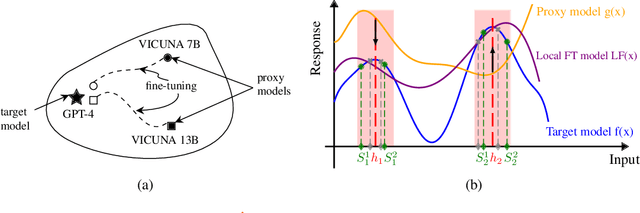

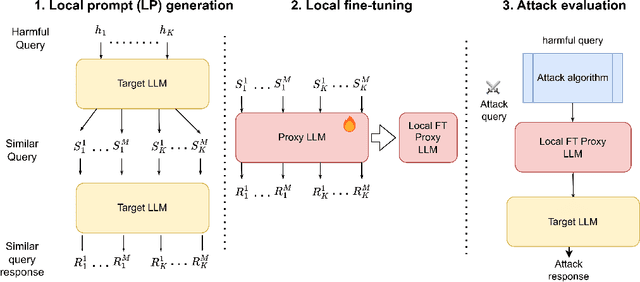

It has been shown that Large Language Model (LLM) alignments can be circumvented by appending specially crafted attack suffixes with harmful queries to elicit harmful responses. To conduct attacks against private target models whose characterization is unknown, public models can be used as proxies to fashion the attack, with successful attacks being transferred from public proxies to private target models. The success rate of attack depends on how closely the proxy model approximates the private model. We hypothesize that for attacks to be transferrable, it is sufficient if the proxy can approximate the target model in the neighborhood of the harmful query. Therefore, in this paper, we propose \emph{Local Fine-Tuning (LoFT)}, \textit{i.e.}, fine-tuning proxy models on similar queries that lie in the lexico-semantic neighborhood of harmful queries to decrease the divergence between the proxy and target models. First, we demonstrate three approaches to prompt private target models to obtain similar queries given harmful queries. Next, we obtain data for local fine-tuning by eliciting responses from target models for the generated similar queries. Then, we optimize attack suffixes to generate attack prompts and evaluate the impact of our local fine-tuning on the attack's success rate. Experiments show that local fine-tuning of proxy models improves attack transferability and increases attack success rate by $39\%$, $7\%$, and $0.5\%$ (absolute) on target models ChatGPT, GPT-4, and Claude respectively.