 Add to Chrome
 Add to Firefox
 Add to Edge
ACME: A Multi-Cultural, Multi-Embodiment Social-Navigation Dataset
Jul 24, 2026
Understanding how robots and humans move in shared spaces is essential for designing effective social robot navigation policies and predicting human behavior. However, existing datasets often lack the diversity needed to capture differences in culture, geography, and human-robot interaction-factors that strongly shape appropriate social behavior. To address this gap, we introduce ACME: A Cross-cultural, Multi-Embodiment dataset for social navigation. A large-scale data collection effort across 8 sites in 5 countries, using 7 robot embodiments, ACME is a large and diverse multi-modal dataset aimed at advancing social navigation research, providing 29.35 hours of onboard robot data and 43.5 hours of overhead pedestrian tracking data. Unlike prior datasets, it focuses on capturing goal-driven social navigation behavior in complex social scenarios with explicit robot-crowd interaction through robot speech. To facilitate learning navigation policies and predicting pedestrian trajectories, ACME provides 3D and 2D scene features, odometry, interaction information, and human-annotated pedestrian trajectory labels. We make ACME easy to use by providing both human-readable data for each sensor modality as well as raw binary data. Our qualitative and quantitative analyses show that our dataset captures more challenging scenarios and a broader distribution of pedestrian behavior than previous datasets.

HumAIN: Human-Aware Implicit Social Robot Navigation
Jul 08, 2026Effective social robot navigation requires sensitivity to human behavior, often revealed through subtle skeletal cues like gait and orientation. We present Human-Aware Implicit Social Robot Navigation (HumAIN), a novel framework that fuses implicit social cues directly into the planning loop via knowledge distillation. We first employ a transformer-based teacher model that fuses rich multi-modal inputs, including historic images, skeletal keypoints, robot state, and a robot's target goal, to learn robust, human-aware representations for the robot's future trajectory planning. To enable real-time deployment, we then distill this knowledge into a lightweight student model. By optimizing for both trajectory reconstruction and latent feature alignment with the teacher, the student learns to infer complex social dynamics from minimal inputs. Bridging the prediction-planning gap with an efficient distilled architecture, our method enables robots to reason about human behavior in a manner that is adaptive, robust, and socially compliant. We validate HumAIN through extensive experiments, where it improves trajectory prediction metrics by an average of 29.8% across all metrics compared to state-of-the-art baselines. These results highlight the benefit of using implicit, whole-body cues to achieve human-like navigation awareness on resource-constrained platforms.
E-SocialNav: Efficient Socially Compliant Navigation with Language Models
Mar 21, 2026Language models (LMs) are increasingly applied to robotic navigation; however, existing benchmarks primarily emphasize navigation success rates while paying limited attention to social compliance. Moreover, relying on large-scale LMs can raise efficiency concerns, as their heavy computational overhead leads to slower response times and higher energy consumption, making them impractical for real-time deployment on resource-constrained robotic platforms. In this work, we evaluate the social compliance of GPT-4o and Claude in robotic navigation and propose E-SocialNav, an efficient LM designed for socially compliant navigation. Despite being trained on a relatively small dataset, E-SocialNav consistently outperforms zero-shot baselines in generating socially compliant behaviors. By employing a two-stage training pipeline consisting of supervised fine-tuning followed by direct preference optimization, E-SocialNav achieves strong performance in both text-level semantic similarity to human annotations and action accuracy. The source code is available at https://github.com/Dr-LingXiao/ESocialNav.
Legs Over Arms: On the Predictive Value of Lower-Body Pose for Human Trajectory Prediction from Egocentric Robot Perception
Feb 09, 2026Predicting human trajectory is crucial for social robot navigation in crowded environments. While most existing approaches treat human as point mass, we present a study on multi-agent trajectory prediction that leverages different human skeletal features for improved forecast accuracy. In particular, we systematically evaluate the predictive utility of 2D and 3D skeletal keypoints and derived biomechanical cues as additional inputs. Through a comprehensive study on the JRDB dataset and another new dataset for social navigation with 360-degree panoramic videos, we find that focusing on lower-body 3D keypoints yields a 13% reduction in Average Displacement Error and augmenting 3D keypoint inputs with corresponding biomechanical cues provides a further 1-4% improvement. Notably, the performance gain persists when using 2D keypoint inputs extracted from equirectangular panoramic images, indicating that monocular surround vision can capture informative cues for motion forecasting. Our finding that robots can forecast human movement efficiently by watching their legs provides actionable insights for designing sensing capabilities for social robot navigation.
MAction-SocialNav: Multi-Action Socially Compliant Navigation via Reasoning-enhanced Prompt Tuning
Dec 25, 2025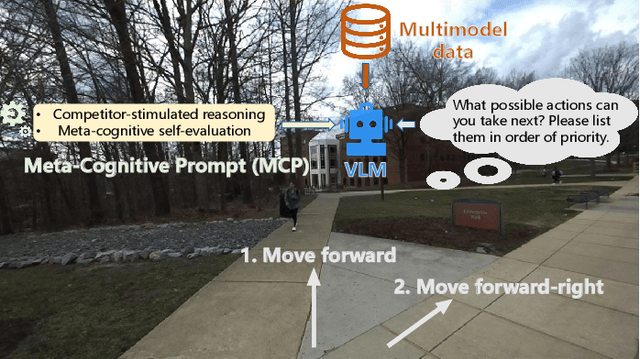
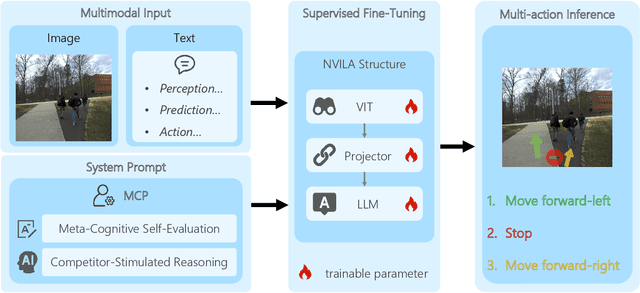
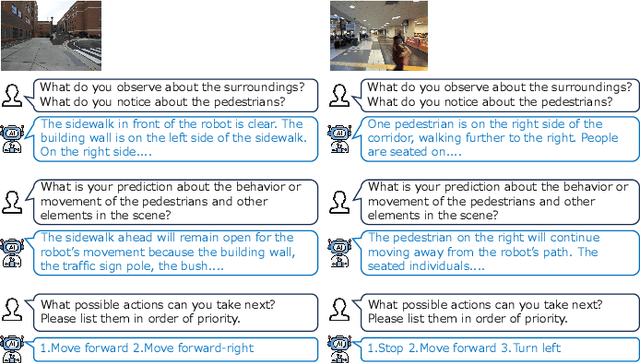
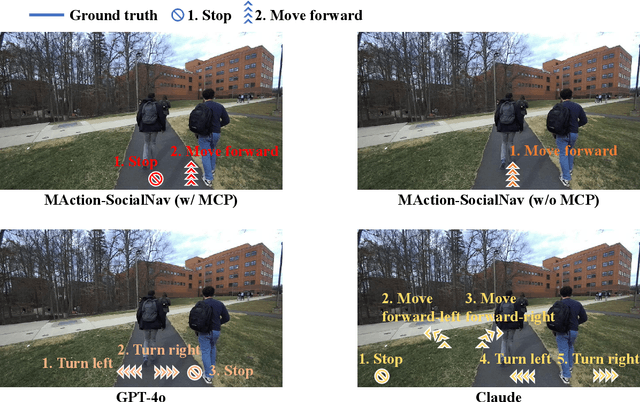
Socially compliant navigation requires robots to move safely and appropriately in human-centered environments by respecting social norms. However, social norms are often ambiguous, and in a single scenario, multiple actions may be equally acceptable. Most existing methods simplify this problem by assuming a single correct action, which limits their ability to handle real-world social uncertainty. In this work, we propose MAction-SocialNav, an efficient vision language model for socially compliant navigation that explicitly addresses action ambiguity, enabling generating multiple plausible actions within one scenario. To enhance the model's reasoning capability, we introduce a novel meta-cognitive prompt (MCP) method. Furthermore, to evaluate the proposed method, we curate a multi-action socially compliant navigation dataset that accounts for diverse conditions, including crowd density, indoor and outdoor environments, and dual human annotations. The dataset contains 789 samples, each with three-turn conversation, split into 710 training samples and 79 test samples through random selection. We also design five evaluation metrics to assess high-level decision precision, safety, and diversity. Extensive experiments demonstrate that the proposed MAction-SocialNav achieves strong social reasoning performance while maintaining high efficiency, highlighting its potential for real-world human robot navigation. Compared with zero-shot GPT-4o and Claude, our model achieves substantially higher decision quality (APG: 0.595 vs. 0.000/0.025) and safety alignment (ER: 0.264 vs. 0.642/0.668), while maintaining real-time efficiency (1.524 FPS, over 3x faster).
Verti-Arena: A Controllable and Standardized Indoor Testbed for Multi-Terrain Off-Road Autonomy
Aug 11, 2025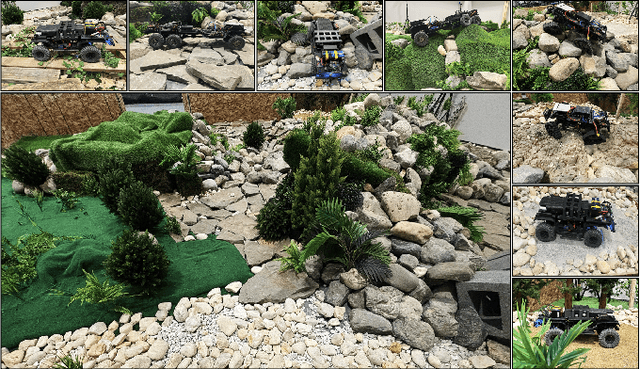
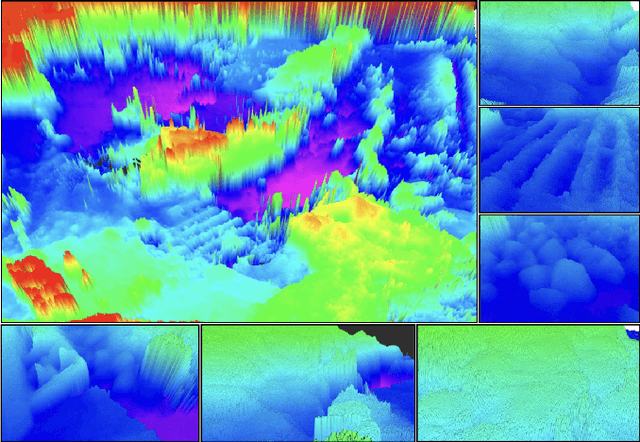
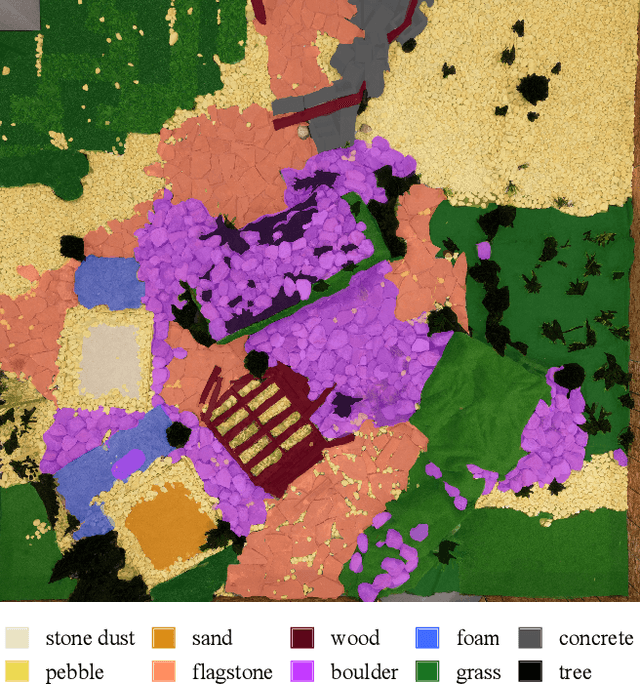
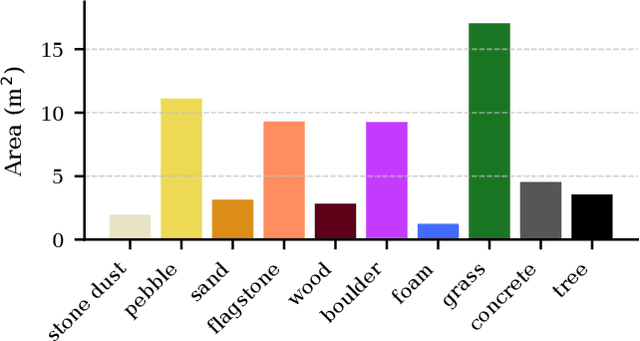
Off-road navigation is an important capability for mobile robots deployed in environments that are inaccessible or dangerous to humans, such as disaster response or planetary exploration. Progress is limited due to the lack of a controllable and standardized real-world testbed for systematic data collection and validation. To fill this gap, we introduce Verti-Arena, a reconfigurable indoor facility designed specifically for off-road autonomy. By providing a repeatable benchmark environment, Verti-Arena supports reproducible experiments across a variety of vertically challenging terrains and provides precise ground truth measurements through onboard sensors and a motion capture system. Verti-Arena also supports consistent data collection and comparative evaluation of algorithms in off-road autonomy research. We also develop a web-based interface that enables research groups worldwide to remotely conduct standardized off-road autonomy experiments on Verti-Arena.
Narrate2Nav: Real-Time Visual Navigation with Implicit Language Reasoning in Human-Centric Environments
Jun 17, 2025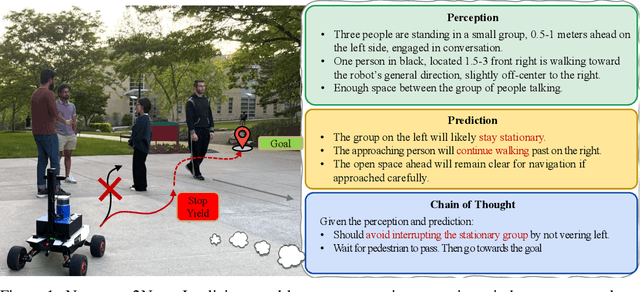
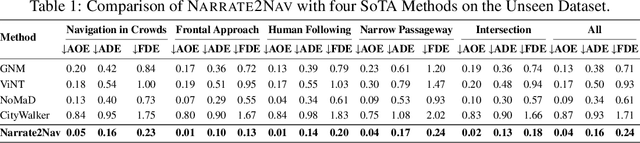
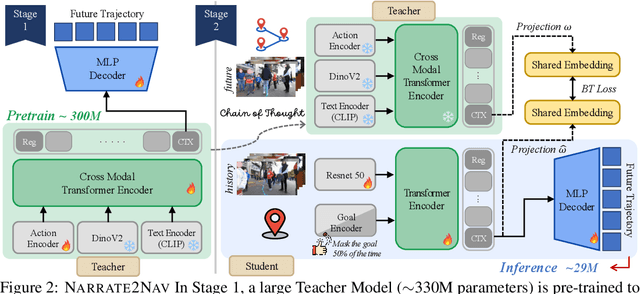

Large Vision-Language Models (VLMs) have demonstrated potential in enhancing mobile robot navigation in human-centric environments by understanding contextual cues, human intentions, and social dynamics while exhibiting reasoning capabilities. However, their computational complexity and limited sensitivity to continuous numerical data impede real-time performance and precise motion control. To this end, we propose Narrate2Nav, a novel real-time vision-action model that leverages a novel self-supervised learning framework based on the Barlow Twins redundancy reduction loss to embed implicit natural language reasoning, social cues, and human intentions within a visual encoder-enabling reasoning in the model's latent space rather than token space. The model combines RGB inputs, motion commands, and textual signals of scene context during training to bridge from robot observations to low-level motion commands for short-horizon point-goal navigation during deployment. Extensive evaluation of Narrate2Nav across various challenging scenarios in both offline unseen dataset and real-world experiments demonstrates an overall improvement of 52.94 percent and 41.67 percent, respectively, over the next best baseline. Additionally, qualitative comparative analysis of Narrate2Nav's visual encoder attention map against four other baselines demonstrates enhanced attention to navigation-critical scene elements, underscoring its effectiveness in human-centric navigation tasks.
AutoSpatial: Visual-Language Reasoning for Social Robot Navigation through Efficient Spatial Reasoning Learning
Mar 10, 2025We present a novel method, AutoSpatial, an efficient approach with structured spatial grounding to enhance VLMs' spatial reasoning. By combining minimal manual supervision with large-scale Visual Question-Answering (VQA) pairs auto-labeling, our approach tackles the challenge of VLMs' limited spatial understanding in social navigation tasks. By applying a hierarchical two-round VQA strategy during training, AutoSpatial achieves both global and detailed understanding of scenarios, demonstrating more accurate spatial perception, movement prediction, Chain of Thought (CoT) reasoning, final action, and explanation compared to other SOTA approaches. These five components are essential for comprehensive social navigation reasoning. Our approach was evaluated using both expert systems (GPT-4o, Gemini 2.0 Flash, and Claude 3.5 Sonnet) that provided cross-validation scores and human evaluators who assigned relative rankings to compare model performances across four key aspects. Augmented by the enhanced spatial reasoning capabilities, AutoSpatial demonstrates substantial improvements by averaged cross-validation score from expert systems in: perception & prediction (up to 10.71%), reasoning (up to 16.26%), action (up to 20.50%), and explanation (up to 18.73%) compared to baseline models trained only on manually annotated data.
GND: Global Navigation Dataset with Multi-Modal Perception and Multi-Category Traversability in Outdoor Campus Environments
Sep 21, 2024


Navigating large-scale outdoor environments requires complex reasoning in terms of geometric structures, environmental semantics, and terrain characteristics, which are typically captured by onboard sensors such as LiDAR and cameras. While current mobile robots can navigate such environments using pre-defined, high-precision maps based on hand-crafted rules catered for the specific environment, they lack commonsense reasoning capabilities that most humans possess when navigating unknown outdoor spaces. To address this gap, we introduce the Global Navigation Dataset (GND), a large-scale dataset that integrates multi-modal sensory data, including 3D LiDAR point clouds and RGB and 360-degree images, as well as multi-category traversability maps (pedestrian walkways, vehicle roadways, stairs, off-road terrain, and obstacles) from ten university campuses. These environments encompass a variety of parks, urban settings, elevation changes, and campus layouts of different scales. The dataset covers approximately 2.7km2 and includes at least 350 buildings in total. We also present a set of novel applications of GND to showcase its utility to enable global robot navigation, such as map-based global navigation, mapless navigation, and global place recognition.
TGS: Trajectory Generation and Selection using Vision Language Models in Mapless Outdoor Environments
Aug 07, 2024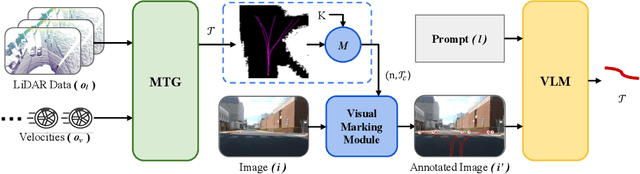
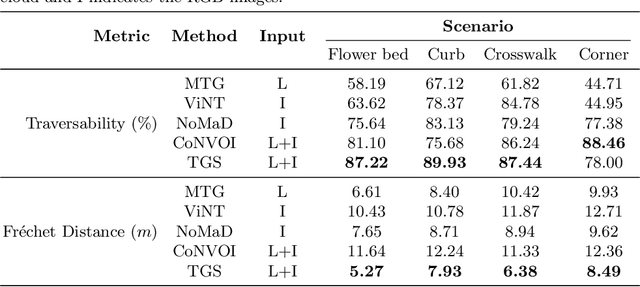
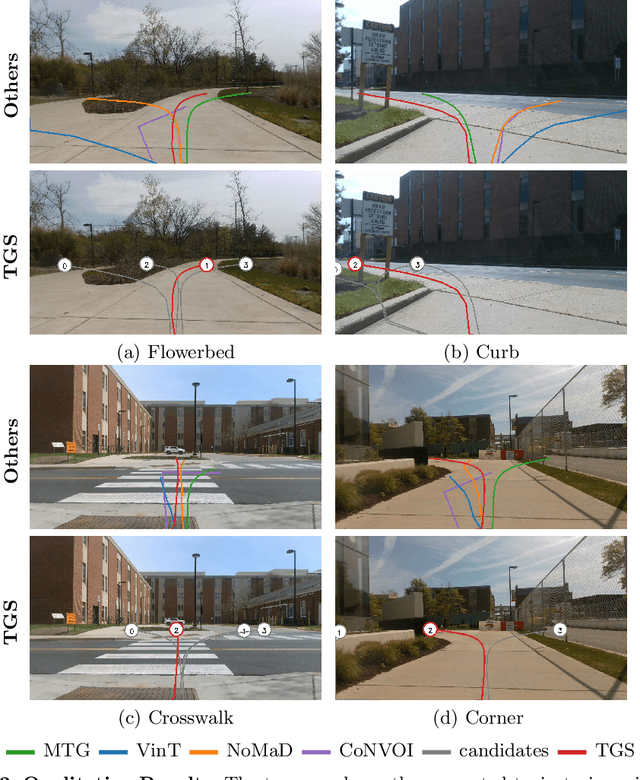
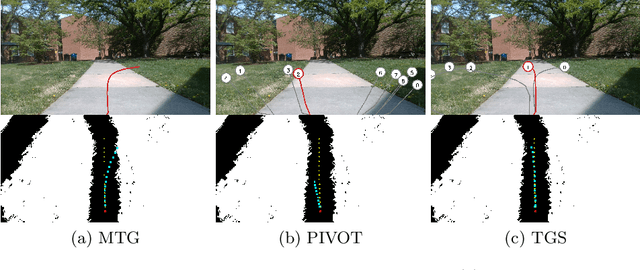
We present a multi-modal trajectory generation and selection algorithm for real-world mapless outdoor navigation in challenging scenarios with unstructured off-road features like buildings, grass, and curbs. Our goal is to compute suitable trajectories that (1) satisfy the environment-specific traversability constraints and (2) generate human-like paths while navigating in crosswalks, sidewalks, etc. Our formulation uses a Conditional Variational Autoencoder (CVAE) generative model enhanced with traversability constraints to generate multiple candidate trajectories for global navigation. We use VLMs and a visual prompting approach with their zero-shot ability of semantic understanding and logical reasoning to choose the best trajectory given the contextual information about the task. We evaluate our methods in various outdoor scenes with wheeled robots and compare the performance with other global navigation algorithms. In practice, we observe at least 3.35% improvement in traversability and 20.61% improvement in terms of human-like navigation in generated trajectories in challenging outdoor navigation scenarios.