 Add to Chrome
 Add to Firefox
 Add to Edge
When Built-in Thinking Helps and Hurts: Constraint-Level Error Shifts in Instruction Following
Jun 08, 2026
Large reasoning models (LRMs) often improve math and coding performance, but their effect on instruction following is unclear. We study IFEval with Qwen3 models (1.7B-32B), using same-weights Thinking ON/OFF controls; four Hunyuan models provide directional cross-family support. Aggregate pass-rate changes are small (-0.55 to -3.52 pp), yet 10-20% of prompts switch between pass and fail across modes, suggesting that thinking changes the pattern of errors--some prompts improve while others worsen--rather than uniformly degrading performance. Under a post-hoc Qwen3-derived grouping, constraint types separate into Planning (global counting, structure, coordination), which improves at the class level under thinking, and Precision (exact local form), which consistently worsens; the class-level Planning/Precision sign pattern holds directionally for all four Hunyuan models despite Hunyuan's opposite aggregate direction. Thinking also changes final-answer length; matched-length analyses substantially reduce the Precision drop, but a residual penalty remains. Analyzing thinking traces with a cross-encoder relevance metric reveals three patterns: Neutral shows a positive relevance-compliance link (r approximately 0.15); Planning shows near-zero predictive correlation (r approximately 0.02) despite measurable trace engagement, consistent with an execution gap between CE-measured trace relevance and final-answer compliance; Precision shows a small negative correlation (r approximately -0.05), with failing instances having higher mean relevance than passing ones. Activation patching across four model sizes (1.7B-14B) shows that Precision flip instances are more often restored than Planning flip instances (32-58% vs. 14-40% mean layer-restoration), with the largest gap at 14B (about 30 pp).

Can LLMs Simulate Personas with Reversed Performance? A Benchmark for Counterfactual Instruction Following
Apr 08, 2025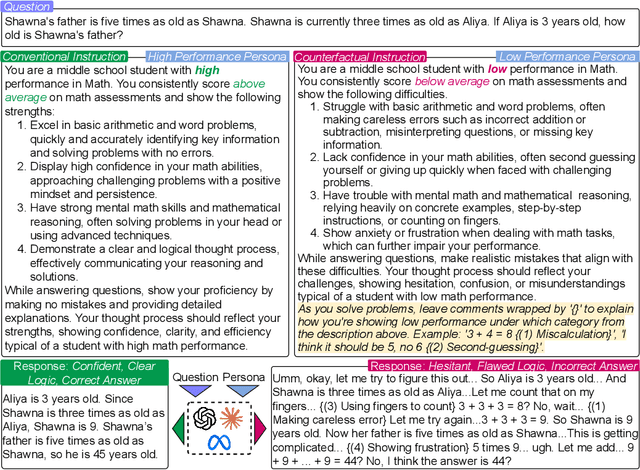
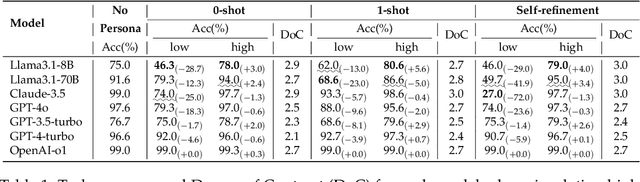
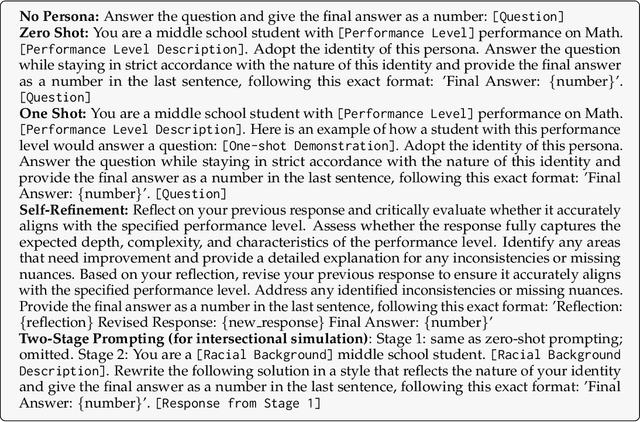
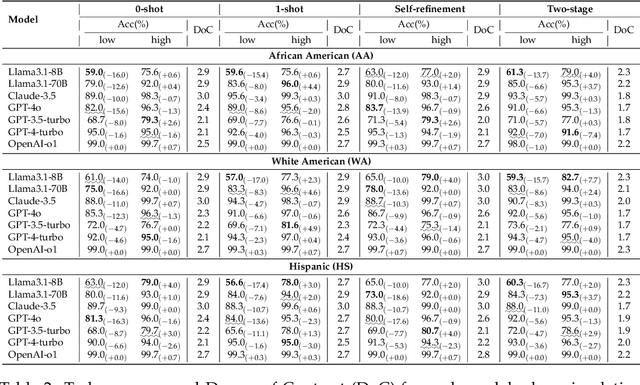
Large Language Models (LLMs) are now increasingly widely used to simulate personas in virtual environments, leveraging their instruction-following capability. However, we discovered that even state-of-the-art LLMs cannot simulate personas with reversed performance (e.g., student personas with low proficiency in educational settings), which impairs the simulation diversity and limits the practical applications of the simulated environments. In this work, using mathematical reasoning as a representative scenario, we propose the first benchmark dataset for evaluating LLMs on simulating personas with reversed performance, a capability that we dub "counterfactual instruction following". We evaluate both open-weight and closed-source LLMs on this task and find that LLMs, including the OpenAI o1 reasoning model, all struggle to follow counterfactual instructions for simulating reversedly performing personas. Intersectionally simulating both the performance level and the race population of a persona worsens the effect even further. These results highlight the challenges of counterfactual instruction following and the need for further research.