 Add to Chrome
 Add to Firefox
 Add to Edge
Failing Gracefully: Mitigating Impact of Inevitable Robot Failures
Aug 05, 2026
Service robots operate in household environments shared with humans, pets, and everyday objects, where they are highly susceptible to failures such as software crashes, hardware degradation, or unpredictable interactions. While roboticists strive to minimize failures, some remain inevitable, making it critical to mitigate their potential consequences for safe and reliable deployment. This paper introduces a novel safety formulation that evaluates both the probability of impactful interactions between robots and surrounding entities during failures, and the severity of their outcomes. By quantifying the impact of failures on different entities, our approach enables robots to make informed planning decisions that balance safety with task efficiency. To support systematic evaluation, we also present FailBench, a MuJoCo-based simulation framework for studying robot-environment interactions under diverse failure modes, including sensing issues and actuator malfunctions. Together, our safety formulation and FailBench provide a foundation for developing safer and more robust motion plans and learned policies in real-world household environments.

Courteous Anticipation: Improving Long-Lived Task Planning in Persistent Shared Environments
Jul 22, 2026We consider a task planning scenario in which robots sharing a persistent environment are assigned tasks one at a time from a held-out sequence. Standard task planners, lacking foresight of future tasks and inconsiderate of others' constraints, solve each task in isolation, leaving terminal states that increase future cost for all, side effects that compound over lengthy task sequences. To reduce cost over the sequence, a robot must anticipate how its actions now may impact performance on future tasks for all robots sharing the environment. Therefore, we present courteous anticipatory planning, wherein a model-based planner proposes candidate plans and selects the one that jointly minimizes immediate cost and aggregated expected future cost across all robots, estimated via independent per-robot learned estimators. This factored formulation avoids combinatorial joint rollouts and supports modular deployment: adding a robot requires only training its own estimator. We evaluate in two persistent PDDL domains, a home environment with robots that have similar capabilities but different responsibilities, and a restaurant environment where robots' distinct capabilities create states that other robots lack the capability to resolve. During lengthy task sequences, our planner reduces total cost by 10.43% versus myopic and 4.03% versus selfish anticipatory planning in a two-robot home environment and by 17.41% and 13.24%, respectively, in a three-robot restaurant.
Scout-Assisted Planning for Heterogeneous Robot Teams under Partially Known Environments
May 21, 2026Autonomous robot teams navigating partially known environments face costly backtracking when ground robots encounter blocked roads that are only revealed upon physical traversal. We address this with Scout-Assisted Planning, a heterogeneous planning framework in which scouting Unmanned Aerial Vehicles proactively gather environmental information to improve Unmanned Ground Vehicle navigation. To focus scouting on the most consequential edges, we propose Information Gain-based Action Pruning, which scores candidate scouting actions by their expected impact on ground robot behavior. Since exact Information Gain-based Action Pruning computation is prohibitively expensive, we develop a Graph Neural Network based model that predicts information gain values directly from graph structure and belief state, reducing planning time to real-time levels without sacrificing solution quality. Experiments across three environment types show that SAP with Information Gain Action Pruning reduces ground robot travel cost by 31.9--37.7% over the Canadian Traveler Problem baseline, and outperforms proximity-based scouting guidance by an additional 8--14%, confirming that principled information-gain-guided scouting is both more effective and computationally feasible for real-world deployment
Object Search in Partially-Known Environments via LLM-informed Model-based Planning and Prompt Selection
Mar 25, 2026We present a novel LLM-informed model-based planning framework, and a novel prompt selection method, for object search in partially-known environments. Our approach uses an LLM to estimate statistics about the likelihood of finding the target object when searching various locations throughout the scene that, combined with travel costs extracted from the environment map, are used to instantiate a model, thus using the LLM to inform planning and achieve effective search performance. Moreover, the abstraction upon which our approach relies is amenable to deployment-time model selection via the recent offline replay approach, an insight we leverage to enable fast prompt and LLM selection during deployment. Simulation experiments demonstrate that our LLM-informed model-based planning approach outperforms the baseline planning strategy that fully relies on LLM and optimistic strategy with as much as 11.8% and 39.2% improvements respectively, and our bandit-like selection approach enables quick selection of best prompts and LLMs resulting in 6.5% lower average cost and 33.8% lower average cumulative regret over baseline UCB bandit selection. Real-robot experiments in an apartment demonstrate similar improvements and so further validate our approach.
Multi-Robot Learning-Informed Task Planning Under Uncertainty
Mar 20, 2026We want a multi-robot team to complete complex tasks in minimum time where the locations of task-relevant objects are not known. Effective task completion requires reasoning over long horizons about the likely locations of task-relevant objects, how individual actions contribute to overall progress, and how to coordinate team efforts. Planning in this setting is extremely challenging: even when task-relevant information is partially known, coordinating which robot performs which action and when is difficult, and uncertainty introduces a multiplicity of possible outcomes for each action, which further complicates long-horizon decision-making and coordination. To address this, we propose a multi-robot planning abstraction that integrates learning to estimate uncertain aspects of the environment with model-based planning for long-horizon coordination. We demonstrate the efficient multi-stage task planning of our approach for 1, 2, and 3 robot teams over competitive baselines in large ProcTHOR household environments. Additionally, we demonstrate the effectiveness of our approach with a team of two LoCoBot mobile robots in real household settings.
Why Do LLM-based Web Agents Fail? A Hierarchical Planning Perspective
Mar 15, 2026Large language model (LLM) web agents are increasingly used for web navigation but remain far from human reliability on realistic, long-horizon tasks. Existing evaluations focus primarily on end-to-end success, offering limited insight into where failures arise. We propose a hierarchical planning framework to analyze web agents across three layers (i.e., high-level planning, low-level execution, and replanning), enabling process-based evaluation of reasoning, grounding, and recovery. Our experiments show that structured Planning Domain Definition Language (PDDL) plans produce more concise and goal-directed strategies than natural language (NL) plans, but low-level execution remains the dominant bottleneck. These results indicate that improving perceptual grounding and adaptive control, not only high-level reasoning, is critical for achieving human-level reliability. This hierarchical perspective provides a principled foundation for diagnosing and advancing LLM web agents.
Effective Task Planning with Missing Objects using Learning-Informed Object Search
Feb 13, 2026Task planning for mobile robots often assumes full environment knowledge and so popular approaches, like planning via the PDDL, cannot plan when the locations of task-critical objects are unknown. Recent learning-driven object search approaches are effective, but operate as standalone tools and so are not straightforwardly incorporated into full task planners, which must additionally determine both what objects are necessary and when in the plan they should be sought out. To address this limitation, we develop a planning framework centered around novel model-based LIOS actions: each a policy that aims to find and retrieve a single object. High-level planning treats LIOS actions as deterministic and so -- informed by model-based calculations of the expected cost of each -- generates plans that interleave search and execution for effective, sound, and complete learning-informed task planning despite uncertainty. Our work effectively reasons about uncertainty while maintaining compatibility with existing full-knowledge solvers. In simulated ProcTHOR homes and in the real world, our approach outperforms non-learned and learned baselines on tasks including retrieval and meal prep.
Learning-Augmented Model-Based Multi-Robot Planning for Time-Critical Search and Inspection Under Uncertainty
Jul 08, 2025In disaster response or surveillance operations, quickly identifying areas needing urgent attention is critical, but deploying response teams to every location is inefficient or often impossible. Effective performance in this domain requires coordinating a multi-robot inspection team to prioritize inspecting locations more likely to need immediate response, while also minimizing travel time. This is particularly challenging because robots must directly observe the locations to determine which ones require additional attention. This work introduces a multi-robot planning framework for coordinated time-critical multi-robot search under uncertainty. Our approach uses a graph neural network to estimate the likelihood of PoIs needing attention from noisy sensor data and then uses those predictions to guide a multi-robot model-based planner to determine the cost-effective plan. Simulated experiments demonstrate that our planner improves performance at least by 16.3\%, 26.7\%, and 26.2\% for 1, 3, and 5 robots, respectively, compared to non-learned and learned baselines. We also validate our approach on real-world platforms using quad-copters.
Anticipatory Planning for Performant Long-Lived Robot in Large-Scale Home-Like Environments
Nov 19, 2024We consider the setting where a robot must complete a sequence of tasks in a persistent large-scale environment, given one at a time. Existing task planners often operate myopically, focusing solely on immediate goals without considering the impact of current actions on future tasks. Anticipatory planning, which reduces the joint objective of the immediate planning cost of the current task and the expected cost associated with future subsequent tasks, offers an approach for improving long-lived task planning. However, applying anticipatory planning in large-scale environments presents significant challenges due to the sheer number of assets involved, which strains the scalability of learning and planning. In this research, we introduce a model-based anticipatory task planning framework designed to scale to large-scale realistic environments. Our framework uses a GNN in particular via a representation inspired by a 3D Scene Graph to learn the essential properties of the environment crucial to estimating the state's expected cost and a sampling-based procedure for practical large-scale anticipatory planning. Our experimental results show that our planner reduces the cost of task sequence by 5.38% in home and 31.5% in restaurant settings. If given time to prepare in advance using our model reduces task sequence costs by 40.6% and 42.5%, respectively.
Anticipatory Task and Motion Planning
Jul 18, 2024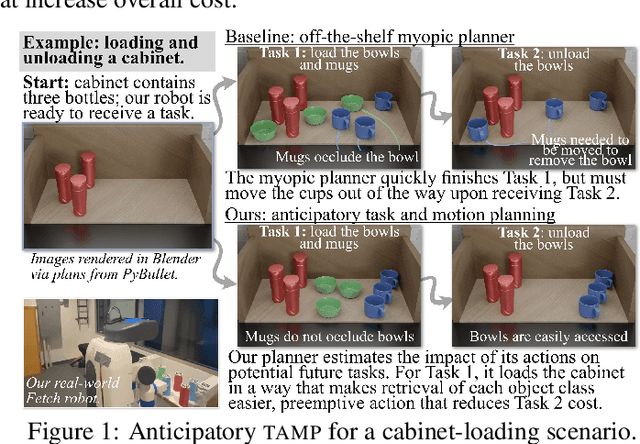

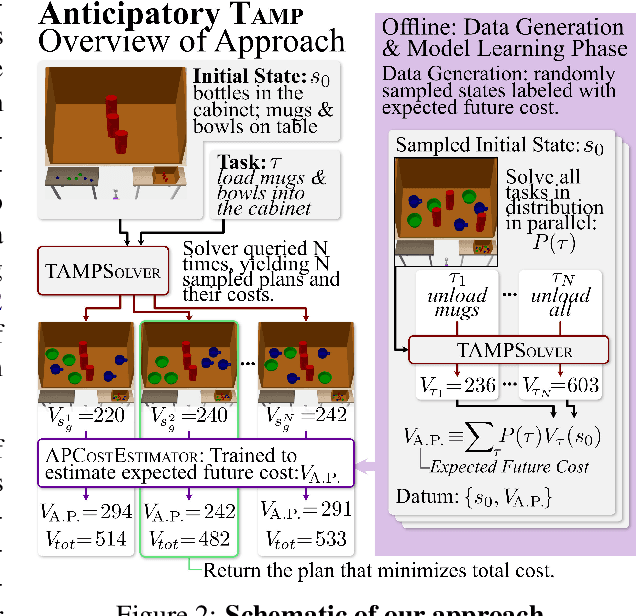

We consider a sequential task and motion planning (tamp) setting in which a robot is assigned continuous-space rearrangement-style tasks one-at-a-time in an environment that persists between each. Lacking advance knowledge of future tasks, existing (myopic) planning strategies unwittingly introduce side effects that impede completion of subsequent tasks: e.g., by blocking future access or manipulation. We present anticipatory task and motion planning, in which estimates of expected future cost from a learned model inform selection of plans generated by a model-based tamp planner so as to avoid such side effects, choosing configurations of the environment that both complete the task and minimize overall cost. Simulated multi-task deployments in navigation-among-movable-obstacles and cabinet-loading domains yield improvements of 32.7% and 16.7% average per-task cost respectively. When given time in advance to prepare the environment, our learning-augmented planning approach yields improvements of 83.1% and 22.3%. Both showcase the value of our approach. Finally, we also demonstrate anticipatory tamp on a real-world Fetch mobile manipulator.