 Add to Chrome
 Add to Firefox
 Add to Edge
10 Open Challenges Steering the Future of Vision-Language-Action Models
Nov 08, 2025
Due to their ability of follow natural language instructions, vision-language-action (VLA) models are increasingly prevalent in the embodied AI arena, following the widespread success of their precursors -- LLMs and VLMs. In this paper, we discuss 10 principal milestones in the ongoing development of VLA models -- multimodality, reasoning, data, evaluation, cross-robot action generalization, efficiency, whole-body coordination, safety, agents, and coordination with humans. Furthermore, we discuss the emerging trends of using spatial understanding, modeling world dynamics, post training, and data synthesis -- all aiming to reach these milestones. Through these discussions, we hope to bring attention to the research avenues that may accelerate the development of VLA models into wider acceptability.

Towards Scalable Web Accessibility Audit with MLLMs as Copilots
Nov 05, 2025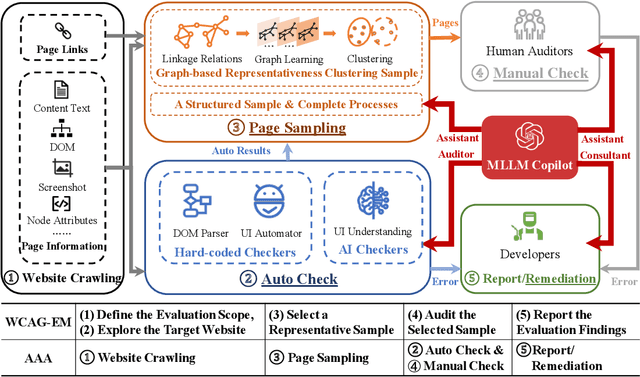
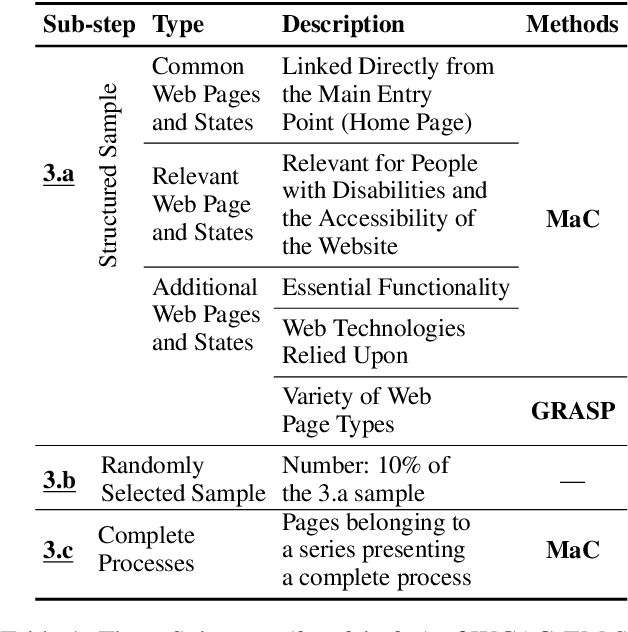
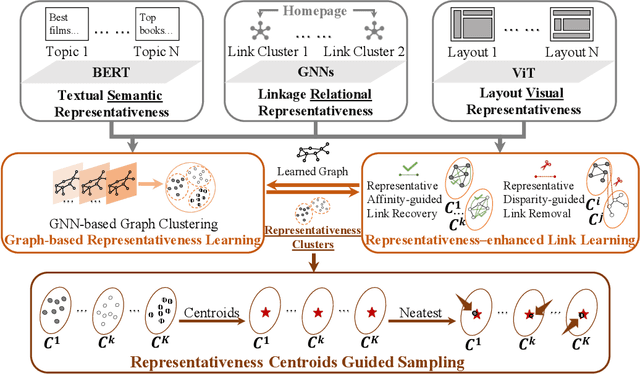
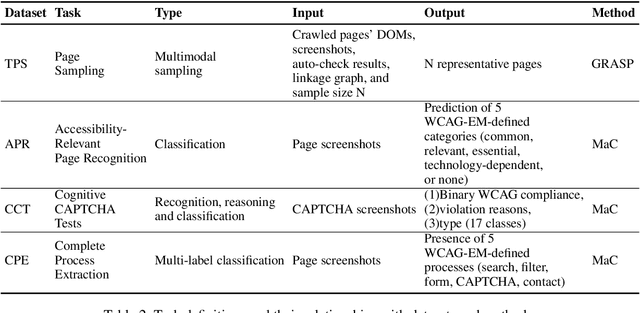
Ensuring web accessibility is crucial for advancing social welfare, justice, and equality in digital spaces, yet the vast majority of website user interfaces remain non-compliant, due in part to the resource-intensive and unscalable nature of current auditing practices. While WCAG-EM offers a structured methodology for site-wise conformance evaluation, it involves great human efforts and lacks practical support for execution at scale. In this work, we present an auditing framework, AAA, which operationalizes WCAG-EM through a human-AI partnership model. AAA is anchored by two key innovations: GRASP, a graph-based multimodal sampling method that ensures representative page coverage via learned embeddings of visual, textual, and relational cues; and MaC, a multimodal large language model-based copilot that supports auditors through cross-modal reasoning and intelligent assistance in high-effort tasks. Together, these components enable scalable, end-to-end web accessibility auditing, empowering human auditors with AI-enhanced assistance for real-world impact. We further contribute four novel datasets designed for benchmarking core stages of the audit pipeline. Extensive experiments demonstrate the effectiveness of our methods, providing insights that small-scale language models can serve as capable experts when fine-tuned.
SheetBrain: A Neuro-Symbolic Agent for Accurate Reasoning over Complex and Large Spreadsheets
Oct 22, 2025Understanding and reasoning over complex spreadsheets remain fundamental challenges for large language models (LLMs), which often struggle with accurately capturing the complex structure of tables and ensuring reasoning correctness. In this work, we propose SheetBrain, a neuro-symbolic dual workflow agent framework designed for accurate reasoning over tabular data, supporting both spreadsheet question answering and manipulation tasks. SheetBrain comprises three core modules: an understanding module, which produces a comprehensive overview of the spreadsheet - including sheet summary and query-based problem insight to guide reasoning; an execution module, which integrates a Python sandbox with preloaded table-processing libraries and an Excel helper toolkit for effective multi-turn reasoning; and a validation module, which verifies the correctness of reasoning and answers, triggering re-execution when necessary. We evaluate SheetBrain on multiple public tabular QA and manipulation benchmarks, and introduce SheetBench, a new benchmark targeting large, multi-table, and structurally complex spreadsheets. Experimental results show that SheetBrain significantly improves accuracy on both existing benchmarks and the more challenging scenarios presented in SheetBench. Our code is publicly available at https://github.com/microsoft/SheetBrain.
StatEval: A Comprehensive Benchmark for Large Language Models in Statistics
Oct 10, 2025Large language models (LLMs) have demonstrated remarkable advances in mathematical and logical reasoning, yet statistics, as a distinct and integrative discipline, remains underexplored in benchmarking efforts. To address this gap, we introduce \textbf{StatEval}, the first comprehensive benchmark dedicated to statistics, spanning both breadth and depth across difficulty levels. StatEval consists of 13,817 foundational problems covering undergraduate and graduate curricula, together with 2374 research-level proof tasks extracted from leading journals. To construct the benchmark, we design a scalable multi-agent pipeline with human-in-the-loop validation that automates large-scale problem extraction, rewriting, and quality control, while ensuring academic rigor. We further propose a robust evaluation framework tailored to both computational and proof-based tasks, enabling fine-grained assessment of reasoning ability. Experimental results reveal that while closed-source models such as GPT5-mini achieve below 57\% on research-level problems, with open-source models performing significantly lower. These findings highlight the unique challenges of statistical reasoning and the limitations of current LLMs. We expect StatEval to serve as a rigorous benchmark for advancing statistical intelligence in large language models. All data and code are available on our web platform: https://stateval.github.io/.
FedDTRE: Federated Dialogue Generation Models Powered by Trustworthiness Evaluation
Oct 09, 2025With the rapid development of artificial intelligence, dialogue systems have become a prominent form of human-computer interaction. However, traditional centralized or fully local training approaches face challenges in balancing privacy preservation and personalization due to data privacy concerns and heterogeneous device capabilities. Federated learning, as a representative distributed paradigm, offers a promising solution. However, existing methods often suffer from overfitting under limited client data and tend to forget global information after multiple training rounds, leading to poor generalization. To address these issues, we propose FedDTRE, a Federated adaptive aggregation strategy for Dialogue generation based on Trustworthiness Evaluation. Instead of directly replacing local models with the global model, FedDTRE leverages trustworthiness scores of both global and local models on a fairness-oriented evaluation dataset to dynamically regulate the global model's contribution during local updates. Experimental results demonstrate that FedDTRE can improve dialogue model performance and enhance the quality of dialogue generation.
VLA-Reasoner: Empowering Vision-Language-Action Models with Reasoning via Online Monte Carlo Tree Search
Sep 26, 2025Vision-Language-Action models (VLAs) achieve strong performance in general robotic manipulation tasks by scaling imitation learning. However, existing VLAs are limited to predicting short-sighted next-action, which struggle with long-horizon trajectory tasks due to incremental deviations. To address this problem, we propose a plug-in framework named VLA-Reasoner that effectively empowers off-the-shelf VLAs with the capability of foreseeing future states via test-time scaling. Specifically, VLA-Reasoner samples and rolls out possible action trajectories where involved actions are rationales to generate future states via a world model, which enables VLA-Reasoner to foresee and reason potential outcomes and search for the optimal actions. We further leverage Monte Carlo Tree Search (MCTS) to improve search efficiency in large action spaces, where stepwise VLA predictions seed the root. Meanwhile, we introduce a confidence sampling mechanism based on Kernel Density Estimation (KDE), to enable efficient exploration in MCTS without redundant VLA queries. We evaluate intermediate states in MCTS via an offline reward shaping strategy, to score predicted futures and correct deviations with long-term feedback. We conducted extensive experiments in both simulators and the real world, demonstrating that our proposed VLA-Reasoner achieves significant improvements over the state-of-the-art VLAs. Our method highlights a potential pathway toward scalable test-time computation of robotic manipulation.
RoboChemist: Long-Horizon and Safety-Compliant Robotic Chemical Experimentation
Sep 10, 2025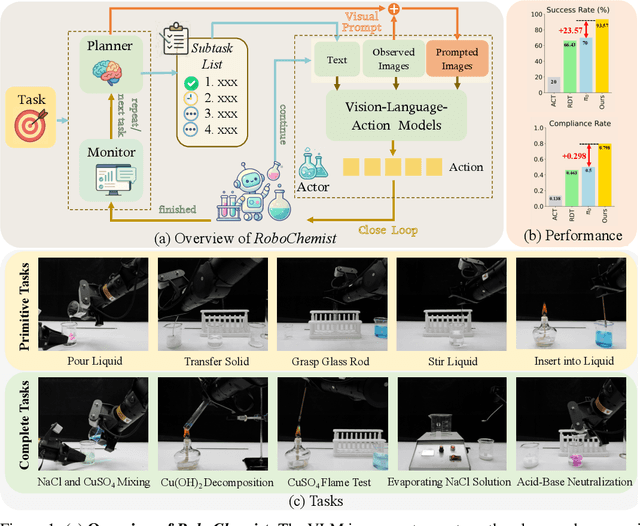
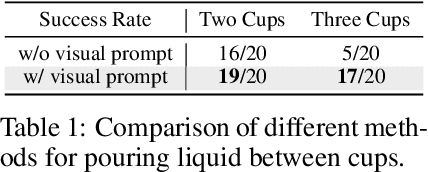
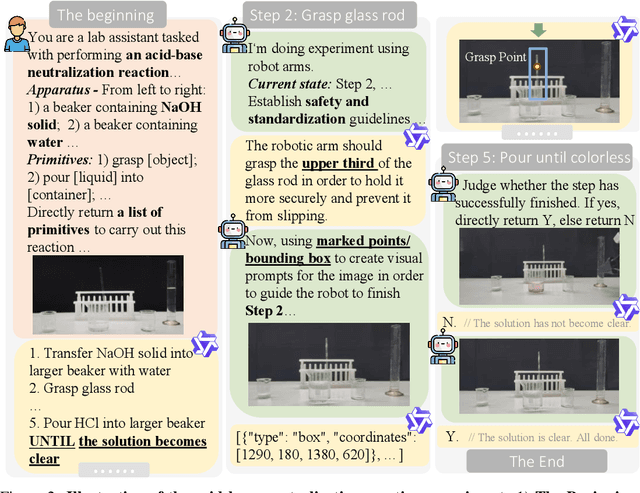

Robotic chemists promise to both liberate human experts from repetitive tasks and accelerate scientific discovery, yet remain in their infancy. Chemical experiments involve long-horizon procedures over hazardous and deformable substances, where success requires not only task completion but also strict compliance with experimental norms. To address these challenges, we propose \textit{RoboChemist}, a dual-loop framework that integrates Vision-Language Models (VLMs) with Vision-Language-Action (VLA) models. Unlike prior VLM-based systems (e.g., VoxPoser, ReKep) that rely on depth perception and struggle with transparent labware, and existing VLA systems (e.g., RDT, pi0) that lack semantic-level feedback for complex tasks, our method leverages a VLM to serve as (1) a planner to decompose tasks into primitive actions, (2) a visual prompt generator to guide VLA models, and (3) a monitor to assess task success and regulatory compliance. Notably, we introduce a VLA interface that accepts image-based visual targets from the VLM, enabling precise, goal-conditioned control. Our system successfully executes both primitive actions and complete multi-step chemistry protocols. Results show 23.57% higher average success rate and a 0.298 average increase in compliance rate over state-of-the-art VLA baselines, while also demonstrating strong generalization to objects and tasks.
TA-VLA: Elucidating the Design Space of Torque-aware Vision-Language-Action Models
Sep 09, 2025Many robotic manipulation tasks require sensing and responding to force signals such as torque to assess whether the task has been successfully completed and to enable closed-loop control. However, current Vision-Language-Action (VLA) models lack the ability to integrate such subtle physical feedback. In this work, we explore Torque-aware VLA models, aiming to bridge this gap by systematically studying the design space for incorporating torque signals into existing VLA architectures. We identify and evaluate several strategies, leading to three key findings. First, introducing torque adapters into the decoder consistently outperforms inserting them into the encoder.Third, inspired by joint prediction and planning paradigms in autonomous driving, we propose predicting torque as an auxiliary output, which further improves performance. This strategy encourages the model to build a physically grounded internal representation of interaction dynamics. Extensive quantitative and qualitative experiments across contact-rich manipulation benchmarks validate our findings.
GWM: Towards Scalable Gaussian World Models for Robotic Manipulation
Aug 25, 2025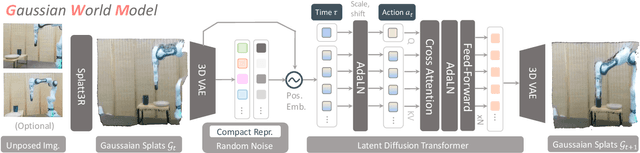
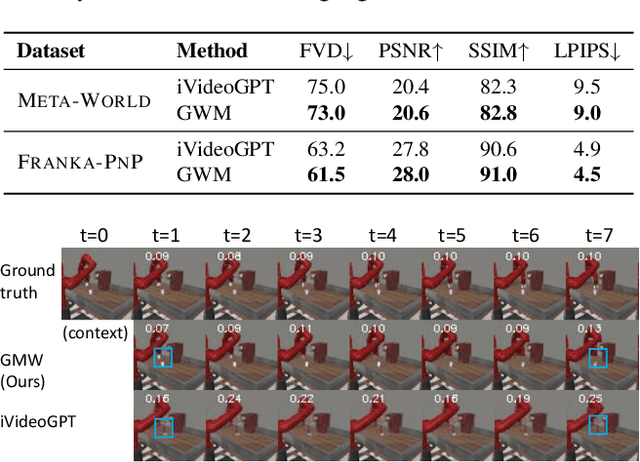
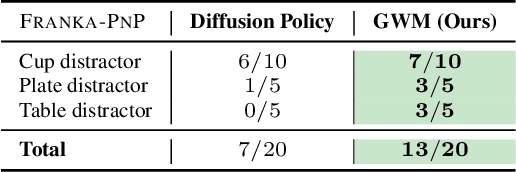
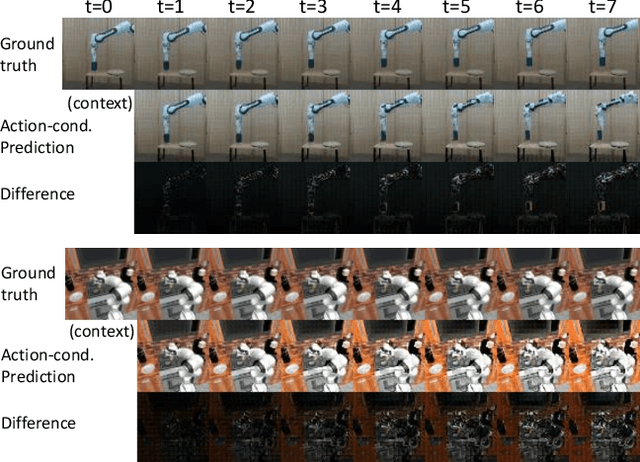
Training robot policies within a learned world model is trending due to the inefficiency of real-world interactions. The established image-based world models and policies have shown prior success, but lack robust geometric information that requires consistent spatial and physical understanding of the three-dimensional world, even pre-trained on internet-scale video sources. To this end, we propose a novel branch of world model named Gaussian World Model (GWM) for robotic manipulation, which reconstructs the future state by inferring the propagation of Gaussian primitives under the effect of robot actions. At its core is a latent Diffusion Transformer (DiT) combined with a 3D variational autoencoder, enabling fine-grained scene-level future state reconstruction with Gaussian Splatting. GWM can not only enhance the visual representation for imitation learning agent by self-supervised future prediction training, but can serve as a neural simulator that supports model-based reinforcement learning. Both simulated and real-world experiments depict that GWM can precisely predict future scenes conditioned on diverse robot actions, and can be further utilized to train policies that outperform the state-of-the-art by impressive margins, showcasing the initial data scaling potential of 3D world model.
SafeBimanual: Diffusion-based Trajectory Optimization for Safe Bimanual Manipulation
Aug 25, 2025Bimanual manipulation has been widely applied in household services and manufacturing, which enables the complex task completion with coordination requirements. Recent diffusion-based policy learning approaches have achieved promising performance in modeling action distributions for bimanual manipulation. However, they ignored the physical safety constraints of bimanual manipulation, which leads to the dangerous behaviors with damage to robots and objects. To this end, we propose a test-time trajectory optimization framework named SafeBimanual for any pre-trained diffusion-based bimanual manipulation policies, which imposes the safety constraints on bimanual actions to avoid dangerous robot behaviors with improved success rate. Specifically, we design diverse cost functions for safety constraints in different dual-arm cooperation patterns including avoidance of tearing objects and collision between arms and objects, which optimizes the manipulator trajectories with guided sampling of diffusion denoising process. Moreover, we employ a vision-language model (VLM) to schedule the cost functions by specifying keypoints and corresponding pairwise relationship, so that the optimal safety constraint is dynamically generated in the entire bimanual manipulation process. SafeBimanual demonstrates superiority on 8 simulated tasks in RoboTwin with a 13.7% increase in success rate and a 18.8% reduction in unsafe interactions over state-of-the-art diffusion-based methods. Extensive experiments on 4 real-world tasks further verify its practical value by improving the success rate by 32.5%.