 Add to Chrome
 Add to Firefox
 Add to Edge
Hypothesis-driven Model Expansion under Uncertainty for Open-World Robot Planning
Jul 07, 2026
We consider an open-world planning setting in which service robots must operate in unknown environments with incomplete knowledge of objects and actions. Traditional closed-world approaches with pre-programmed knowledge bases fail when robots encounter unexpected situations and tasks, posing a fundamental challenge for autonomous knowledge expansion in human environments. In this work, we propose an open-world planning framework that enables robots to automatically generate, verify, and update hypotheses about their abstract world models. Our key insight is to explicitly maintain uncertainty-aware knowledge expansion and integrate hypothesis verification into goal-reaching planning. The framework leverages foundation models to generate initial hypotheses over states and transitions, and applies automated planning to produce action sequences that jointly address hypothesis verification and task execution. Through iterative execution and refinement, the robot expands its knowledge by incorporating verification feedback from the foundation models when hypotheses prove incorrect. Extensive experiments in simulated and real-world environments demonstrate that our framework enables autonomous knowledge expansion and effective operation in open-world settings. These results indicate that integrating uncertainty-aware model expansion from robot foundation models with planning advances the practical deployment of household service robots.

GROW$^2$: Grounding Which and Where for Robot Tool Use
Jun 29, 2026Can the robot use a plate to cut a cake if no knife is available? Tool use greatly expands robot capabilities, but to use tools creatively beyond their intended functions, the robot faces the challenge of $\textit{open-world affordance grounding}$: select an open-category object to act as a tool and localize its specific region of action. To this end, we introduce GROW$^2$ (GROunding Which and Where), which leverages object parts as a natural abstraction to split the grounding process hierarchically into semantic and geometric levels, thus bypassing the need for data-heavy, end-to-end training. Semantically, GROW$^2$ harnesses the commonsense reasoning of Vision-Language Models (VLMs) to parse a natural-language task instruction, select a suitable object as the tool, and identify task-relevant parts on the tool and the target object. Geometrically, vision foundation models then ground the selected parts into precise 3D regions from a single RGB-D image. Experiments on established benchmarks show that GROW$^2$ outperforms state-of-the-art baselines on affordance prediction benchmarks. Further, it achieves zero-shot generalization over open-category objects and outperforms baselines in both simulated and real-world robot tool use experiments.
CANINE: Coaching Visually Impaired Users for Interactive Navigation with a Robot Guide Dog
May 19, 2026Robot guide dogs offer navigation assistance that greatly expands the independent mobility of the visually impaired, but their effective use requires subtle human-robot coordination that is difficult for users to learn from generic verbal instructions. To tackle this challenge, we present CANINE, an automated coaching system that trains users for interactive navigation with a robot guide dog, through personalized, adaptive verbal feedback. CANINE decomposes a complex coordination task into sub-skills and operates at two levels. At the high level, it decides what to train by tracking the learner's proficiency across sub-skills using knowledge tracing and prioritizing training on the weakest areas. At the low level, CANINE decides how to train each sub-skill by observing each human practice episode, using foundation models to infer the underlying causes of errors, and generating targeted verbal corrections adaptively. A controlled study with blindfolded participants, treated as a proxy population for quantitative evaluation, demonstrates that CANINE significantly improves both learning efficiency and final navigation performance compared to generic verbal instructions. We further validate CANINE through a retention study and an exploratory case study. The retention study shows lasting skill improvement after two weeks. The case study confirms CANINE's effectiveness in training a visually impaired user, while revealing additional design considerations for real-world deployment. Both are well aligned with the findings of the controlled study. Project page: https://cunjunyu.github.io/project/canine/
Active Contact Sensing for Robust Robot-to-Human Object Handover
May 06, 2026Robot-to-human object handover is an essential skill for robot assistants, from serving drinks at home to passing surgical tools in the operating room. We expect robots to perform handover robustly -- to release the object only after a firm human grasp while ignoring incidental touches. Existing passive-sensing methods struggle to generalize across diverse objects and human behaviors, as they lack informative perturbations to disambiguate different contact conditions, such as firm grasp versus incidental touch. We propose an active sensing approach for robust handovers: the robot applies information-gathering motions and senses the resulting human-applied forces to infer the contact state. A firm grasp produces forces in multiple directions, while an accidental touch does not. To capture this distinction, we model the contact state with a Bayesian linear model: a distribution over piecewise-linear mappings from robot motions to human-applied forces. This model enables firm grasp detection and active information gathering. In experiments with 12 participants and 30 diverse rigid objects, our method achieved a 97.5% success rate -- over 30% higher than two common baselines.
Visibility-Aware Mobile Grasping in Dynamic Environments
May 04, 2026This paper addresses the problem of mobile grasping in dynamic, unknown environments where a robot must operate under a limited field-of-view. The fundamental challenge is the inherent trade-off between ``seeing'' around to reduce environmental uncertainty and ``moving'' the body to achieve task progress in a high-dimensional configuration space, subject to visibility constraints. Previous approaches often assume known or static environments and decouple these objectives, failing to guarantee safety when unobserved dynamic obstacles intersect the robot's path during manipulation. In this paper, we propose a unified mobile grasping system comprising two core components: (1) an iterative low-level whole-body planner coupled with velocity-aware active perception to navigate dynamic environments safely; and (2) a hierarchical high-level planner based on behavior trees that adaptively generates subgoals to guide the robot through exploration and runtime failures. We provide experimental results across 400 randomized simulation scenarios and real-world deployment on a Fetch mobile manipulator. Results show that our system achieves a success rate of 68.8\% and 58.0\% in unknown static and dynamic environments, respectively, significantly boosting success rates by 22.8\% and 18.0\% over the \nam approach in both unknown static and dynamic environments, with improved collision safety.
Navigation beyond Wayfinding: Robots Collaborating with Visually Impaired Users for Environmental Interactions
Mar 15, 2026Robotic guidance systems have shown promise in supporting blind and visually impaired (BVI) individuals with wayfinding and obstacle avoidance. However, most existing systems assume a clear path and do not support a critical aspect of navigation - environmental interactions that require manipulating objects to enable movement. These interactions are challenging for a human-robot pair because they demand (i) precise localization and manipulation of interaction targets (e.g., pressing elevator buttons) and (ii) dynamic coordination between the user's and robot's movements (e.g., pulling out a chair to sit). We present a collaborative human-robot approach that combines our robotic guide dog's precise sensing and localization capabilities with the user's ability to perform physical manipulation. The system alternates between two modes: lead mode, where the robot detects and guides the user to the target, and adaptation mode, where the robot adjusts its motion as the user interacts with the environment (e.g., opening a door). Evaluation results show that our system enables navigation that is safer, smoother, and more efficient than both a traditional white cane and a non-adaptive guiding system, with the performance gap widening as tasks demand higher precision in locating interaction targets. These findings highlight the promise of human-robot collaboration in advancing assistive technologies toward more generalizable and realistic navigation support.
SignScene: Visual Sign Grounding for Mapless Navigation
Feb 13, 2026Navigational signs enable humans to navigate unfamiliar environments without maps. This work studies how robots can similarly exploit signs for mapless navigation in the open world. A central challenge lies in interpreting signs: real-world signs are diverse and complex, and their abstract semantic contents need to be grounded in the local 3D scene. We formalize this as sign grounding, the problem of mapping semantic instructions on signs to corresponding scene elements and navigational actions. Recent Vision-Language Models (VLMs) offer the semantic common-sense and reasoning capabilities required for this task, but are sensitive to how spatial information is represented. We propose SignScene, a sign-centric spatial-semantic representation that captures navigation-relevant scene elements and sign information, and presents them to VLMs in a form conducive to effective reasoning. We evaluate our grounding approach on a dataset of 114 queries collected across nine diverse environment types, achieving 88% grounding accuracy and significantly outperforming baselines. Finally, we demonstrate that it enables real-world mapless navigation on a Spot robot using only signs.
From Obstacles to Etiquette: Robot Social Navigation with VLM-Informed Path Selection
Feb 09, 2026Navigating socially in human environments requires more than satisfying geometric constraints, as collision-free paths may still interfere with ongoing activities or conflict with social norms. Addressing this challenge calls for analyzing interactions between agents and incorporating common-sense reasoning into planning. This paper presents a social robot navigation framework that integrates geometric planning with contextual social reasoning. The system first extracts obstacles and human dynamics to generate geometrically feasible candidate paths, then leverages a fine-tuned vision-language model (VLM) to evaluate these paths, informed by contextually grounded social expectations, selecting a socially optimized path for the controller. This task-specific VLM distills social reasoning from large foundation models into a smaller and efficient model, allowing the framework to perform real-time adaptation in diverse human-robot interaction contexts. Experiments in four social navigation contexts demonstrate that our method achieves the best overall performance with the lowest personal space violation duration, the minimal pedestrian-facing time, and no social zone intrusions. Project page: https://path-etiquette.github.io
10 Open Challenges Steering the Future of Vision-Language-Action Models
Nov 08, 2025Due to their ability of follow natural language instructions, vision-language-action (VLA) models are increasingly prevalent in the embodied AI arena, following the widespread success of their precursors -- LLMs and VLMs. In this paper, we discuss 10 principal milestones in the ongoing development of VLA models -- multimodality, reasoning, data, evaluation, cross-robot action generalization, efficiency, whole-body coordination, safety, agents, and coordination with humans. Furthermore, we discuss the emerging trends of using spatial understanding, modeling world dynamics, post training, and data synthesis -- all aiming to reach these milestones. Through these discussions, we hope to bring attention to the research avenues that may accelerate the development of VLA models into wider acceptability.
Robot Operation of Home Appliances by Reading User Manuals
May 26, 2025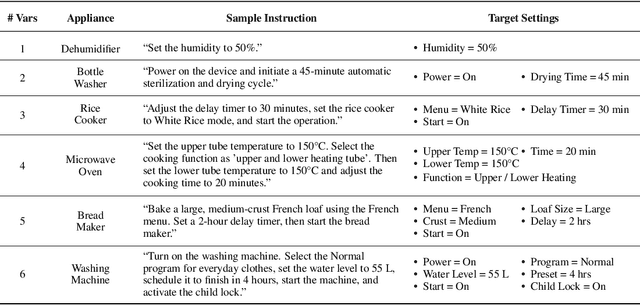
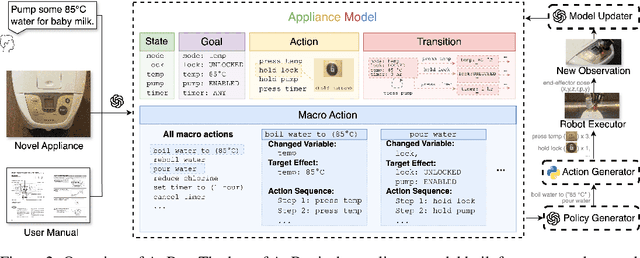
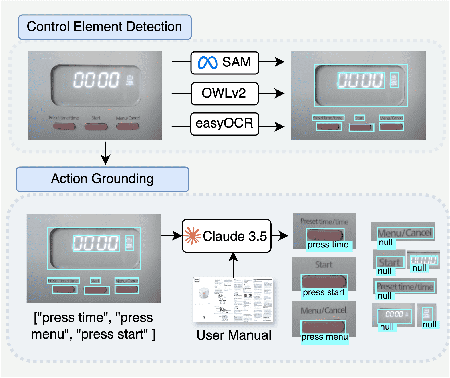
Operating home appliances, among the most common tools in every household, is a critical capability for assistive home robots. This paper presents ApBot, a robot system that operates novel household appliances by "reading" their user manuals. ApBot faces multiple challenges: (i) infer goal-conditioned partial policies from their unstructured, textual descriptions in a user manual document, (ii) ground the policies to the appliance in the physical world, and (iii) execute the policies reliably over potentially many steps, despite compounding errors. To tackle these challenges, ApBot constructs a structured, symbolic model of an appliance from its manual, with the help of a large vision-language model (VLM). It grounds the symbolic actions visually to control panel elements. Finally, ApBot closes the loop by updating the model based on visual feedback. Our experiments show that across a wide range of simulated and real-world appliances, ApBot achieves consistent and statistically significant improvements in task success rate, compared with state-of-the-art large VLMs used directly as control policies. These results suggest that a structured internal representations plays an important role in robust robot operation of home appliances, especially, complex ones.