 Add to Chrome
 Add to Firefox
 Add to Edge
CG-DMER: Hybrid Contrastive-Generative Framework for Disentangled Multimodal ECG Representation Learning
Feb 24, 2026
Accurate interpretation of electrocardiogram (ECG) signals is crucial for diagnosing cardiovascular diseases. Recent multimodal approaches that integrate ECGs with accompanying clinical reports show strong potential, but they still face two main concerns from a modality perspective: (1) intra-modality: existing models process ECGs in a lead-agnostic manner, overlooking spatial-temporal dependencies across leads, which restricts their effectiveness in modeling fine-grained diagnostic patterns; (2) inter-modality: existing methods directly align ECG signals with clinical reports, introducing modality-specific biases due to the free-text nature of the reports. In light of these two issues, we propose CG-DMER, a contrastive-generative framework for disentangled multimodal ECG representation learning, powered by two key designs: (1) Spatial-temporal masked modeling is designed to better capture fine-grained temporal dynamics and inter-lead spatial dependencies by applying masking across both spatial and temporal dimensions and reconstructing the missing information. (2) A representation disentanglement and alignment strategy is designed to mitigate unnecessary noise and modality-specific biases by introducing modality-specific and modality-shared encoders, ensuring a clearer separation between modality-invariant and modality-specific representations. Experiments on three public datasets demonstrate that CG-DMER achieves state-of-the-art performance across diverse downstream tasks.

ProductNet: a Collection of High-Quality Datasets for Product Representation Learning
Apr 18, 2019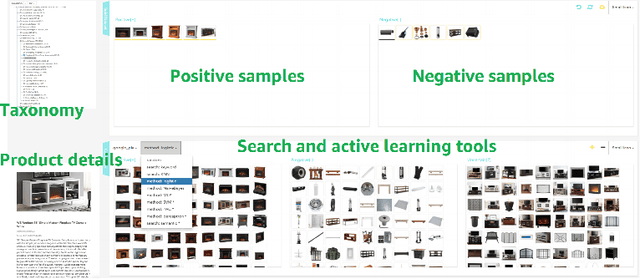
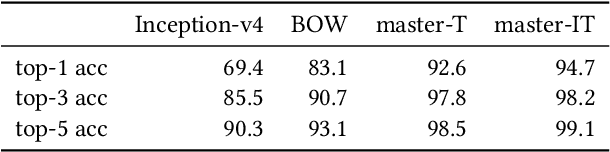
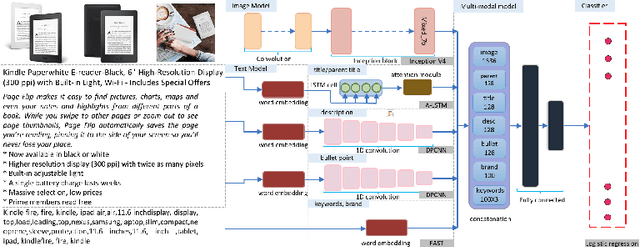
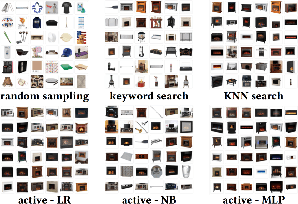
ProductNet is a collection of high-quality product datasets for better product understanding. Motivated by ImageNet, ProductNet aims at supporting product representation learning by curating product datasets of high quality with properly chosen taxonomy. In this paper, the two goals of building high-quality product datasets and learning product representation support each other in an iterative fashion: the product embedding is obtained via a multi-modal deep neural network (master model) designed to leverage product image and catalog information; and in return, the embedding is utilized via active learning (local model) to vastly accelerate the annotation process. For the labeled data, the proposed master model yields high categorization accuracy (94.7% top-1 accuracy for 1240 classes), which can be used as search indices, partition keys, and input features for machine learning models. The product embedding, as well as the fined-tuned master model for a specific business task, can also be used for various transfer learning tasks.
Reference Product Search
Apr 11, 2019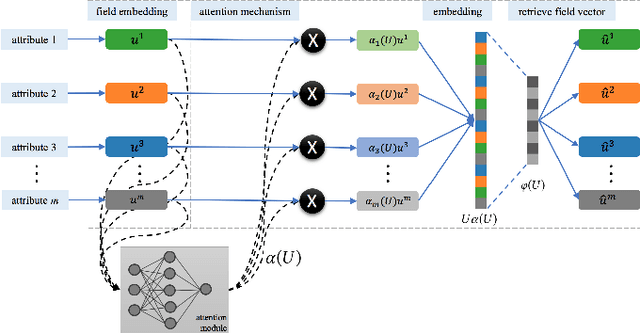
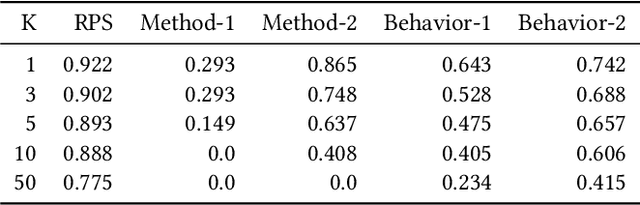
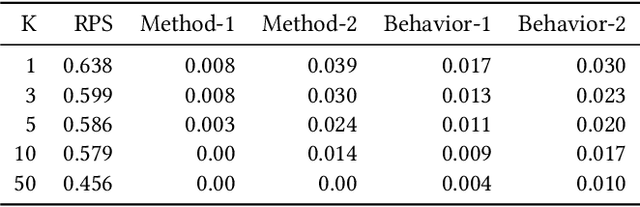
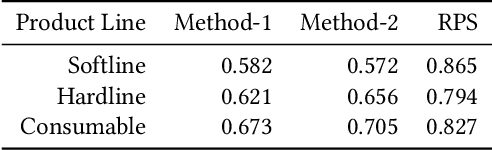
For a product of interest, we propose a search method to surface a set of reference products. The reference products can be used as candidates to support downstream modeling tasks and business applications. The search method consists of product representation learning and fingerprint-type vector searching. The product catalog information is transformed into a high-quality embedding of low dimensions via a novel attention auto-encoder neural network, and the embedding is further coupled with a binary encoding vector for fast retrieval. We conduct extensive experiments to evaluate the proposed method, and compare it with peer services to demonstrate its advantage in terms of search return rate and precision.