 Add to Chrome
 Add to Firefox
 Add to Edge
Towards Long-Horizon Vessel Trajectory and Destination Forecasting with Reasoning Large Language Models
Jun 07, 2026
Long-horizon maritime trajectory prediction is important for shipping management, logistics planning, and maritime risk analysis, yet month-level forecasting remains insufficiently studied. Existing deep learning methods mainly focus on short- and mid-term coordinate extrapolation and often struggle to preserve route feasibility and destination correctness over extended horizons. This paper investigates joint long-horizon vessel trajectory and destination forecasting with reasoning-capable large language models, and develops a Maritime LLM post-training framework based on Reinforcement Learning with Verifiable Reward (RLVR). An AIS-based benchmark is constructed with 60-day historical trajectories and 30-day forecasting horizons, where trajectories are converted into semantic textual representations for RL prompt construction. RLVR aligns LLMs with maritime forecasting objectives by enforcing physical validity, providing early-weighted trajectory supervision, and evaluating destination correctness through hierarchical matching and curriculum learning. Experimental results show that RLVR-trained LLMs substantially improve over zero-shot LLMs and representative deep learning baselines, especially on destination-related metrics. Among the evaluated RLVR-trained variants, 4B LLMs achieve the best overall performance, suggesting that reward-compatible optimization and task-specific capacity matching are more important than simply using larger 8B or 14B LLMs. The results also show that LSTM remains a strong deep learning baseline under limited fine-tuning data, while Transformer-style spatio-temporal models typically require larger datasets and richer structured inputs. Overall, this work advances semantic, verifier-aligned maritime forecasting for operational decision support.

Phy-CoSF: Physics-Guided Continuous Spectral Fields Reconstruction and Super-Resolution for Snapshot Compressive Imaging
May 13, 2026Recent advances have demonstrated that coded aperture snapshot spectral imaging (CASSI) systems show great potential for capturing 3D hyperspectral images (HSIs) from a single 2D measurement. Despite the inherent spectral continuity of scenes captured by CASSI, most existing reconstruction methods are restricted to fixed, discrete spectral outputs, thereby precluding continuous spectral reconstruction or spectral super-resolution. To address this challenge, we propose Phy-CoSF, which synergizes deep unfolding networks with implicit neural representations, establishing a new paradigm for continuous spectral reconstruction and super-resolution in CASSI. Specifically, we propose a two-phase architecture that bridges discrete-wavelength training with continuous spectral rendering, enabling the synthesis of high-fidelity HSIs at arbitrary target wavelengths. At the core of our framework lies the continuous spectral fields (CoSF) module, embedded within each unfolding stage as a dynamic prior, which comprises a triple-branch cross-domain feature mixer for comprehensive spatial-frequency-channel feature fusion, alongside a spectral synthesis head that generates spectral intensities by querying continuous wavelength coordinates. Extensive experimental results demonstrate that Phy-CoSF not only achieves continuous modeling at arbitrary spectral resolutions but also outperforms many state-of-the-art methods in both reconstruction fidelity and spectral detail preservation. Our code and more results are available at: https://github.com/PaiDii/Phy-CoSF.git.
Adaptor: Advancing Assistive Teleoperation with Few-Shot Learning and Cross-Operator Generalization
Apr 10, 2026Assistive teleoperation enhances efficiency via shared control, yet inter-operator variability, stemming from diverse habits and expertise, induces highly heterogeneous trajectory distributions that undermine intent recognition stability. We present Adaptor, a few-shot framework for robust cross-operator intent recognition. The Adaptor bridges the domain gap through two stages: (i) preprocessing, which models intent uncertainty by synthesizing trajectory perturbations via noise injection and performs geometry-aware keyframe extraction; and (ii) policy learning, which encodes the processed trajectories with an Intention Expert and fuses them with the pre-trained vision-language model context to condition an Action Expert for action generation. Experiments on real-world and simulated benchmarks demonstrate that Adaptor achieves state-of-the-art performance, improving success rates and efficiency over baselines. Moreover, the method exhibits low variance across operators with varying expertise, demonstrating robust cross-operator generalization.
GraspALL: Adaptive Structural Compensation from Illumination Variation for Robotic Garment Grasping in Any Low-Light Conditions
Mar 16, 2026Achieving accurate garment grasping under dynamically changing illumination is crucial for all-day operation of service robots.However, the reduced illumination in low-light scenes severely degrades garment structural features, leading to a significant drop in grasping robustness.Existing methods typically enhance RGB features by exploiting the illumination-invariant properties of non-RGB modalities, yet they overlook the varying dependence on non-RGB features under varying lighting conditions, which can introduce misaligned non-RGB cues and thereby weaken the model's adaptability to illumination changes when utilizing multimodal information.To address this problem, we propose GraspALL, an illumination-structure interactive compensation model.The innovation of GraspALL lies in encoding continuous illumination changes into quantitative references to guide adaptive feature fusion between RGB and non-RGB modalities according to varying lighting intensities, thereby generating illumination-consistent grasping representations.Experiments on the self-built garment grasping dataset demonstrate that GraspALL improves grasping accuracy by 32-44% over baselines under diverse illumination conditions.
Triply Laplacian Scale Mixture Modeling for Seismic Data Noise Suppression
Feb 20, 2025Sparsity-based tensor recovery methods have shown great potential in suppressing seismic data noise. These methods exploit tensor sparsity measures capturing the low-dimensional structures inherent in seismic data tensors to remove noise by applying sparsity constraints through soft-thresholding or hard-thresholding operators. However, in these methods, considering that real seismic data are non-stationary and affected by noise, the variances of tensor coefficients are unknown and may be difficult to accurately estimate from the degraded seismic data, leading to undesirable noise suppression performance. In this paper, we propose a novel triply Laplacian scale mixture (TLSM) approach for seismic data noise suppression, which significantly improves the estimation accuracy of both the sparse tensor coefficients and hidden scalar parameters. To make the optimization problem manageable, an alternating direction method of multipliers (ADMM) algorithm is employed to solve the proposed TLSM-based seismic data noise suppression problem. Extensive experimental results on synthetic and field seismic data demonstrate that the proposed TLSM algorithm outperforms many state-of-the-art seismic data noise suppression methods in both quantitative and qualitative evaluations while providing exceptional computational efficiency.
CausalMob: Causal Human Mobility Prediction with LLMs-derived Human Intentions toward Public Events
Dec 03, 2024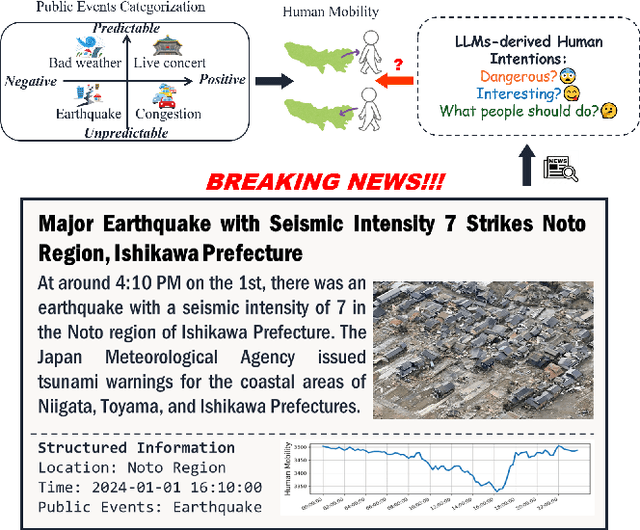
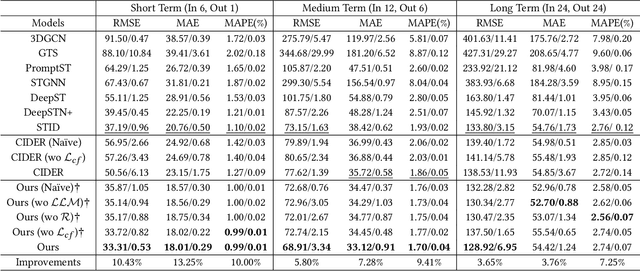
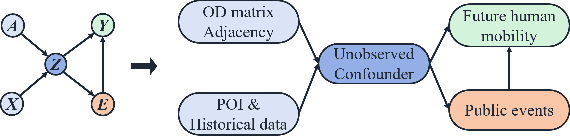
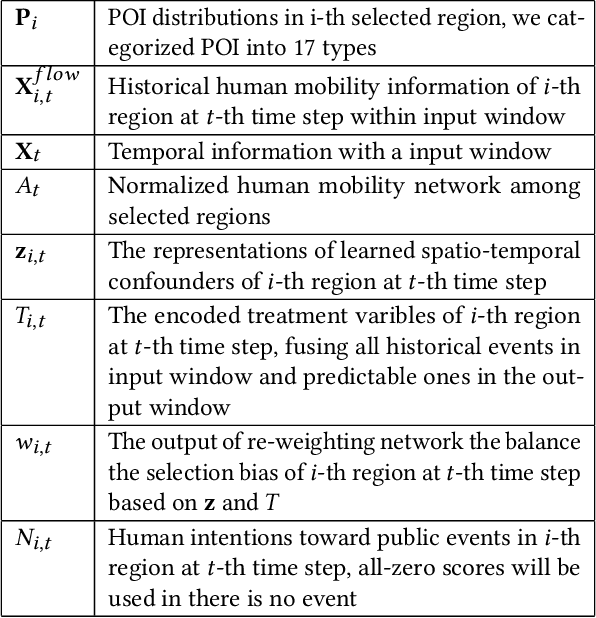
Large-scale human mobility exhibits spatial and temporal patterns that can assist policymakers in decision making. Although traditional prediction models attempt to capture these patterns, they often interfered by non-periodic public events, such as disasters and occasional celebrations. Since regular human mobility patterns are heavily affected by these events, estimating their causal effects is critical to accurate mobility predictions. Although news articles provide unique perspectives on these events in an unstructured format, processing is a challenge. In this study, we propose a causality-augmented prediction model, called \textbf{CausalMob}, to analyze the causal effects of public events. We first utilize large language models (LLMs) to extract human intentions from news articles and transform them into features that act as causal treatments. Next, the model learns representations of spatio-temporal regional covariates from multiple data sources to serve as confounders for causal inference. Finally, we present a causal effect estimation framework to ensure event features remain independent of confounders during prediction. Based on large-scale real-world data, the experimental results show that the proposed model excels in human mobility prediction, outperforming state-of-the-art models.
Taming the Long Tail in Human Mobility Prediction
Oct 19, 2024
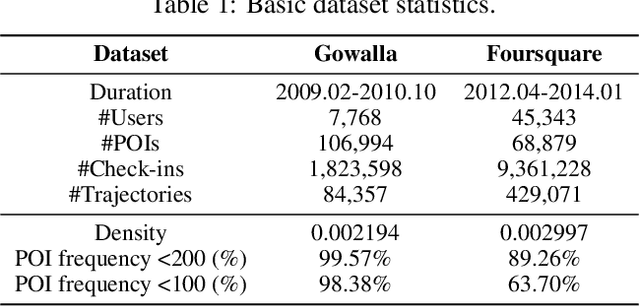
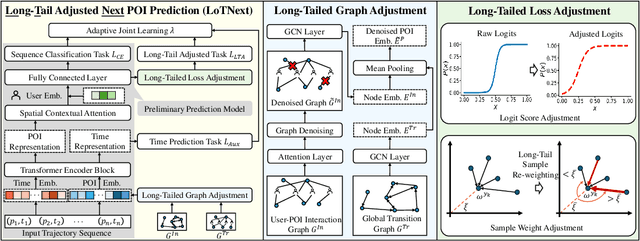
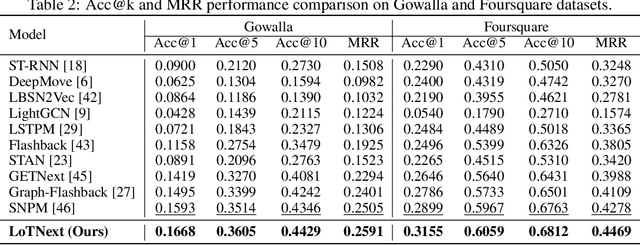
With the popularity of location-based services, human mobility prediction plays a key role in enhancing personalized navigation, optimizing recommendation systems, and facilitating urban mobility and planning. This involves predicting a user's next POI (point-of-interest) visit using their past visit history. However, the uneven distribution of visitations over time and space, namely the long-tail problem in spatial distribution, makes it difficult for AI models to predict those POIs that are less visited by humans. In light of this issue, we propose the Long-Tail Adjusted Next POI Prediction (LoTNext) framework for mobility prediction, combining a Long-Tailed Graph Adjustment module to reduce the impact of the long-tailed nodes in the user-POI interaction graph and a novel Long-Tailed Loss Adjustment module to adjust loss by logit score and sample weight adjustment strategy. Also, we employ the auxiliary prediction task to enhance generalization and accuracy. Our experiments with two real-world trajectory datasets demonstrate that LoTNext significantly surpasses existing state-of-the-art works. Our code is available at https://github.com/Yukayo/LoTNext.
FANNO: Augmenting High-Quality Instruction Data with Open-Sourced LLMs Only
Aug 02, 2024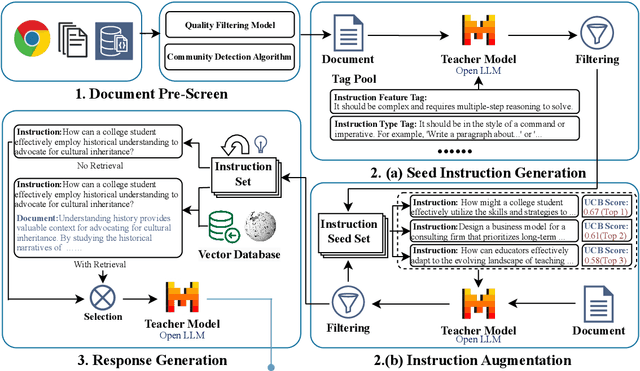


Instruction fine-tuning stands as a crucial advancement in leveraging large language models (LLMs) for enhanced task performance. However, the annotation of instruction datasets has traditionally been expensive and laborious, often relying on manual annotations or costly API calls of proprietary LLMs. To address these challenges, we introduce FANNO, a fully autonomous, open-sourced framework that revolutionizes the annotation process without the need for pre-existing annotated data. Utilizing a Mistral-7b-instruct model, FANNO efficiently produces diverse and high-quality datasets through a structured process involving document pre-screening, instruction generation, and response generation. Experiments on Open LLM Leaderboard and AlpacaEval benchmark show that the FANNO can generate high-quality data with diversity and complexity for free, comparable to human-annotated or cleaned datasets like Alpaca-GPT4-Cleaned.
TrafPS: A Shapley-based Visual Analytics Approach to Interpret Traffic
Mar 07, 2024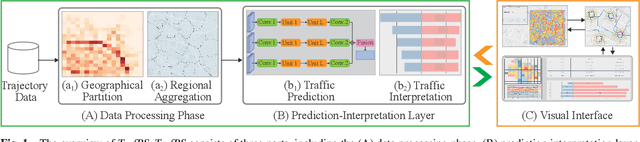
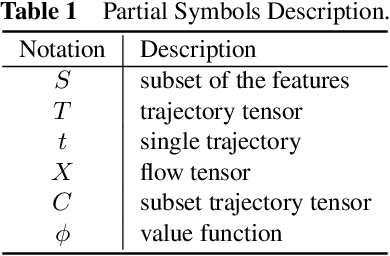

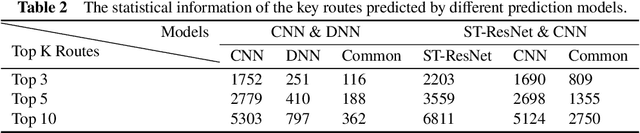
Recent achievements in deep learning (DL) have shown its potential for predicting traffic flows. Such predictions are beneficial for understanding the situation and making decisions in traffic control. However, most state-of-the-art DL models are considered "black boxes" with little to no transparency for end users with respect to the underlying mechanisms. Some previous work tried to "open the black boxes" and increase the interpretability of how predictions are generated. However, it still remains challenging to handle complex models on large-scale spatio-temporal data and discover salient spatial and temporal patterns that significantly influence traffic flows. To overcome the challenges, we present TrafPS, a visual analytics approach for interpreting traffic prediction outcomes to support decision-making in traffic management and urban planning. The measurements, region SHAP and trajectory SHAP, are proposed to quantify the impact of flow patterns on urban traffic at different levels. Based on the task requirement from the domain experts, we employ an interactive visual interface for multi-aspect exploration and analysis of significant flow patterns. Two real-world case studies demonstrate the effectiveness of TrafPS in identifying key routes and decision-making support for urban planning.
PlanGPT: Enhancing Urban Planning with Tailored Language Model and Efficient Retrieval
Feb 29, 2024


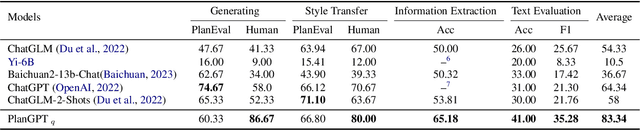
In the field of urban planning, general-purpose large language models often struggle to meet the specific needs of planners. Tasks like generating urban planning texts, retrieving related information, and evaluating planning documents pose unique challenges. To enhance the efficiency of urban professionals and overcome these obstacles, we introduce PlanGPT, the first specialized Large Language Model tailored for urban and spatial planning. Developed through collaborative efforts with institutions like the Chinese Academy of Urban Planning, PlanGPT leverages a customized local database retrieval framework, domain-specific fine-tuning of base models, and advanced tooling capabilities. Empirical tests demonstrate that PlanGPT has achieved advanced performance, delivering responses of superior quality precisely tailored to the intricacies of urban planning.