 Add to Chrome
 Add to Firefox
 Add to Edge
Practical Noise Modeling for SPAD Intensity Imaging
Aug 01, 2026
Single-photon avalanche diode (SPAD) cameras are promising for low-light and high-dynamic-range intensity imaging, but their practical use is limited by complex sensor-specific noise. Unlike time-correlated single-photon counting (TCSPC) systems, SPAD cameras record whether at least one detection occurred in each gate without photon timestamps in intensity imaging mode, making explicit noise decomposition difficult. We present a practical noise modeling and calibration framework for SPAD intensity denoising. Our forward model describes binary-frame accumulation with a Binomial observation process, models signal-independent dark noise as an exposure-dependent pure dark count term plus an exposure-independent dark-frame bias term, and incorporates pixel-wise response non-uniformity. We design a dedicated calibration procedure for the proposed model and use it to build a count-domain noise-synthesis pipeline for network training. For denoising, we further design a SPAD-specific dark-shading correction (SPAD-DSC) to remove most systematic noise before network training. We construct a real-world SPAD intensity dataset for testing. Experimental results demonstrate the superiority of the proposed noise model.

Optical Flow from Photons
Aug 01, 2026Optical flow remains challenging in high-speed and low-light scenes, where the limited frame rate and sensitivity of conventional cameras lead to motion blur and underexposure. Single-photon avalanche diode (SPAD) cameras offer single-photon sensitivity and extremely fine temporal sampling. However, individual slices in these high FPS binary photon streams are too sparse for dense correspondence. Temporal aggregation can provide the spatial cues required by optical flow, but accumulating photons at fixed coordinates blurs moving structures. Motion-aware aggregation can reduce this blur, yet it depends on the flow being estimated. To address this dependency, we propose QuantaFlow, the first method for dense optical flow directly from SPAD streams. Instead of constructing a fixed input representation, QuantaFlow embeds SPAD representation construction into iterative flow refinement. At each iteration, the current flow coarsely aligns the slices within the source and target sub-streams. A photon-flux transformation then constructs multi-scale representations containing intensity and structural cues, while adaptive multi-scale fusion balances photon noise and residual motion blur at each pixel. The fused representations drive a feature-warping flow update, and the refined flow guides representation construction in the next iteration. We further construct a synthetic dataset for SPAD optical-flow training and evaluation. Experiments on the synthetic dataset and real-world SPAD data demonstrate the effectiveness and generalization of QuantaFlow.
All-in-One Transferring Image Compression from Human Perception to Multi-Machine Perception
Apr 17, 2025Efficiently transferring Learned Image Compression (LIC) model from human perception to machine perception is an emerging challenge in vision-centric representation learning. Existing approaches typically adapt LIC to downstream tasks in a single-task manner, which is inefficient, lacks task interaction, and results in multiple task-specific bitstreams. To address these limitations, we propose an asymmetric adaptor framework that supports multi-task adaptation within a single model. Our method introduces a shared adaptor to learn general semantic features and task-specific adaptors to preserve task-level distinctions. With only lightweight plug-in modules and a frozen base codec, our method achieves strong performance across multiple tasks while maintaining compression efficiency. Experiments on the PASCAL-Context benchmark demonstrate that our method outperforms both Fully Fine-Tuned and other Parameter Efficient Fine-Tuned (PEFT) baselines, and validating the effectiveness of multi-vision transferring.
Hybrid Feature Embedding For Automatic Building Outline Extraction
Jul 20, 2023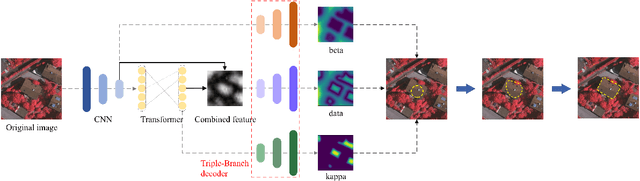
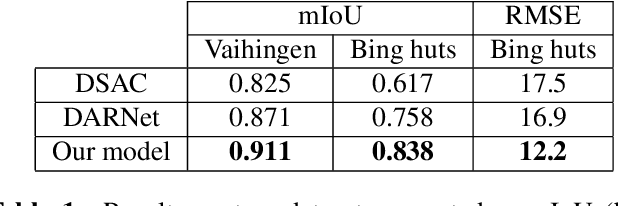
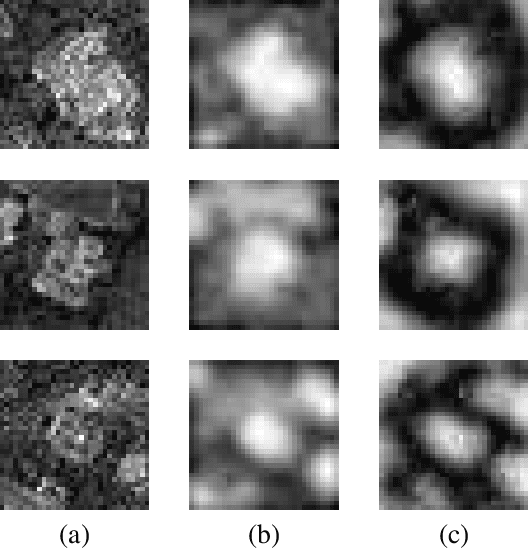
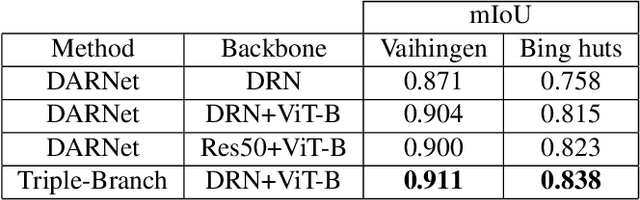
Building outline extracted from high-resolution aerial images can be used in various application fields such as change detection and disaster assessment. However, traditional CNN model cannot recognize contours very precisely from original images. In this paper, we proposed a CNN and Transformer based model together with active contour model to deal with this problem. We also designed a triple-branch decoder structure to handle different features generated by encoder. Experiment results show that our model outperforms other baseline model on two datasets, achieving 91.1% mIoU on Vaihingen and 83.8% on Bing huts.