 Add to Chrome
 Add to Firefox
 Add to Edge
Sample-Efficient Diffusion-based Reinforcement Learning with Critic Guidance
May 28, 2026
Recent advances in reinforcement learning (RL) have achieved great successes by leveraging the multimodality and exploration capability of diffusion policies. Among these approaches, one representative branch focuses on the sampling-based policy optimization. This design enables better exploration capability of the diffusion model, particularly at the beginning of training, but suffer from low exploitation in Q-value information, resulting in a slow policy convergence. Another branch pays attention to gradient-based policy optimization, which sufficiently exploits the gradient of the Q function yet tends to collapse into a unimodal policy with low diversity. To address this issue, we propose CGPO, \textbf{C}ritic-\textbf{G}uided diffusion \textbf{P}olicy \textbf{O}ptimization, which effectively balances exploration and exploitation with the training-free guidance technique integrated into the denoising process of diffusion policy. Concretely, CGPO steers action generation toward high-value regions defined by the critic network and uses the guided actions as regression objectives. In this manner, CGPO reduces the time required to obtain high-quality actions and improves final performance with better balance between the exploration-exploitation tradeoff. We validate the effectiveness of CGPO on 5 MuJoCo locomotion tasks, and CGPO achieves state-of-the-art performance compared with existing diffusion-based RL methods. Notably, CGPO is the first success to incorporate diffusion policy into real-world RL, with its superior performance on Franka robot arm grasping tasks. Our official page is released at https://dingsht.tech/cgpo-webpage.

Sample from What You See: Visuomotor Policy Learning via Diffusion Bridge with Observation-Embedded Stochastic Differential Equation
Dec 08, 2025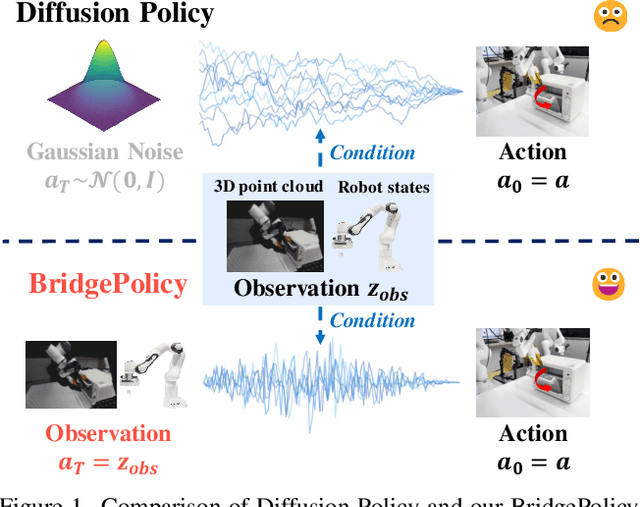
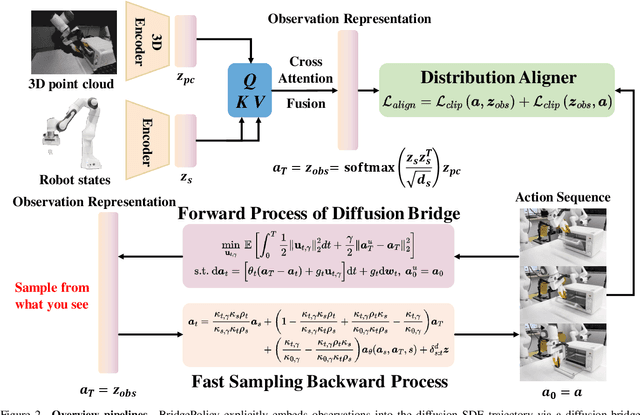
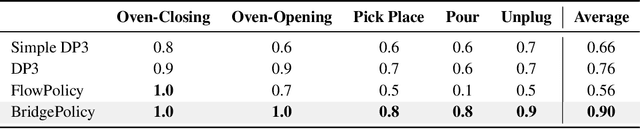
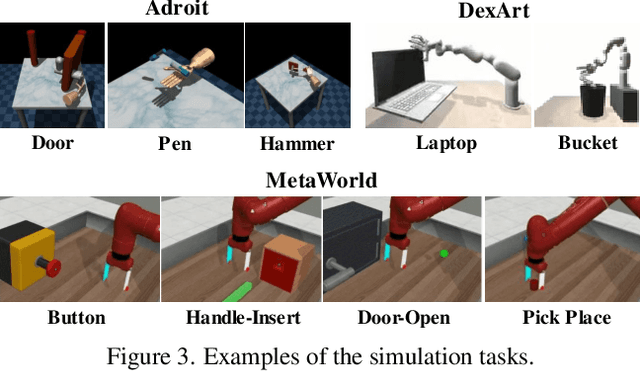
Imitation learning with diffusion models has advanced robotic control by capturing multi-modal action distributions. However, existing approaches typically treat observations as high-level conditioning inputs to the denoising network, rather than integrating them into the stochastic dynamics of the diffusion process itself. As a result, sampling must begin from random Gaussian noise, weakening the coupling between perception and control and often yielding suboptimal performance. We introduce BridgePolicy, a generative visuomotor policy that explicitly embeds observations within the stochastic differential equation via a diffusion-bridge formulation. By constructing an observation-informed trajectory, BridgePolicy enables sampling to start from a rich, informative prior rather than random noise, substantially improving precision and reliability in control. A key challenge is that classical diffusion bridges connect distributions with matched dimensionality, whereas robotic observations are heterogeneous and multi-modal and do not naturally align with the action space. To address this, we design a multi-modal fusion module and a semantic aligner that unify visual and state inputs and align observation and action representations, making the bridge applicable to heterogeneous robot data. Extensive experiments across 52 simulation tasks on three benchmarks and five real-world tasks demonstrate that BridgePolicy consistently outperforms state-of-the-art generative policies.
HORAE: A Domain-Agnostic Modeling Language for Automating Multimodal Service Regulation
Jun 06, 2024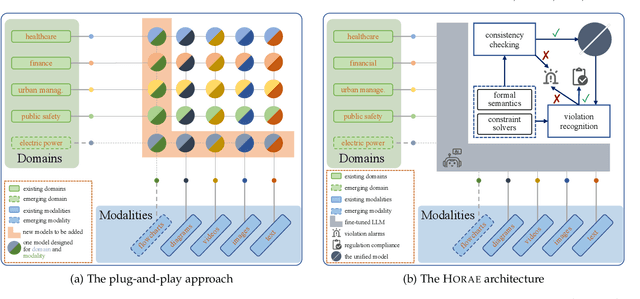
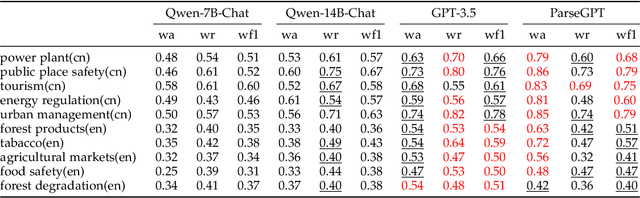

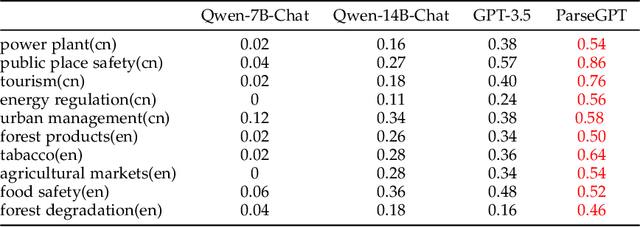
Artificial intelligence is rapidly encroaching on the field of service regulation. This work presents the design principles behind HORAE, a unified specification language to model multimodal regulation rules across a diverse set of domains. We show how HORAE facilitates an intelligent service regulation pipeline by further exploiting a fine-tuned large language model named HORAE that automates the HORAE modeling process, thereby yielding an end-to-end framework for fully automated intelligent service regulation.
Easy Begun is Half Done: Spatial-Temporal Graph Modeling with ST-Curriculum Dropout
Nov 28, 2022
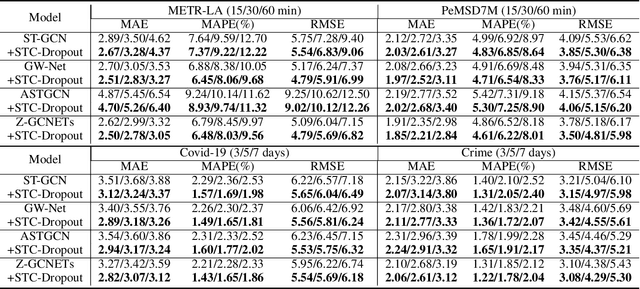


Spatial-temporal (ST) graph modeling, such as traffic speed forecasting and taxi demand prediction, is an important task in deep learning area. However, for the nodes in graph, their ST patterns can vary greatly in difficulties for modeling, owning to the heterogeneous nature of ST data. We argue that unveiling the nodes to the model in a meaningful order, from easy to complex, can provide performance improvements over traditional training procedure. The idea has its root in Curriculum Learning which suggests in the early stage of training models can be sensitive to noise and difficult samples. In this paper, we propose ST-Curriculum Dropout, a novel and easy-to-implement strategy for spatial-temporal graph modeling. Specifically, we evaluate the learning difficulty of each node in high-level feature space and drop those difficult ones out to ensure the model only needs to handle fundamental ST relations at the beginning, before gradually moving to hard ones. Our strategy can be applied to any canonical deep learning architecture without extra trainable parameters, and extensive experiments on a wide range of datasets are conducted to illustrate that, by controlling the difficulty level of ST relations as the training progresses, the model is able to capture better representation of the data and thus yields better generalization.