 Add to Chrome
 Add to Firefox
 Add to Edge
When Does Multimodal Learning Help in Healthcare? A Benchmark on EHR and Chest X-Ray Fusion
Feb 27, 2026
Machine learning holds promise for advancing clinical decision support, yet it remains unclear when multimodal learning truly helps in practice, particularly under modality missingness and fairness constraints. In this work, we conduct a systematic benchmark of multimodal fusion between Electronic Health Records (EHR) and chest X-rays (CXR) on standardized cohorts from MIMIC-IV and MIMIC-CXR, aiming to answer four fundamental questions: when multimodal fusion improves clinical prediction, how different fusion strategies compare, how robust existing methods are to missing modalities, and whether multimodal models achieve algorithmic fairness. Our study reveals several key insights. Multimodal fusion improves performance when modalities are complete, with gains concentrating in diseases that require complementary information from both EHR and CXR. While cross-modal learning mechanisms capture clinically meaningful dependencies beyond simple concatenation, the rich temporal structure of EHR introduces strong modality imbalance that architectural complexity alone cannot overcome. Under realistic missingness, multimodal benefits rapidly degrade unless models are explicitly designed to handle incomplete inputs. Moreover, multimodal fusion does not inherently improve fairness, with subgroup disparities mainly arising from unequal sensitivity across demographic groups. To support reproducible and extensible evaluation, we further release a flexible benchmarking toolkit that enables plug-and-play integration of new models and datasets. Together, this work provides actionable guidance on when multimodal learning helps, when it fails, and why, laying the foundation for developing clinically deployable multimodal systems that are both effective and reliable. The open-source toolkit can be found at https://github.com/jakeykj/CareBench.

Rethinking Diffusion Models with Symmetries through Canonicalization with Applications to Molecular Graph Generation
Feb 16, 2026Many generative tasks in chemistry and science involve distributions invariant to group symmetries (e.g., permutation and rotation). A common strategy enforces invariance and equivariance through architectural constraints such as equivariant denoisers and invariant priors. In this paper, we challenge this tradition through the alternative canonicalization perspective: first map each sample to an orbit representative with a canonical pose or order, train an unconstrained (non-equivariant) diffusion or flow model on the canonical slice, and finally recover the invariant distribution by sampling a random symmetry transform at generation time. Building on a formal quotient-space perspective, our work provides a comprehensive theory of canonical diffusion by proving: (i) the correctness, universality and superior expressivity of canonical generative models over invariant targets; (ii) canonicalization accelerates training by removing diffusion score complexity induced by group mixtures and reducing conditional variance in flow matching. We then show that aligned priors and optimal transport act complementarily with canonicalization and further improves training efficiency. We instantiate the framework for molecular graph generation under $S_n \times SE(3)$ symmetries. By leveraging geometric spectra-based canonicalization and mild positional encodings, canonical diffusion significantly outperforms equivariant baselines in 3D molecule generation tasks, with similar or even less computation. Moreover, with a novel architecture Canon, CanonFlow achieves state-of-the-art performance on the challenging GEOM-DRUG dataset, and the advantage remains large in few-step generation.
GR-Diffusion: 3D Gaussian Representation Meets Diffusion in Whole-Body PET Reconstruction
Feb 12, 2026Positron emission tomography (PET) reconstruction is a critical challenge in molecular imaging, often hampered by noise amplification, structural blurring, and detail loss due to sparse sampling and the ill-posed nature of inverse problems. The three-dimensional discrete Gaussian representation (GR), which efficiently encodes 3D scenes using parameterized discrete Gaussian distributions, has shown promise in computer vision. In this work, we pro-pose a novel GR-Diffusion framework that synergistically integrates the geometric priors of GR with the generative power of diffusion models for 3D low-dose whole-body PET reconstruction. GR-Diffusion employs GR to generate a reference 3D PET image from projection data, establishing a physically grounded and structurally explicit benchmark that overcomes the low-pass limitations of conventional point-based or voxel-based methods. This reference image serves as a dual guide during the diffusion process, ensuring both global consistency and local accuracy. Specifically, we employ a hierarchical guidance mechanism based on the GR reference. Fine-grained guidance leverages differences to refine local details, while coarse-grained guidance uses multi-scale difference maps to correct deviations. This strategy allows the diffusion model to sequentially integrate the strong geometric prior from GR and recover sub-voxel information. Experimental results on the UDPET and Clinical datasets with varying dose levels show that GR-Diffusion outperforms state-of-the-art methods in enhancing 3D whole-body PET image quality and preserving physiological details.
Improving Data and Reward Design for Scientific Reasoning in Large Language Models
Feb 09, 2026Solving open-ended science questions remains challenging for large language models, particularly due to inherently unreliable supervision and evaluation. The bottleneck lies in the data construction and reward design for scientific post-training. We develop a large-scale, systematic data processing pipeline that transforms heterogeneous open-source science data into Dr. SCI dataset, which comprises of 1M questions across eight STEM subjects, with explicit verifiable/open-ended splits, scalable difficulty annotation, and fine-grained rubrics that operationalize evaluation for open-ended answers. Building on this dataset, we propose the Dr. SCI post-training pipeline, which redesigns the standard SFT -> RL workflow through three components: (i) Exploration-Expanding SFT, which broadens the model's reasoning pattern coverage prior to RL; (ii) Dynamic Difficulty Curriculum, which adapts training data to the model's evolving scientific capability; and (iii) SciRubric-Guided RL, which enables stable reinforcement learning on open-ended scientific questions via rubric-based evaluation with explicit answer correctness. Qwen3-4B-Base trained using Dr.SCI pipeline achieves 63.2 on GPQA-diamond and 32.4 on GPQA-general, consistently improves over strong post-trained baselines such as o1-mini and GPT-4o, demonstrating substantial gains in scientific reasoning, especially in open-ended settings.
A2Eval: Agentic and Automated Evaluation for Embodied Brain
Feb 02, 2026Current embodied VLM evaluation relies on static, expert-defined, manually annotated benchmarks that exhibit severe redundancy and coverage imbalance. This labor intensive paradigm drains computational and annotation resources, inflates costs, and distorts model rankings, ultimately stifling iterative development. To address this, we propose Agentic Automatic Evaluation (A2Eval), the first agentic framework that automates benchmark curation and evaluation through two collaborative agents. The Data Agent autonomously induces capability dimensions and assembles a balanced, compact evaluation suite, while the Eval Agent synthesizes and validates executable evaluation pipelines, enabling fully autonomous, high-fidelity assessment. Evaluated across 10 benchmarks and 13 models, A2Eval compresses evaluation suites by 85%, reduces overall computational costs by 77%, and delivers a 4.6x speedup while preserving evaluation quality. Crucially, A2Eval corrects systematic ranking biases, improves human alignment to Spearman's rho=0.85, and maintains high ranking fidelity (Kendall's tau=0.81), establishing a new standard for high-fidelity, low-cost embodied assessment. Our code and data will be public soon.
Accurate Calibration and Robust LiDAR-Inertial Odometry for Spinning Actuated LiDAR Systems
Jan 24, 2026Accurate calibration and robust localization are fundamental for downstream tasks in spinning actuated LiDAR applications. Existing methods, however, require parameterizing extrinsic parameters based on different mounting configurations, limiting their generalizability. Additionally, spinning actuated LiDAR inevitably scans featureless regions, which complicates the balance between scanning coverage and localization robustness. To address these challenges, this letter presents a targetless LiDAR-motor calibration (LM-Calibr) on the basis of the Denavit-Hartenberg convention and an environmental adaptive LiDAR-inertial odometry (EVA-LIO). LM-Calibr supports calibration of LiDAR-motor systems with various mounting configurations. Extensive experiments demonstrate its accuracy and convergence across different scenarios, mounting angles, and initial values. Additionally, EVA-LIO adaptively selects downsample rates and map resolutions according to spatial scale. This adaptivity enables the actuator to operate at maximum speed, thereby enhancing scanning completeness while ensuring robust localization, even when LiDAR briefly scans featureless areas. The source code and hardware design are available on GitHub: \textcolor{blue}{\href{https://github.com/zijiechenrobotics/lm_calibr}{github.com/zijiechenrobotics/lm\_calibr}}. The video is available at \textcolor{blue}{\href{https://youtu.be/cZyyrkmeoSk}{youtu.be/cZyyrkmeoSk}}
Breaking the Data Barrier -- Building GUI Agents Through Task Generalization
Apr 15, 2025Graphical User Interface (GUI) agents offer cross-platform solutions for automating complex digital tasks, with significant potential to transform productivity workflows. However, their performance is often constrained by the scarcity of high-quality trajectory data. To address this limitation, we propose training Vision Language Models (VLMs) on data-rich, reasoning-intensive tasks during a dedicated mid-training stage, and then examine how incorporating these tasks facilitates generalization to GUI planning scenarios. Specifically, we explore a range of tasks with readily available instruction-tuning data, including GUI perception, multimodal reasoning, and textual reasoning. Through extensive experiments across 11 mid-training tasks, we demonstrate that: (1) Task generalization proves highly effective, yielding substantial improvements across most settings. For instance, multimodal mathematical reasoning enhances performance on AndroidWorld by an absolute 6.3%. Remarkably, text-only mathematical data significantly boosts GUI web agent performance, achieving a 5.6% improvement on WebArena and 5.4% improvement on AndroidWorld, underscoring notable cross-modal generalization from text-based to visual domains; (2) Contrary to prior assumptions, GUI perception data - previously considered closely aligned with GUI agent tasks and widely utilized for training - has a comparatively limited impact on final performance; (3) Building on these insights, we identify the most effective mid-training tasks and curate optimized mixture datasets, resulting in absolute performance gains of 8.0% on WebArena and 12.2% on AndroidWorld. Our work provides valuable insights into cross-domain knowledge transfer for GUI agents and offers a practical approach to addressing data scarcity challenges in this emerging field. The code, data and models will be available at https://github.com/hkust-nlp/GUIMid.
Process Reward Modeling with Entropy-Driven Uncertainty
Mar 28, 2025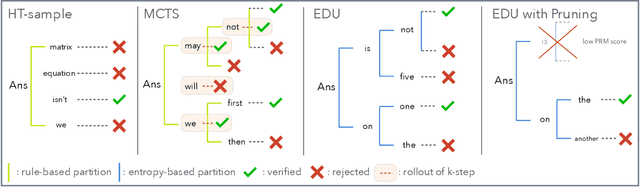
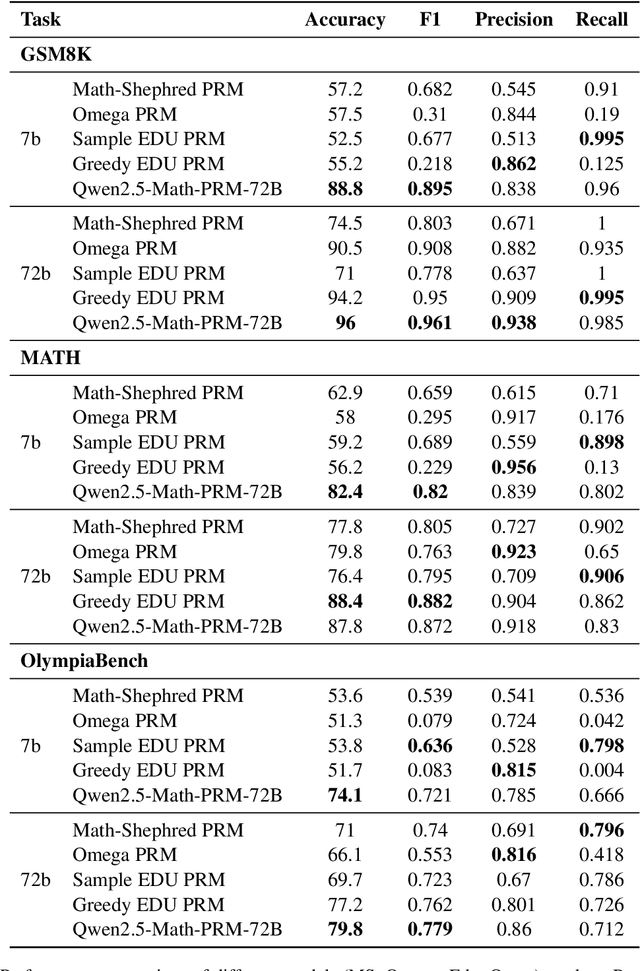
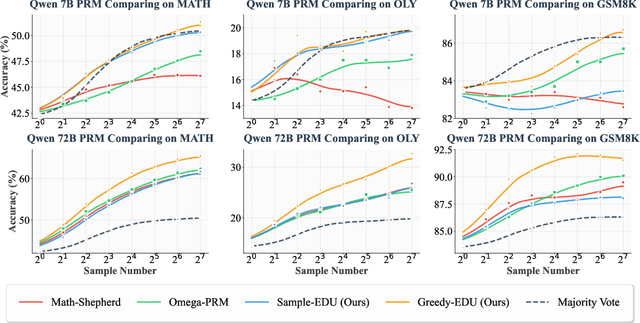
This paper presents the Entropy-Driven Unified Process Reward Model (EDU-PRM), a novel framework that approximates state-of-the-art performance in process supervision while drastically reducing training costs. EDU-PRM introduces an entropy-guided dynamic step partitioning mechanism, using logit distribution entropy to pinpoint high-uncertainty regions during token generation dynamically. This self-assessment capability enables precise step-level feedback without manual fine-grained annotation, addressing a critical challenge in process supervision. Experiments on the Qwen2.5-72B model with only 7,500 EDU-PRM-generated training queries demonstrate accuracy closely approximating the full Qwen2.5-72B-PRM (71.1% vs. 71.6%), achieving a 98% reduction in query cost compared to prior methods. This work establishes EDU-PRM as an efficient approach for scalable process reward model training.
UBER: Uncertainty-Based Evolution with Large Language Models for Automatic Heuristic Design
Dec 30, 2024

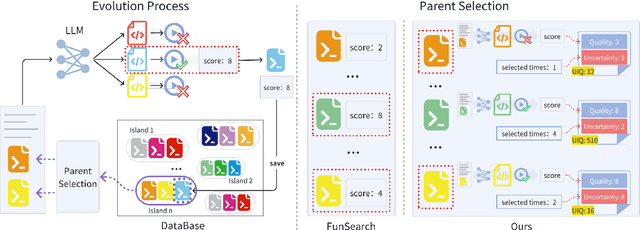

NP-hard problem-solving traditionally relies on heuristics, but manually crafting effective heuristics for complex problems remains challenging. While recent work like FunSearch has demonstrated that large language models (LLMs) can be leveraged for heuristic design in evolutionary algorithm (EA) frameworks, their potential is not fully realized due to its deficiency in exploitation and exploration. We present UBER (Uncertainty-Based Evolution for Refinement), a method that enhances LLM+EA methods for automatic heuristic design by integrating uncertainty on top of the FunSearch framework. UBER introduces two key innovations: an Uncertainty-Inclusive Evolution Process (UIEP) for adaptive exploration-exploitation balance, and a principled Uncertainty-Inclusive Island Reset (UIIS) strategy for maintaining population diversity. Through extensive experiments on challenging NP-complete problems, UBER demonstrates significant improvements over FunSearch. Our work provides a new direction for the synergy of LLMs and EA, advancing the field of automatic heuristic design.
Quality and Quantity: Unveiling a Million High-Quality Images for Text-to-Image Synthesis in Fashion Design
Nov 29, 2023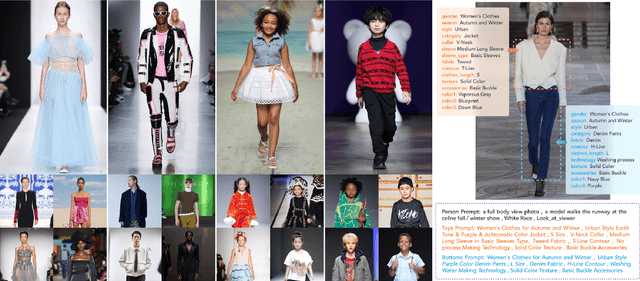
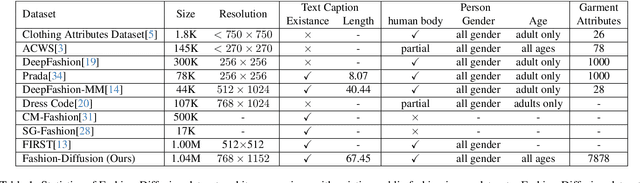
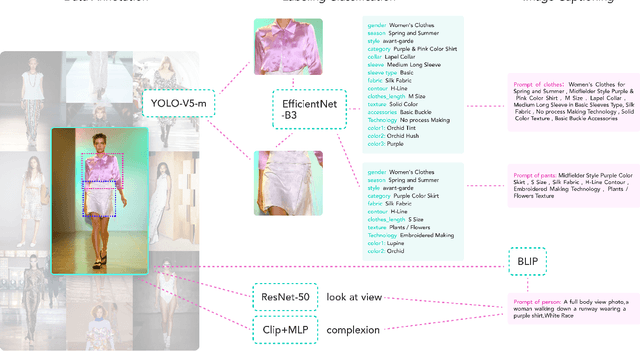
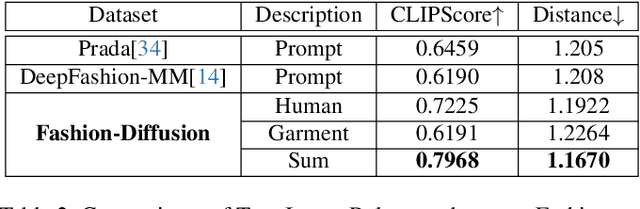
The fusion of AI and fashion design has emerged as a promising research area. However, the lack of extensive, interrelated data on clothing and try-on stages has hindered the full potential of AI in this domain. Addressing this, we present the Fashion-Diffusion dataset, a product of multiple years' rigorous effort. This dataset, the first of its kind, comprises over a million high-quality fashion images, paired with detailed text descriptions. Sourced from a diverse range of geographical locations and cultural backgrounds, the dataset encapsulates global fashion trends. The images have been meticulously annotated with fine-grained attributes related to clothing and humans, simplifying the fashion design process into a Text-to-Image (T2I) task. The Fashion-Diffusion dataset not only provides high-quality text-image pairs and diverse human-garment pairs but also serves as a large-scale resource about humans, thereby facilitating research in T2I generation. Moreover, to foster standardization in the T2I-based fashion design field, we propose a new benchmark comprising multiple datasets for evaluating the performance of fashion design models. This work represents a significant leap forward in the realm of AI-driven fashion design, setting a new standard for future research in this field.