 Add to Chrome
 Add to Firefox
 Add to Edge
Making Your LLMs More Objective: Stabilizing LLM Safety Behavior Across Traits with Trait-Invariant Safety Tuning
Aug 12, 2026
Aligned large language models (LLMs) are expected to exhibit safety behavior based on the content of the user request: they should refuse unsafe requests and comply with safe ones. However, we show that the same request can elicit substantially different safety decisions under different traits assigned in the system prompt, a failure mode we call trait-induced safety variation. To measure this failure, we introduce refusal-based metrics: Trait-Induced Deviation measures dataset-level deviation from the no-trait baseline, while Trait-Induced Flip Rate measures whether the same request receives different safety decisions across traits. We then provide a representation-level analysis of the mechanism behind trait-induced safety shifts and find that traits perturb the model's safety representations within a low-dimensional subspace. To achieve trait-invariant safety, where safety behavior remains stable across traits, we introduce Trait-Invariant Safety Tuning (TIST), a simple yet effective self-distillation framework that aligns an LLM's trait-conditioned behavior with its no-trait behavior. Guided by our analysis, we further propose Trait-Subspace Neutralization (TraSN), an instantiation of TIST, which enforces invariance only within the identified trait subspace. Experiments show that TraSN improves trait-invariant safety and strengthens harmful-request safety while preserving general capability. Our results highlight traits as an important factor in LLM safety and robust model behavior.

GuideSkill: Evolving Executable LLM Agent Skills for Guideline-Grounded Clinical Reasoning
Jul 28, 2026Clinical practice guidelines (CPGs) encode diagnostic criteria, but LLM systems typically retrieve guideline text or absorb it through training rather than execute its rules. We introduce GuideSkill, an external reasoning layer that compiles disease-specific criteria into executable functions returning ordinal diagnostic-support scores. GuideSkill-Zero is initialized from guidelines, while GuideSkill-Evo uses case--diagnosis pairs to refine covered skills and add missing diagnoses. At inference, an LLM proposes a differential diagnosis, grounds the features required by each matched skill, and fuses its ranking with the executed skill scores. Across four benchmarks and four backbones, GuideSkill-Zero improves macro-average accuracy over guideline RAG by 13.45% on average. GuideSkill-Evo achieves the highest macro-average for every backbone, improves over direct inference by 18.49% relatively, and increases gold-label skill coverage from 56.5% to 99.5%. On Qwen3.5-9B, it also exceeds the strongest parameter-update baseline by 11.16% without updating the backbone. Expert evaluation further indicates that GuideSkill produces clinically sound and broadly acceptable skills, suggesting that its initialized and evolved rules are reliable and practically meaningful. These results support executable skills as a model-agnostic mechanism for combining guideline-derived procedures with case-derived diagnostic patterns.
Z-1: Efficient Reinforcement Learning for Vision-Language-Action Models
Jun 30, 2026Vision-Language-Action (VLA) models offer a promising framework for robotic manipulation by connecting language instructions, visual observations, and continuous control. However, most existing policies remain limited by behavior cloning or supervised fine-tuning (SFT) from fixed demonstrations, which provides limited opportunity to improve from the policy's own failures. In this paper, we present Z-1, a reinforcement learning (RL) post-training framework for flow-based VLA models. Built on top of $π_{0.5}$, Z-1 uses only publicly released RoboCasa demonstrations for SFT and then applies a task-wise Group Relative Policy Optimization (GRPO) strategy across $24$ standard RoboCasa tasks. To improve the efficiency and stability of online optimization, Z-1 combines shared-prefix rollout construction, tree-structured trajectory branching, completion-aware reward calibration, and selective joint training of VLM and Action Expert. Across all $24$ RoboCasa tasks, Z-1 achieves an average success rate of $80.6\%$, improving over its SFT initialization by $13.2\%$ points and outperforms the published sota models. These results show that systematic GRPO post-training can substantially improve flow-based VLA policies without additional private demonstrations.
MedGuideX: Internalizing Decision Logic from Executable Guidelines into Large Language Models for Clinical Reasoning
May 26, 2026Clinical practice guidelines (CPGs) encode evidence-based decision logic that clinicians apply by evaluating patient variables, conditional criteria, and recommendation rules. However, existing methods often use CPGs as free-text training data or retrieval sources, underutilizing their procedural decision structure. To better exploit this structure, we introduce a guideline-derived training pipeline that transforms CPG recommendations into executable clinical decision logic and uses it to generate factual and counterfactual question-answering data. Theses data teach models both guideline-supported decisions and how decisions change under different patient conditions. Post-training a medical LLM on the generated data yields MedGuideX. Across four clinical reasoning benchmarks, MedGuideX achieves a 10.28% relative improvement in average accuracy. Physician evaluation further shows that MedGuideX better recovers clinician authored reasoning steps and produces physician-preferred rationales in faithfulness, validity, completeness, and clarity. Overall, our results show that executable decision logic from CPGs can be transformed into scalable supervision for building reliable medical LLMs.
RAG or Learning? Understanding the Limits of LLM Adaptation under Continuous Knowledge Drift in the Real World
Apr 06, 2026Large language models (LLMs) acquire most of their knowledge during pretraining, which ties them to a fixed snapshot of the world and makes adaptation to continuously evolving knowledge challenging. As facts, entities, and events change over time, models may experience continuous knowledge drift, resulting not only in outdated predictions but also in temporally inconsistent reasoning. Although existing approaches, such as continual finetuning, knowledge editing, and retrieval-augmented generation (RAG), aim to update or supplement model knowledge, they are rarely evaluated in settings that reflect chronological, evolving, and real-world knowledge evolution. In this work, we introduce a new benchmark of real-world dynamic events, constructed from time-stamped evidence that captures how knowledge evolves over time, which enables systematic evaluation of model adaptation under continuous knowledge drift. The benchmark reveals that most existing methods, including vanilla RAG and several learning-based approaches, struggle under this setting, exposing critical limitations such as catastrophic forgetting and temporal inconsistency. To mitigate these limitations, we propose a time-aware retrieval baseline, Chronos, which progressively organizes retrieved evidence into an Event Evolution Graph to enable more temporally consistent understanding in LLMs without additional training. Overall, this work provides a foundation for analyzing and advancing LLM adaptation to continuous knowledge drift in realistic settings.
SupChain-Bench: Benchmarking Large Language Models for Real-World Supply Chain Management
Feb 07, 2026Large language models (LLMs) have shown promise in complex reasoning and tool-based decision making, motivating their application to real-world supply chain management. However, supply chain workflows require reliable long-horizon, multi-step orchestration grounded in domain-specific procedures, which remains challenging for current models. To systematically evaluate LLM performance in this setting, we introduce SupChain-Bench, a unified real-world benchmark that assesses both supply chain domain knowledge and long-horizon tool-based orchestration grounded in standard operating procedures (SOPs). Our experiments reveal substantial gaps in execution reliability across models. We further propose SupChain-ReAct, an SOP-free framework that autonomously synthesizes executable procedures for tool use, achieving the strongest and most consistent tool-calling performance. Our work establishes a principled benchmark for studying reliable long-horizon orchestration in real-world operational settings and highlights significant room for improvement in LLM-based supply chain agents.
EHR-RAG: Bridging Long-Horizon Structured Electronic Health Records and Large Language Models via Enhanced Retrieval-Augmented Generation
Jan 29, 2026Electronic Health Records (EHRs) provide rich longitudinal clinical evidence that is central to medical decision-making, motivating the use of retrieval-augmented generation (RAG) to ground large language model (LLM) predictions. However, long-horizon EHRs often exceed LLM context limits, and existing approaches commonly rely on truncation or vanilla retrieval strategies that discard clinically relevant events and temporal dependencies. To address these challenges, we propose EHR-RAG, a retrieval-augmented framework designed for accurate interpretation of long-horizon structured EHR data. EHR-RAG introduces three components tailored to longitudinal clinical prediction tasks: Event- and Time-Aware Hybrid EHR Retrieval to preserve clinical structure and temporal dynamics, Adaptive Iterative Retrieval to progressively refine queries in order to expand broad evidence coverage, and Dual-Path Evidence Retrieval and Reasoning to jointly retrieves and reasons over both factual and counterfactual evidence. Experiments across four long-horizon EHR prediction tasks show that EHR-RAG consistently outperforms the strongest LLM-based baselines, achieving an average Macro-F1 improvement of 10.76%. Overall, our work highlights the potential of retrieval-augmented LLMs to advance clinical prediction on structured EHR data in practice.
TreeAdv: Tree-Structured Advantage Redistribution for Group-Based RL
Jan 07, 2026Reinforcement learning with group-based objectives, such as Group Relative Policy Optimization (GRPO), is a common framework for aligning large language models on complex reasoning tasks. However, standard GRPO treats each rollout trajectory as an independent flat sequence and assigns a single sequence-level advantage to all tokens, which leads to sample inefficiency and a length bias toward verbose, redundant chains of thought without improving logical depth. We introduce TreeAdv (Tree-Structured Advantage Redistribution for Group-Based RL), which makes the tree structure of group rollouts explicit for both exploration and advantage assignment. Specifically, TreeAdv builds a group of trees (a forest) based on an entropy-driven sampling method where each tree branches at high-uncertainty decisions while sharing low-uncertainty tokens across rollouts. Then, TreeAdv aggregates token-level advantages for internal tree segments by redistributing the advantages of complete rollouts (all leaf nodes), and TreeAdv can easily apply to group-based objectives such as GRPO or GSPO. Across 10 math reasoning benchmarks, TreeAdv consistently outperforms GRPO and GSPO, while using substantially fewer generated tokens under identical supervision, data, and decoding budgets.
Bingo: Boosting Efficient Reasoning of LLMs via Dynamic and Significance-based Reinforcement Learning
Jun 09, 2025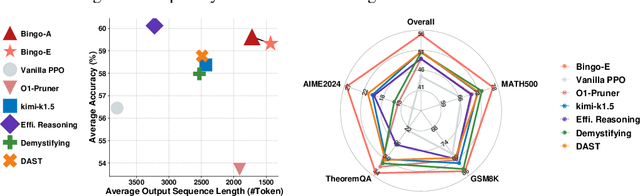
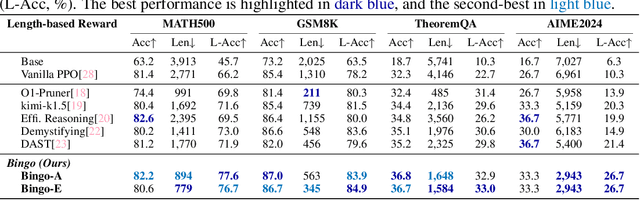
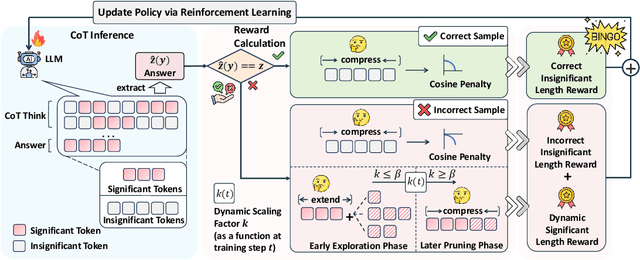
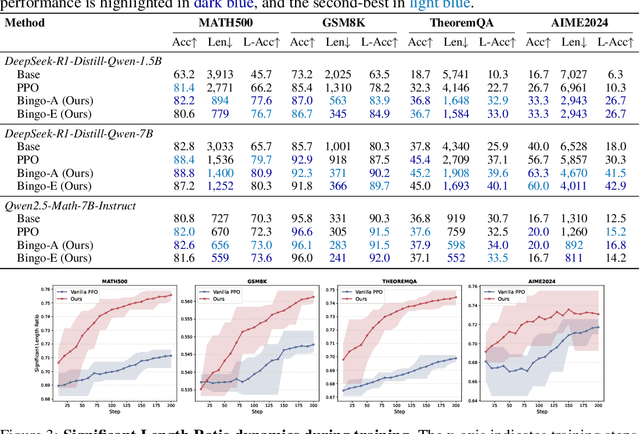
Large language models have demonstrated impressive reasoning capabilities, yet they often suffer from inefficiencies due to unnecessarily verbose or redundant outputs. While many works have explored reinforcement learning (RL) to enhance reasoning abilities, most primarily focus on improving accuracy, with limited attention to reasoning efficiency. Some existing approaches introduce direct length-based rewards to encourage brevity, but this often leads to noticeable drops in accuracy. In this paper, we propose Bingo, an RL framework that advances length-based reward design to boost efficient reasoning. Bingo incorporates two key mechanisms: a significance-aware length reward, which gradually guides the model to reduce only insignificant tokens, and a dynamic length reward, which initially encourages elaborate reasoning for hard questions but decays over time to improve overall efficiency. Experiments across multiple reasoning benchmarks show that Bingo improves both accuracy and efficiency. It outperforms the vanilla reward and several other length-based reward baselines in RL, achieving a favorable trade-off between accuracy and efficiency. These results underscore the potential of training LLMs explicitly for efficient reasoning.
Fortune: Formula-Driven Reinforcement Learning for Symbolic Table Reasoning in Language Models
May 29, 2025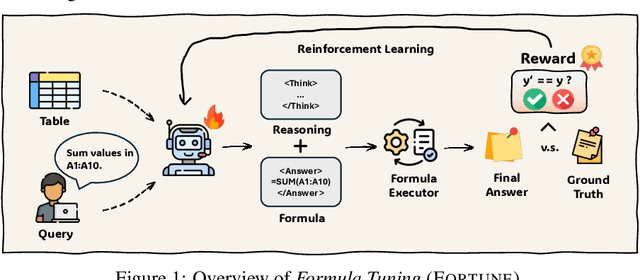
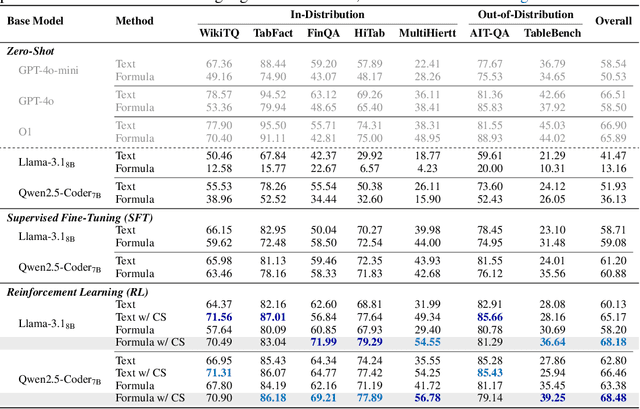

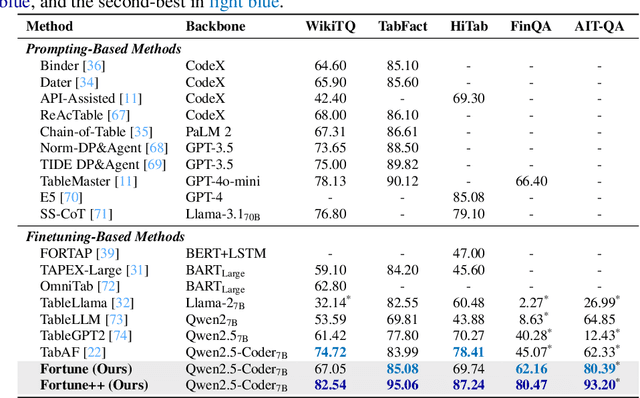
Tables are a fundamental structure for organizing and analyzing data, making effective table understanding a critical capability for intelligent systems. While large language models (LMs) demonstrate strong general reasoning abilities, they continue to struggle with accurate numerical or symbolic reasoning over tabular data, especially in complex scenarios. Spreadsheet formulas provide a powerful and expressive medium for representing executable symbolic operations, encoding rich reasoning patterns that remain largely underutilized. In this paper, we propose Formula Tuning (Fortune), a reinforcement learning (RL) framework that trains LMs to generate executable spreadsheet formulas for question answering over general tabular data. Formula Tuning reduces the reliance on supervised formula annotations by using binary answer correctness as a reward signal, guiding the model to learn formula derivation through reasoning. We provide a theoretical analysis of its advantages and demonstrate its effectiveness through extensive experiments on seven table reasoning benchmarks. Formula Tuning substantially enhances LM performance, particularly on multi-step numerical and symbolic reasoning tasks, enabling a 7B model to outperform O1 on table understanding. This highlights the potential of formula-driven RL to advance symbolic table reasoning in LMs.