 Add to Chrome
 Add to Firefox
 Add to Edge
Z-1: Efficient Reinforcement Learning for Vision-Language-Action Models
Jun 30, 2026
Vision-Language-Action (VLA) models offer a promising framework for robotic manipulation by connecting language instructions, visual observations, and continuous control. However, most existing policies remain limited by behavior cloning or supervised fine-tuning (SFT) from fixed demonstrations, which provides limited opportunity to improve from the policy's own failures. In this paper, we present Z-1, a reinforcement learning (RL) post-training framework for flow-based VLA models. Built on top of $π_{0.5}$, Z-1 uses only publicly released RoboCasa demonstrations for SFT and then applies a task-wise Group Relative Policy Optimization (GRPO) strategy across $24$ standard RoboCasa tasks. To improve the efficiency and stability of online optimization, Z-1 combines shared-prefix rollout construction, tree-structured trajectory branching, completion-aware reward calibration, and selective joint training of VLM and Action Expert. Across all $24$ RoboCasa tasks, Z-1 achieves an average success rate of $80.6\%$, improving over its SFT initialization by $13.2\%$ points and outperforms the published sota models. These results show that systematic GRPO post-training can substantially improve flow-based VLA policies without additional private demonstrations.

TreeAdv: Tree-Structured Advantage Redistribution for Group-Based RL
Jan 07, 2026Reinforcement learning with group-based objectives, such as Group Relative Policy Optimization (GRPO), is a common framework for aligning large language models on complex reasoning tasks. However, standard GRPO treats each rollout trajectory as an independent flat sequence and assigns a single sequence-level advantage to all tokens, which leads to sample inefficiency and a length bias toward verbose, redundant chains of thought without improving logical depth. We introduce TreeAdv (Tree-Structured Advantage Redistribution for Group-Based RL), which makes the tree structure of group rollouts explicit for both exploration and advantage assignment. Specifically, TreeAdv builds a group of trees (a forest) based on an entropy-driven sampling method where each tree branches at high-uncertainty decisions while sharing low-uncertainty tokens across rollouts. Then, TreeAdv aggregates token-level advantages for internal tree segments by redistributing the advantages of complete rollouts (all leaf nodes), and TreeAdv can easily apply to group-based objectives such as GRPO or GSPO. Across 10 math reasoning benchmarks, TreeAdv consistently outperforms GRPO and GSPO, while using substantially fewer generated tokens under identical supervision, data, and decoding budgets.
Process Reward Modeling with Entropy-Driven Uncertainty
Mar 28, 2025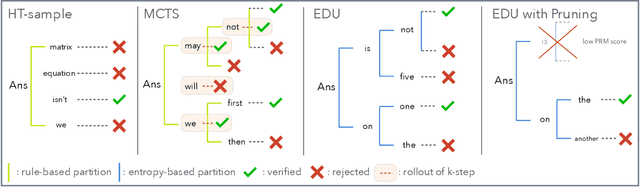
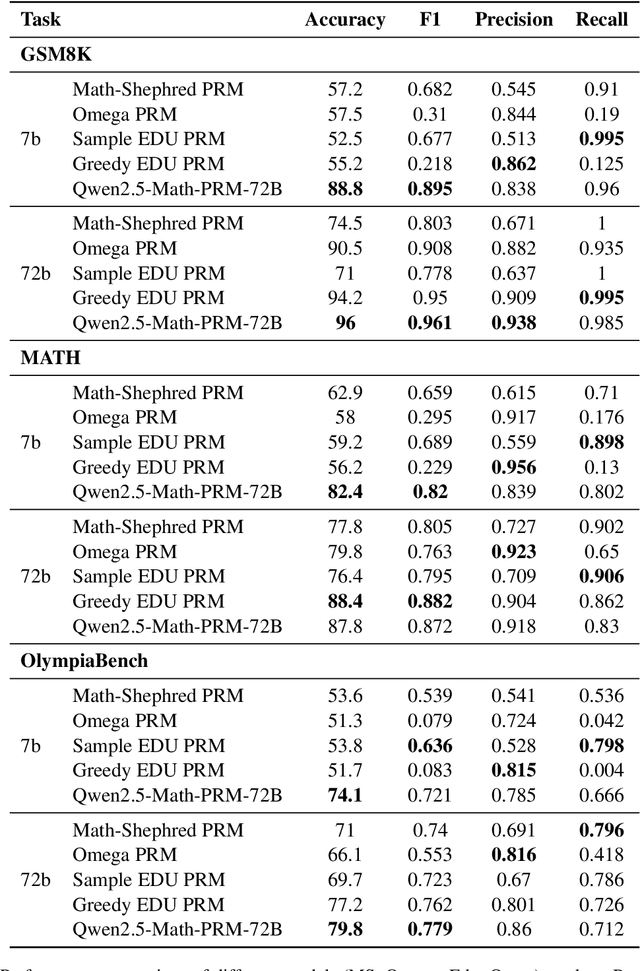
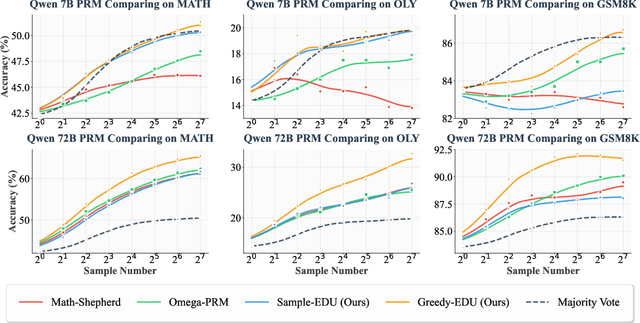
This paper presents the Entropy-Driven Unified Process Reward Model (EDU-PRM), a novel framework that approximates state-of-the-art performance in process supervision while drastically reducing training costs. EDU-PRM introduces an entropy-guided dynamic step partitioning mechanism, using logit distribution entropy to pinpoint high-uncertainty regions during token generation dynamically. This self-assessment capability enables precise step-level feedback without manual fine-grained annotation, addressing a critical challenge in process supervision. Experiments on the Qwen2.5-72B model with only 7,500 EDU-PRM-generated training queries demonstrate accuracy closely approximating the full Qwen2.5-72B-PRM (71.1% vs. 71.6%), achieving a 98% reduction in query cost compared to prior methods. This work establishes EDU-PRM as an efficient approach for scalable process reward model training.