 Add to Chrome
 Add to Firefox
 Add to Edge
SVSR: A Self-Verification and Self-Rectification Paradigm for Multimodal Reasoning
Apr 11, 2026
Current multimodal models often suffer from shallow reasoning, leading to errors caused by incomplete or inconsistent thought processes. To address this limitation, we propose Self-Verification and Self-Rectification (SVSR), a unified framework that explicitly integrates self-verification and self-rectification into the model's reasoning pipeline, substantially improving robustness and reliability in complex visual understanding and multimodal reasoning tasks. SVSR is built on a novel three-stage training paradigm. First, we construct a high-quality unified preference dataset by refining reasoning traces from pre-trained vision-language models, incorporating both forward and backward reasoning to embed self-reflective signals. Second, we perform cold-start supervised fine-tuning on this dataset to learn structured, multi-step reasoning behaviors. Third, we apply a Semi-online Direct Preference Optimization (Semi-online DPO) process, continuously augmenting the training corpus with high-quality, model-generated reasoning traces filtered by a powerful teacher VLM. This pipeline enables the model to learn, elicit, and refine its ability to self-verify and self-rectify. Extensive experiments across diverse benchmarks demonstrate that SVSR improves reasoning accuracy and enables stronger generalization to unseen tasks and question types. Notably, once trained with explicit self-reflective reasoning, the model also exhibits improved implicit reasoning ability, outperforming strong baselines even when no explicit reasoning traces are provided. These results highlight the potential of SVSR for building more dependable, introspective, and cognitively aligned multimodal systems.

Cognitive Pivot Points and Visual Anchoring: Unveiling and Rectifying Hallucinations in Multimodal Reasoning Models
Apr 11, 2026Multimodal Large Reasoning Models (MLRMs) have achieved remarkable strides in visual reasoning through test time compute scaling, yet long chain reasoning remains prone to hallucinations. We identify a concerning phenomenon termed the Reasoning Vision Truth Disconnect (RVTD): hallucinations are strongly correlated with cognitive bifurcation points that often exhibit high entropy states. We attribute this vulnerability to a breakdown in visual semantic anchoring, localized within the network's intermediate layers; specifically, during these high uncertainty transitions, the model fails to query visual evidence, reverting instead to language priors. Consequently, we advocate a shift from solely outcome level supervision to augmenting it with fine grained internal attention guidance. To this end, we propose V-STAR (Visual Structural Training with Attention Reinforcement), a lightweight, holistic training paradigm designed to internalize visually aware reasoning capabilities. Central to our approach is the Hierarchical Visual Attention Reward (HVAR), integrated within the GRPO framework. Upon detecting high entropy states, this mechanism dynamically incentivizes visual attention across critical intermediate layers, thereby anchoring the reasoning process back to the visual input. Furthermore, we introduce the Forced Reflection Mechanism (FRM), a trajectory editing strategy that disrupts cognitive inertia by triggering reflection around high entropy cognitive bifurcation points and encouraging verification of subsequent steps against the visual input, thereby translating external debiasing interventions into an intrinsic capability for hallucination mitigation.
Do No Harm: Exposing Hidden Vulnerabilities of LLMs via Persona-based Client Simulation Attack in Psychological Counseling
Apr 06, 2026The increasing use of large language models (LLMs) in mental healthcare raises safety concerns in high-stakes therapeutic interactions. A key challenge is distinguishing therapeutic empathy from maladaptive validation, where supportive responses may inadvertently reinforce harmful beliefs or behaviors in multi-turn conversations. This risk is largely overlooked by existing red-teaming frameworks, which focus mainly on generic harms or optimization-based attacks. To address this gap, we introduce Personality-based Client Simulation Attack (PCSA), the first red-teaming framework that simulates clients in psychological counseling through coherent, persona-driven client dialogues to expose vulnerabilities in psychological safety alignment. Experiments on seven general and mental health-specialized LLMs show that PCSA substantially outperforms four competitive baselines. Perplexity analysis and human inspection further indicate that PCSA generates more natural and realistic dialogues. Our results reveal that current LLMs remain vulnerable to domain-specific adversarial tactics, providing unauthorized medical advice, reinforcing delusions, and implicitly encouraging risky actions.
Thinking in Uncertainty: Mitigating Hallucinations in MLRMs with Latent Entropy-Aware Decoding
Mar 09, 2026Recent advancements in multimodal large reasoning models (MLRMs) have significantly improved performance in visual question answering. However, we observe that transition words (e.g., because, however, and wait) are closely associated with hallucinations and tend to exhibit high-entropy states. We argue that adequate contextual reasoning information can be directly extracted from the token probability distribution. Inspired by superposed representation theory, we propose leveraging latent superposed reasoning to integrate multiple candidate semantics and maintain latent reasoning trajectories. The hypothesis is that reliance on discrete textual inputs may drive the model toward sequential explicit reasoning, underutilizing dense contextual cues during high-entropy reasoning stages. Therefore, we propose constructing rich semantic representations from the token probability distributions to enhance in-context reasoning. With this goal, we present Latent Entropy-Aware Decoding (LEAD), an efficient plug-and-play decoding strategy that leverages semantic context to achieve reliable reasoning. The heart of our method lies in entropy-aware reasoning mode switching. The model employs probability-weighted continuous embeddings under high-entropy states and transitions back to discrete token embeddings as entropy decreases. Moreover, we propose a prior-guided visual anchor injection strategy that encourages the model to focus on visual information. Extensive experiments show that LEAD effectively mitigates hallucinations across various MLRMs on multiple benchmarks.
PsychEthicsBench: Evaluating Large Language Models Against Australian Mental Health Ethics
Jan 07, 2026The increasing integration of large language models (LLMs) into mental health applications necessitates robust frameworks for evaluating professional safety alignment. Current evaluative approaches primarily rely on refusal-based safety signals, which offer limited insight into the nuanced behaviors required in clinical practice. In mental health, clinically inadequate refusals can be perceived as unempathetic and discourage help-seeking. To address this gap, we move beyond refusal-centric metrics and introduce \texttt{PsychEthicsBench}, the first principle-grounded benchmark based on Australian psychology and psychiatry guidelines, designed to evaluate LLMs' ethical knowledge and behavioral responses through multiple-choice and open-ended tasks with fine-grained ethicality annotations. Empirical results across 14 models reveal that refusal rates are poor indicators of ethical behavior, revealing a significant divergence between safety triggers and clinical appropriateness. Notably, we find that domain-specific fine-tuning can degrade ethical robustness, as several specialized models underperform their base backbones in ethical alignment. PsychEthicsBench provides a foundation for systematic, jurisdiction-aware evaluation of LLMs in mental health, encouraging more responsible development in this domain.
A Survey of Scientific Large Language Models: From Data Foundations to Agent Frontiers
Aug 28, 2025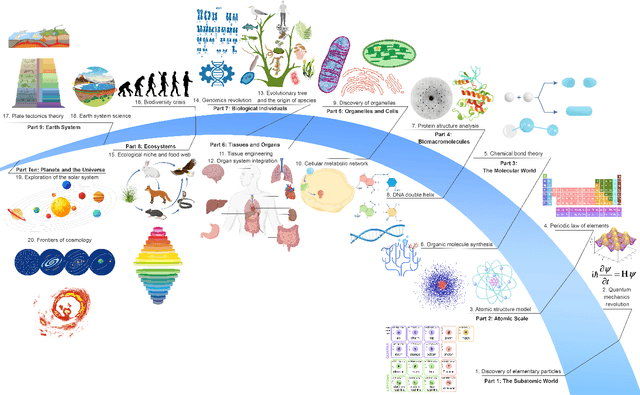
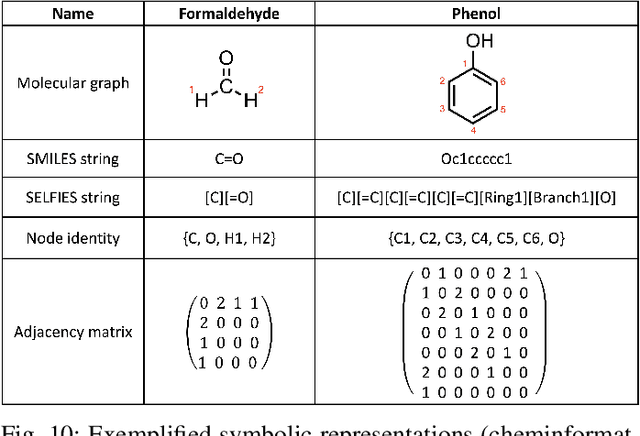
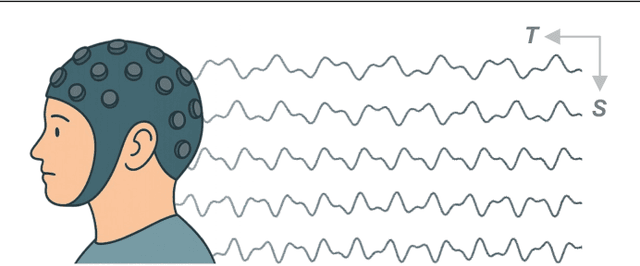
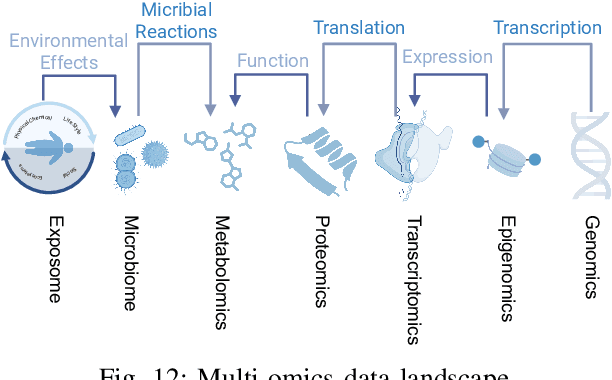
Scientific Large Language Models (Sci-LLMs) are transforming how knowledge is represented, integrated, and applied in scientific research, yet their progress is shaped by the complex nature of scientific data. This survey presents a comprehensive, data-centric synthesis that reframes the development of Sci-LLMs as a co-evolution between models and their underlying data substrate. We formulate a unified taxonomy of scientific data and a hierarchical model of scientific knowledge, emphasizing the multimodal, cross-scale, and domain-specific challenges that differentiate scientific corpora from general natural language processing datasets. We systematically review recent Sci-LLMs, from general-purpose foundations to specialized models across diverse scientific disciplines, alongside an extensive analysis of over 270 pre-/post-training datasets, showing why Sci-LLMs pose distinct demands -- heterogeneous, multi-scale, uncertainty-laden corpora that require representations preserving domain invariance and enabling cross-modal reasoning. On evaluation, we examine over 190 benchmark datasets and trace a shift from static exams toward process- and discovery-oriented assessments with advanced evaluation protocols. These data-centric analyses highlight persistent issues in scientific data development and discuss emerging solutions involving semi-automated annotation pipelines and expert validation. Finally, we outline a paradigm shift toward closed-loop systems where autonomous agents based on Sci-LLMs actively experiment, validate, and contribute to a living, evolving knowledge base. Collectively, this work provides a roadmap for building trustworthy, continually evolving artificial intelligence (AI) systems that function as a true partner in accelerating scientific discovery.
Seeing Far and Clearly: Mitigating Hallucinations in MLLMs with Attention Causal Decoding
May 22, 2025Recent advancements in multimodal large language models (MLLMs) have significantly improved performance in visual question answering. However, they often suffer from hallucinations. In this work, hallucinations are categorized into two main types: initial hallucinations and snowball hallucinations. We argue that adequate contextual information can be extracted directly from the token interaction process. Inspired by causal inference in the decoding strategy, we propose to leverage causal masks to establish information propagation between multimodal tokens. The hypothesis is that insufficient interaction between those tokens may lead the model to rely on outlier tokens, overlooking dense and rich contextual cues. Therefore, we propose to intervene in the propagation process by tackling outlier tokens to enhance in-context inference. With this goal, we present FarSight, a versatile plug-and-play decoding strategy to reduce attention interference from outlier tokens merely by optimizing the causal mask. The heart of our method is effective token propagation. We design an attention register structure within the upper triangular matrix of the causal mask, dynamically allocating attention to capture attention diverted to outlier tokens. Moreover, a positional awareness encoding method with a diminishing masking rate is proposed, allowing the model to attend to further preceding tokens, especially for video sequence tasks. With extensive experiments, FarSight demonstrates significant hallucination-mitigating performance across different MLLMs on both image and video benchmarks, proving its effectiveness.
Incomplete Modality Disentangled Representation for Ophthalmic Disease Grading and Diagnosis
Feb 17, 2025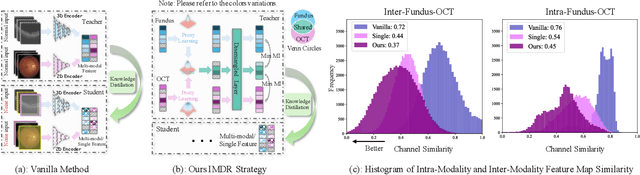
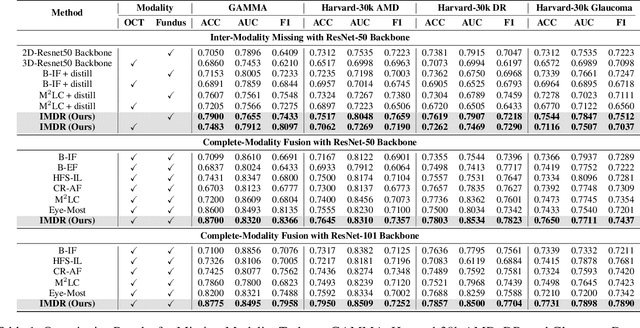
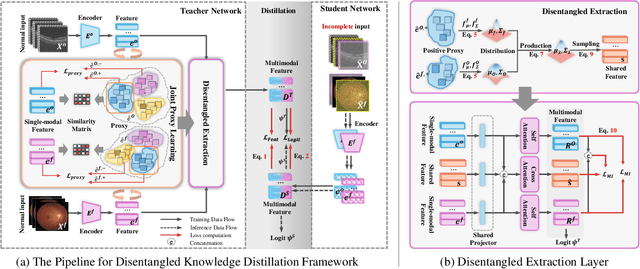
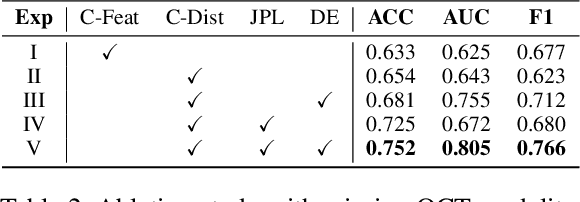
Ophthalmologists typically require multimodal data sources to improve diagnostic accuracy in clinical decisions. However, due to medical device shortages, low-quality data and data privacy concerns, missing data modalities are common in real-world scenarios. Existing deep learning methods tend to address it by learning an implicit latent subspace representation for different modality combinations. We identify two significant limitations of these methods: (1) implicit representation constraints that hinder the model's ability to capture modality-specific information and (2) modality heterogeneity, causing distribution gaps and redundancy in feature representations. To address these, we propose an Incomplete Modality Disentangled Representation (IMDR) strategy, which disentangles features into explicit independent modal-common and modal-specific features by guidance of mutual information, distilling informative knowledge and enabling it to reconstruct valuable missing semantics and produce robust multimodal representations. Furthermore, we introduce a joint proxy learning module that assists IMDR in eliminating intra-modality redundancy by exploiting the extracted proxies from each class. Experiments on four ophthalmology multimodal datasets demonstrate that the proposed IMDR outperforms the state-of-the-art methods significantly.
* 7 Pages, 6 figures
MMRC: A Large-Scale Benchmark for Understanding Multimodal Large Language Model in Real-World Conversation
Feb 17, 2025Recent multimodal large language models (MLLMs) have demonstrated significant potential in open-ended conversation, generating more accurate and personalized responses. However, their abilities to memorize, recall, and reason in sustained interactions within real-world scenarios remain underexplored. This paper introduces MMRC, a Multi-Modal Real-world Conversation benchmark for evaluating six core open-ended abilities of MLLMs: information extraction, multi-turn reasoning, information update, image management, memory recall, and answer refusal. With data collected from real-world scenarios, MMRC comprises 5,120 conversations and 28,720 corresponding manually labeled questions, posing a significant challenge to existing MLLMs. Evaluations on 20 MLLMs in MMRC indicate an accuracy drop during open-ended interactions. We identify four common failure patterns: long-term memory degradation, inadequacies in updating factual knowledge, accumulated assumption of error propagation, and reluctance to say no. To mitigate these issues, we propose a simple yet effective NOTE-TAKING strategy, which can record key information from the conversation and remind the model during its responses, enhancing conversational capabilities. Experiments across six MLLMs demonstrate significant performance improvements.
Neighbor Does Matter: Density-Aware Contrastive Learning for Medical Semi-supervised Segmentation
Dec 27, 2024
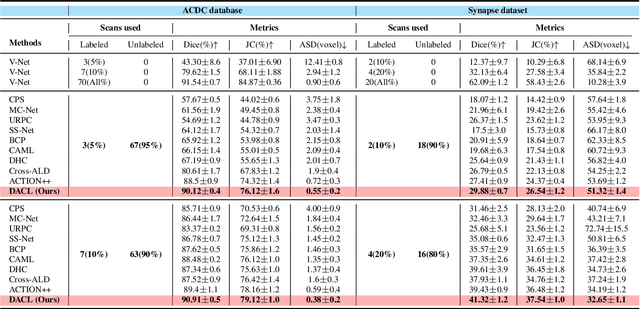

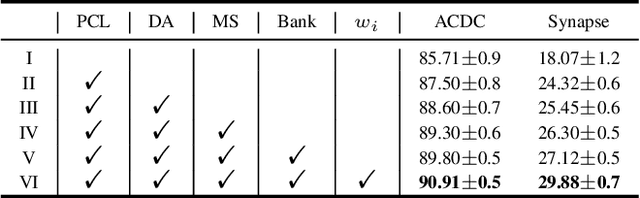
In medical image analysis, multi-organ semi-supervised segmentation faces challenges such as insufficient labels and low contrast in soft tissues. To address these issues, existing studies typically employ semi-supervised segmentation techniques using pseudo-labeling and consistency regularization. However, these methods mainly rely on individual data samples for training, ignoring the rich neighborhood information present in the feature space. In this work, we argue that supervisory information can be directly extracted from the geometry of the feature space. Inspired by the density-based clustering hypothesis, we propose using feature density to locate sparse regions within feature clusters. Our goal is to increase intra-class compactness by addressing sparsity issues. To achieve this, we propose a Density-Aware Contrastive Learning (DACL) strategy, pushing anchored features in sparse regions towards cluster centers approximated by high-density positive samples, resulting in more compact clusters. Specifically, our method constructs density-aware neighbor graphs using labeled and unlabeled data samples to estimate feature density and locate sparse regions. We also combine label-guided co-training with density-guided geometric regularization to form complementary supervision for unlabeled data. Experiments on the Multi-Organ Segmentation Challenge dataset demonstrate that our proposed method outperforms state-of-the-art methods, highlighting its efficacy in medical image segmentation tasks.