 Add to Chrome
 Add to Firefox
 Add to Edge
SAIF: A Stability-Aware Inference Framework for Medical Image Segmentation with Segment Anything Model
Mar 13, 2026
Segment Anything Model (SAM) enable scalable medical image segmentation but suffer from inference-time instability when deployed as a frozen backbone. In practice, bounding-box prompts often contain localization errors, and fixed threshold binarization introduces additional decision uncertainty. These factors jointly cause high prediction variance, especially near object boundaries, degrading reliability. We propose the Stability-Aware Inference Framework (SAIF), a training-free and plug-and-play inference framework that improves robustness by explicitly modeling prompt and threshold uncertainty. SAIF constructs a joint uncertainty space via structured box perturbations and threshold variations, evaluates each hypothesis using decision stability and boundary consistency, and introduces a stability-consistency score to filter unstable candidates and perform stability-weighted fusion in probability space. Experiments on Synapse, CVC-ClinicDB, Kvasir-SEG, and CVC-300 demonstrate that SAIF consistently improves segmentation accuracy and robustness, achieving state-of-the-art performance without retraining or architectural modification. Our anonymous code is released at https://anonymous.4open.science/r/SAIF.

Semantic Class Distribution Learning for Debiasing Semi-Supervised Medical Image Segmentation
Mar 05, 2026Medical image segmentation is critical for computer-aided diagnosis. However, dense pixel-level annotation is time-consuming and expensive, and medical datasets often exhibit severe class imbalance. Such imbalance causes minority structures to be overwhelmed by dominant classes in feature representations, hindering the learning of discriminative features and making reliable segmentation particularly challenging. To address this, we propose the Semantic Class Distribution Learning (SCDL) framework, a plug-and-play module that mitigates supervision and representation biases by learning structured class-conditional feature distributions. SCDL integrates Class Distribution Bidirectional Alignment (CDBA) to align embeddings with learnable class proxies and leverages Semantic Anchor Constraints (SAC) to guide proxies using labeled data. Experiments on the Synapse and AMOS datasets demonstrate that SCDL significantly improves segmentation performance across both overall and class-level metrics, with particularly strong gains on minority classes, achieving state-of-the-art results. Our code is released at https://github.com/Zyh55555/SCDL.
Neighbor Does Matter: Density-Aware Contrastive Learning for Medical Semi-supervised Segmentation
Dec 27, 2024
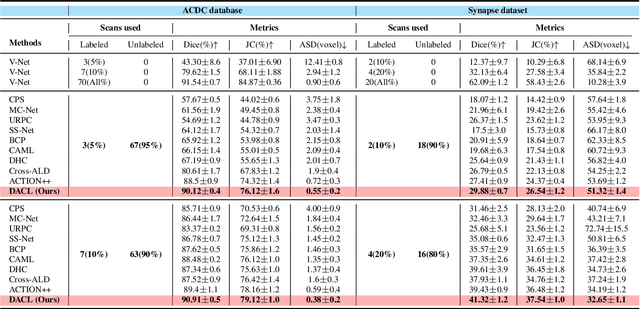

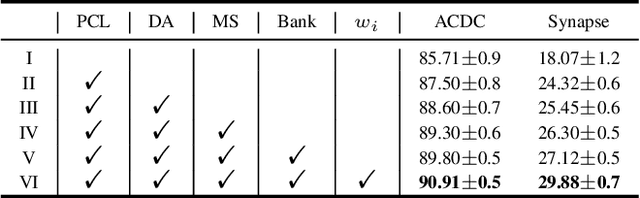
In medical image analysis, multi-organ semi-supervised segmentation faces challenges such as insufficient labels and low contrast in soft tissues. To address these issues, existing studies typically employ semi-supervised segmentation techniques using pseudo-labeling and consistency regularization. However, these methods mainly rely on individual data samples for training, ignoring the rich neighborhood information present in the feature space. In this work, we argue that supervisory information can be directly extracted from the geometry of the feature space. Inspired by the density-based clustering hypothesis, we propose using feature density to locate sparse regions within feature clusters. Our goal is to increase intra-class compactness by addressing sparsity issues. To achieve this, we propose a Density-Aware Contrastive Learning (DACL) strategy, pushing anchored features in sparse regions towards cluster centers approximated by high-density positive samples, resulting in more compact clusters. Specifically, our method constructs density-aware neighbor graphs using labeled and unlabeled data samples to estimate feature density and locate sparse regions. We also combine label-guided co-training with density-guided geometric regularization to form complementary supervision for unlabeled data. Experiments on the Multi-Organ Segmentation Challenge dataset demonstrate that our proposed method outperforms state-of-the-art methods, highlighting its efficacy in medical image segmentation tasks.