 Add to Chrome
 Add to Firefox
 Add to Edge
LaME: Learning to Think in Latent Space for Multimodal Embedding via Information Bottleneck
Jun 11, 2026
Reasoning-driven universal multimodal embedding has advanced rapidly by introducing Chain-of-Thought (CoT) reasoning into the embedding pipeline. Despite the strong performance across both general and complex tasks, this paradigm suffers from two core limitations: (i) autoregressive CoT reasoning incurs high computational cost, making it impractical for low-latency retrieval; and (ii) embedding performance is heavily coupled with CoT annotation quality, making large-scale training unreliable. These raise fundamental questions: Is textual CoT the optimal form of reasoning for embedding, and can effective embedding reasoning be accomplished in latent space? To this end, we propose LaME (Latent Reasoning Multimodal Embedding), which formulates embedding-oriented latent reasoning as a weakly supervised information bottleneck. LaME employs K learnable reason tokens as a fixed-capacity bottleneck, completing all reasoning within a single forward pass. The two weak supervision signals structurally decouple contrastive from autoregressive objectives and eliminate dependence on CoT annotations, while a two-stage training pipeline ensures stable convergence. Experiments on MMEB-v2 and MRMR show that LaME achieves competitive performance, surpassing some explicit CoT-based models, while delivering 60x faster inference than explicit CoT methods and 2x faster than latent baselines with throughput comparable to discriminative embedding models. Code will be released.

Beyond Chain-of-Thought: Rewrite as a Universal Interface for Generative Multimodal Embeddings
Apr 24, 2026Multimodal Large Language Models (MLLMs) have emerged as a promising foundation for universal multimodal embeddings. Recent studies have shown that reasoning-driven generative multimodal embeddings can outperform discriminative embeddings on several embedding tasks. However, Chain-of-Thought (CoT) reasoning tends to generate redundant thinking steps and introduce semantic ambiguity in the summarized answers in broader retrieval scenarios. To address this limitation, we propose Rewrite-driven Multimodal Embedding (RIME), a unified framework that jointly optimizes generation and embedding through a retrieval-friendly rewrite. Meanwhile, we present the Cross-Mode Alignment (CMA) to bridge the generative and discriminative embedding spaces, enabling flexible mutual retrieval to trade off efficiency and accuracy. Based on this, we also introduce Refine Reinforcement Learning (Refine-RL) that treats discriminative embeddings as stable semantic anchors to guide the rewrite optimization. Extensive experiments on MMEB-V2, MRMR and UVRB demonstrate that RIME substantially outperforms prior generative embedding models while significantly reducing the length of thinking.
SVSR: A Self-Verification and Self-Rectification Paradigm for Multimodal Reasoning
Apr 11, 2026Current multimodal models often suffer from shallow reasoning, leading to errors caused by incomplete or inconsistent thought processes. To address this limitation, we propose Self-Verification and Self-Rectification (SVSR), a unified framework that explicitly integrates self-verification and self-rectification into the model's reasoning pipeline, substantially improving robustness and reliability in complex visual understanding and multimodal reasoning tasks. SVSR is built on a novel three-stage training paradigm. First, we construct a high-quality unified preference dataset by refining reasoning traces from pre-trained vision-language models, incorporating both forward and backward reasoning to embed self-reflective signals. Second, we perform cold-start supervised fine-tuning on this dataset to learn structured, multi-step reasoning behaviors. Third, we apply a Semi-online Direct Preference Optimization (Semi-online DPO) process, continuously augmenting the training corpus with high-quality, model-generated reasoning traces filtered by a powerful teacher VLM. This pipeline enables the model to learn, elicit, and refine its ability to self-verify and self-rectify. Extensive experiments across diverse benchmarks demonstrate that SVSR improves reasoning accuracy and enables stronger generalization to unseen tasks and question types. Notably, once trained with explicit self-reflective reasoning, the model also exhibits improved implicit reasoning ability, outperforming strong baselines even when no explicit reasoning traces are provided. These results highlight the potential of SVSR for building more dependable, introspective, and cognitively aligned multimodal systems.
RiO-DETR: DETR for Real-time Oriented Object Detection
Mar 10, 2026We present RiO-DETR: DETR for Real-time Oriented Object Detection, the first real-time oriented detection transformer to the best of our knowledge. Adapting DETR to oriented bounding boxes (OBBs) poses three challenges: semantics-dependent orientation, angle periodicity that breaks standard Euclidean refinement, and an enlarged search space that slows convergence. RiO-DETR resolves these issues with task-native designs while preserving real-time efficiency. First, we propose Content-Driven Angle Estimation by decoupling angle from positional queries, together with Rotation-Rectified Orthogonal Attention to capture complementary cues for reliable orientation. Second, Decoupled Periodic Refinement combines bounded coarse-to-fine updates with a Shortest-Path Periodic Loss for stable learning across angular seams. Third, Oriented Dense O2O injects angular diversity into dense supervision to speed up angle convergence at no extra cost. Extensive experiments on DOTA-1.0, DIOR-R, and FAIR-1M-2.0 demonstrate RiO-DETR establishes a new speed--accuracy trade-off for real-time oriented detection. Code will be made publicly available.
LLaDA-VLA: Vision Language Diffusion Action Models
Sep 10, 2025The rapid progress of auto-regressive vision-language models (VLMs) has inspired growing interest in vision-language-action models (VLA) for robotic manipulation. Recently, masked diffusion models, a paradigm distinct from autoregressive models, have begun to demonstrate competitive performance in text generation and multimodal applications, leading to the development of a series of diffusion-based VLMs (d-VLMs). However, leveraging such models for robot policy learning remains largely unexplored. In this work, we present LLaDA-VLA, the first Vision-Language-Diffusion-Action model built upon pretrained d-VLMs for robotic manipulation. To effectively adapt d-VLMs to robotic domain, we introduce two key designs: (1) a localized special-token classification strategy that replaces full-vocabulary classification with special action token classification, reducing adaptation difficulty; (2) a hierarchical action-structured decoding strategy that decodes action sequences hierarchically considering the dependencies within and across actions. Extensive experiments demonstrate that LLaDA-VLA significantly outperforms state-of-the-art VLAs on both simulation and real-world robots.
Create Anything Anywhere: Layout-Controllable Personalized Diffusion Model for Multiple Subjects
May 27, 2025Diffusion models have significantly advanced text-to-image generation, laying the foundation for the development of personalized generative frameworks. However, existing methods lack precise layout controllability and overlook the potential of dynamic features of reference subjects in improving fidelity. In this work, we propose Layout-Controllable Personalized Diffusion (LCP-Diffusion) model, a novel framework that integrates subject identity preservation with flexible layout guidance in a tuning-free approach. Our model employs a Dynamic-Static Complementary Visual Refining module to comprehensively capture the intricate details of reference subjects, and introduces a Dual Layout Control mechanism to enforce robust spatial control across both training and inference stages. Extensive experiments validate that LCP-Diffusion excels in both identity preservation and layout controllability. To the best of our knowledge, this is a pioneering work enabling users to "create anything anywhere".
Dome-DETR: DETR with Density-Oriented Feature-Query Manipulation for Efficient Tiny Object Detection
May 09, 2025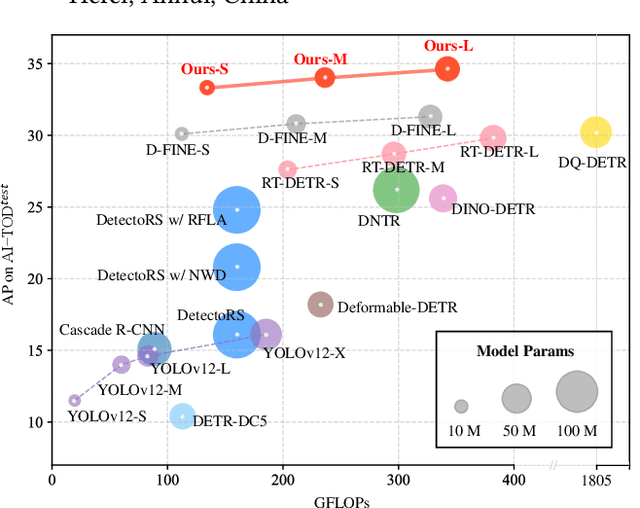
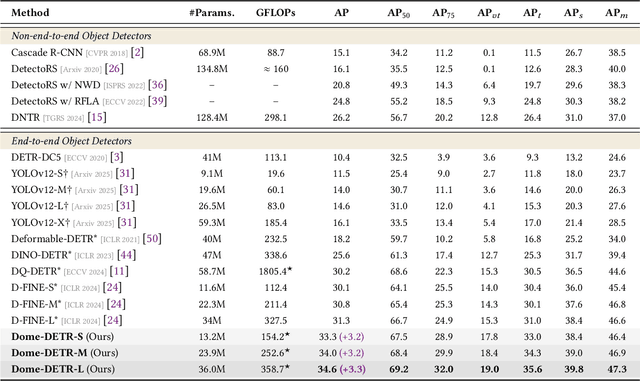
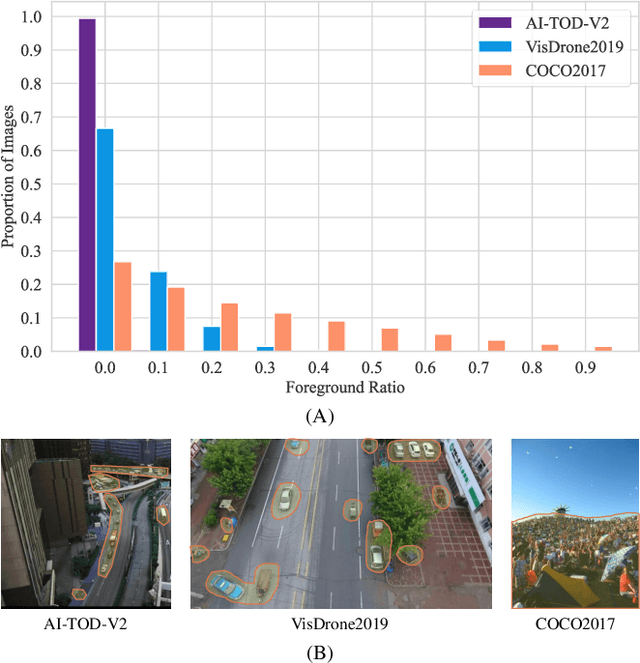
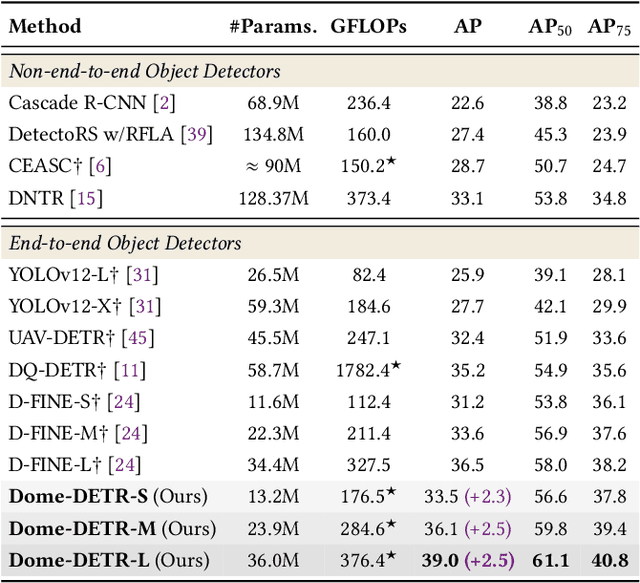
Tiny object detection plays a vital role in drone surveillance, remote sensing, and autonomous systems, enabling the identification of small targets across vast landscapes. However, existing methods suffer from inefficient feature leverage and high computational costs due to redundant feature processing and rigid query allocation. To address these challenges, we propose Dome-DETR, a novel framework with Density-Oriented Feature-Query Manipulation for Efficient Tiny Object Detection. To reduce feature redundancies, we introduce a lightweight Density-Focal Extractor (DeFE) to produce clustered compact foreground masks. Leveraging these masks, we incorporate Masked Window Attention Sparsification (MWAS) to focus computational resources on the most informative regions via sparse attention. Besides, we propose Progressive Adaptive Query Initialization (PAQI), which adaptively modulates query density across spatial areas for better query allocation. Extensive experiments demonstrate that Dome-DETR achieves state-of-the-art performance (+3.3 AP on AI-TOD-V2 and +2.5 AP on VisDrone) while maintaining low computational complexity and a compact model size. Code will be released upon acceptance.
Efficient Spiking Point Mamba for Point Cloud Analysis
Apr 19, 2025
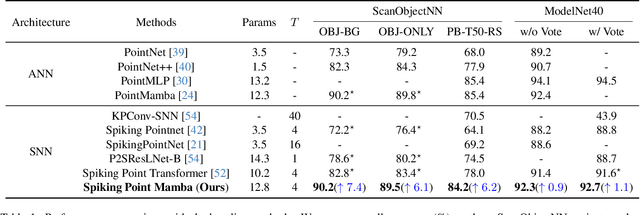
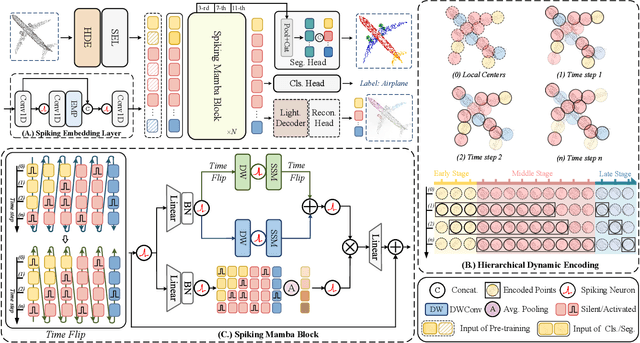
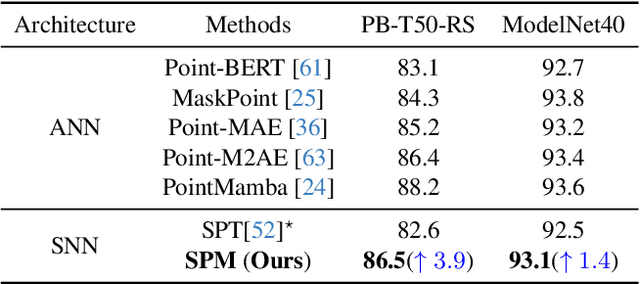
Bio-inspired Spiking Neural Networks (SNNs) provide an energy-efficient way to extract 3D spatio-temporal features. However, existing 3D SNNs have struggled with long-range dependencies until the recent emergence of Mamba, which offers superior computational efficiency and sequence modeling capability. In this work, we propose Spiking Point Mamba (SPM), the first Mamba-based SNN in the 3D domain. Due to the poor performance of simply transferring Mamba to 3D SNNs, SPM is designed to utilize both the sequence modeling capabilities of Mamba and the temporal feature extraction of SNNs. Specifically, we first introduce Hierarchical Dynamic Encoding (HDE), an improved direct encoding method that effectively introduces dynamic temporal mechanism, thereby facilitating temporal interactions. Then, we propose a Spiking Mamba Block (SMB), which builds upon Mamba while learning inter-time-step features and minimizing information loss caused by spikes. Finally, to further enhance model performance, we adopt an asymmetric SNN-ANN architecture for spike-based pre-training and finetune. Compared with the previous state-of-the-art SNN models, SPM improves OA by +6.2%, +6.1%, and +7.4% on three variants of ScanObjectNN, and boosts instance mIOU by +1.9% on ShapeNetPart. Meanwhile, its energy consumption is at least 3.5x lower than that of its ANN counterpart. The code will be made publicly available.
COSMIC: Clique-Oriented Semantic Multi-space Integration for Robust CLIP Test-Time Adaptation
Mar 30, 2025Recent vision-language models (VLMs) face significant challenges in test-time adaptation to novel domains. While cache-based methods show promise by leveraging historical information, they struggle with both caching unreliable feature-label pairs and indiscriminately using single-class information during querying, significantly compromising adaptation accuracy. To address these limitations, we propose COSMIC (Clique-Oriented Semantic Multi-space Integration for CLIP), a robust test-time adaptation framework that enhances adaptability through multi-granular, cross-modal semantic caching and graph-based querying mechanisms. Our framework introduces two key innovations: Dual Semantics Graph (DSG) and Clique Guided Hyper-class (CGH). The Dual Semantics Graph constructs complementary semantic spaces by incorporating textual features, coarse-grained CLIP features, and fine-grained DINOv2 features to capture rich semantic relationships. Building upon these dual graphs, the Clique Guided Hyper-class component leverages structured class relationships to enhance prediction robustness through correlated class selection. Extensive experiments demonstrate COSMIC's superior performance across multiple benchmarks, achieving significant improvements over state-of-the-art methods: 15.81% gain on out-of-distribution tasks and 5.33% on cross-domain generation with CLIP RN-50. Code is available at github.com/hf618/COSMIC.
Spiking Point Transformer for Point Cloud Classification
Feb 19, 2025Spiking Neural Networks (SNNs) offer an attractive and energy-efficient alternative to conventional Artificial Neural Networks (ANNs) due to their sparse binary activation. When SNN meets Transformer, it shows great potential in 2D image processing. However, their application for 3D point cloud remains underexplored. To this end, we present Spiking Point Transformer (SPT), the first transformer-based SNN framework for point cloud classification. Specifically, we first design Queue-Driven Sampling Direct Encoding for point cloud to reduce computational costs while retaining the most effective support points at each time step. We introduce the Hybrid Dynamics Integrate-and-Fire Neuron (HD-IF), designed to simulate selective neuron activation and reduce over-reliance on specific artificial neurons. SPT attains state-of-the-art results on three benchmark datasets that span both real-world and synthetic datasets in the SNN domain. Meanwhile, the theoretical energy consumption of SPT is at least 6.4$\times$ less than its ANN counterpart.