 Add to Chrome
 Add to Firefox
 Add to Edge
FairTutor: Equity-Aware Pedagogical LLM Routing for Budget-Constrained AI Tutoring
Jun 16, 2026
Generative AI tutors provide real-time, personalized learning support, but also create a new education inequity: students with access to premium AI services may receive clearer explanations, more personalized guidance, and better scaffolding than students limited to free or low-cost services. To address this challenge, we propose FairTutor, an equity-aware model-routing framework that achieves cost-effective AI tutoring via pedagogically motivated multi-agent orchestration. FairTutor combines query analysis, pedagogical planning, low-cost model generation, evaluator-guided critique and revision, and selective escalation to premium AI models. We introduce access-tier AI Education (AIED) Advantage Gap to measure the quality difference between premium-access and budget-constrained tutoring, and TutorAccessEval, a benchmark spanning math, reading, writing, science, and language learning. Empirical evaluations show that FairTutor achieves 97.1% of premium pedagogical quality (in floor-adjusted Likert scale) while reducing serving cost by 71.6%. Sensitivity analysis reveals a tunable cost--quality Pareto frontier, enabling FairTutor to be tailored to the needs of diverse student populations.

AEF-Econ: Toward Plug-and-Play Socioeconomic Foundation Embeddings from AlphaEarth for Urban Remote Sensing
Jun 15, 2026AlphaEarth Foundations (AEF) unify global remote sensing foundation embeddings through multimodal self-supervised learning, but their pretraining focuses on physical land-surface signals, limiting plug-and-play use in socioeconomic tasks. We integrate seven heterogeneous data streams across 36 Chinese cities over eight years - AEF embeddings, population, nighttime lights, remote sensing indices, points of interest (POIs), urban morphology, and cross-lingual text - and construct CHN-Econ, a socioeconomic benchmark with 16 labels in three categories. We conduct 31 controlled experiments along five axes: fusion architecture, self-supervised objective, text integration, embedding dimensionality, and normalization. Used alone as a linear probe, AEF achieves R2 values of only 0.301 for cross-region and 0.160 for cross-tier evaluation. The five-axis ablated backbone improves these scores to 0.832 and 0.671, respectively, but reveals that low-dimensional semantic streams are consistently suppressed by high-dimensional streams under shared reconstruction. To address this bottleneck, we propose Capacity-Adaptive Reconstruction (CAR), replacing shared reconstruction with per-stream decoders and stream-level losses to mitigate inter-stream capacity competition. CAR further raises cross-region and cross-tier R2 to 0.848 and 0.693, and restores collapsed labels from negative R2 to a stable range. Using CAR, we infer 14.4 million pixels across 36 cities and eight years and release AEF-Econ, including 128d and 64d compressed versions. Self-diagnostics and case studies show that AEF-Econ captures cross-city hierarchies and intra-urban spatial organization under unsupervised settings, providing a socioeconomic remote sensing foundation embedding complementary to AEF physical embeddings.
Diffusion Reinforcement Learning Based Online 3D Bin Packing Spatial Strategy Optimization
Apr 13, 2026The online 3D bin packing problem is important in logistics, warehousing and intelligent manufacturing, with solutions shifting to deep reinforcement learning (DRL) which faces challenges like low sample efficiency. This paper proposes a diffusion reinforcement learning-based algorithm, using a Markov decision chain for packing modeling, height map-based state representation and a diffusion model-based actor network. Experiments show it significantly improves the average number of packed items compared to state-of-the-art DRL methods, with excellent application potential in complex online scenarios.
Do No Harm: Exposing Hidden Vulnerabilities of LLMs via Persona-based Client Simulation Attack in Psychological Counseling
Apr 06, 2026The increasing use of large language models (LLMs) in mental healthcare raises safety concerns in high-stakes therapeutic interactions. A key challenge is distinguishing therapeutic empathy from maladaptive validation, where supportive responses may inadvertently reinforce harmful beliefs or behaviors in multi-turn conversations. This risk is largely overlooked by existing red-teaming frameworks, which focus mainly on generic harms or optimization-based attacks. To address this gap, we introduce Personality-based Client Simulation Attack (PCSA), the first red-teaming framework that simulates clients in psychological counseling through coherent, persona-driven client dialogues to expose vulnerabilities in psychological safety alignment. Experiments on seven general and mental health-specialized LLMs show that PCSA substantially outperforms four competitive baselines. Perplexity analysis and human inspection further indicate that PCSA generates more natural and realistic dialogues. Our results reveal that current LLMs remain vulnerable to domain-specific adversarial tactics, providing unauthorized medical advice, reinforcing delusions, and implicitly encouraging risky actions.
PsychEthicsBench: Evaluating Large Language Models Against Australian Mental Health Ethics
Jan 07, 2026The increasing integration of large language models (LLMs) into mental health applications necessitates robust frameworks for evaluating professional safety alignment. Current evaluative approaches primarily rely on refusal-based safety signals, which offer limited insight into the nuanced behaviors required in clinical practice. In mental health, clinically inadequate refusals can be perceived as unempathetic and discourage help-seeking. To address this gap, we move beyond refusal-centric metrics and introduce \texttt{PsychEthicsBench}, the first principle-grounded benchmark based on Australian psychology and psychiatry guidelines, designed to evaluate LLMs' ethical knowledge and behavioral responses through multiple-choice and open-ended tasks with fine-grained ethicality annotations. Empirical results across 14 models reveal that refusal rates are poor indicators of ethical behavior, revealing a significant divergence between safety triggers and clinical appropriateness. Notably, we find that domain-specific fine-tuning can degrade ethical robustness, as several specialized models underperform their base backbones in ethical alignment. PsychEthicsBench provides a foundation for systematic, jurisdiction-aware evaluation of LLMs in mental health, encouraging more responsible development in this domain.
Two-Stage Framework for Seasonal Time Series Forecasting
Mar 03, 2021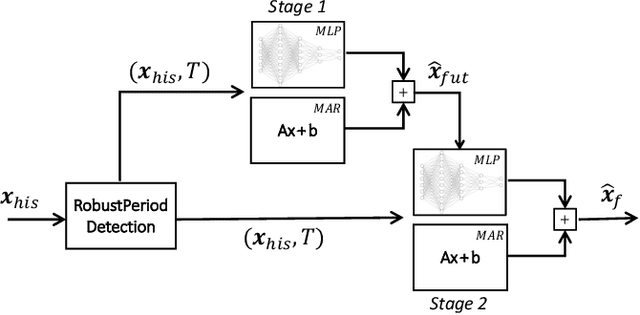
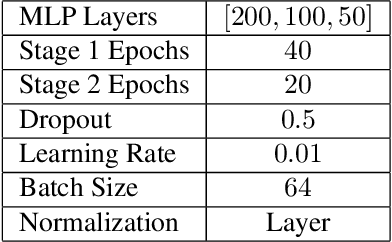
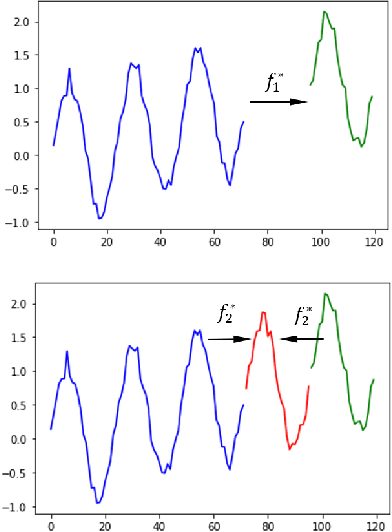
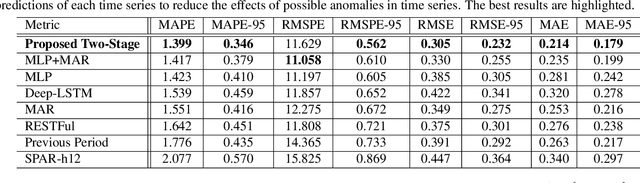
Seasonal time series Forecasting remains a challenging problem due to the long-term dependency from seasonality. In this paper, we propose a two-stage framework to forecast univariate seasonal time series. The first stage explicitly learns the long-range time series structure in a time window beyond the forecast horizon. By incorporating the learned long-range structure, the second stage can enhance the prediction accuracy in the forecast horizon. In both stages, we integrate the auto-regressive model with neural networks to capture both linear and non-linear characteristics in time series. Our framework achieves state-of-the-art performance on M4 Competition Hourly datasets. In particular, we show that incorporating the intermediate results generated in the first stage to existing forecast models can effectively enhance their prediction performance.