 Add to Chrome
 Add to Firefox
 Add to Edge
DeepGuard: Secure Code Generation via Multi-Layer Semantic Aggregation
Apr 10, 2026
Large Language Models (LLMs) for code generation can replicate insecure patterns from their training data. To mitigate this, a common strategy for security hardening is to fine-tune models using supervision derived from the final transformer layer. However, this design may suffer from a final-layer bottleneck: vulnerability-discriminative cues can be distributed across layers and become less detectable near the output representations optimized for next-token prediction. To diagnose this issue, we perform layer-wise linear probing. We observe that vulnerability-related signals are most detectable in a band of intermediate-to-upper layers yet attenuate toward the final layers. Motivated by this observation, we introduce DeepGuard, a framework that leverages distributed security-relevant cues by aggregating representations from multiple upper layers via an attention-based module. The aggregated signal powers a dedicated security analyzer within a multi-objective training objective that balances security enhancement and functional correctness, and further supports a lightweight inference-time steering strategy. Extensive experiments across five code LLMs demonstrate that DeepGuard improves the secure-and-correct generation rate by an average of 11.9% over strong baselines such as SVEN. It also preserves functional correctness while exhibiting generalization to held-out vulnerability types. Our code is public at https://github.com/unknownhl/DeepGuard.

MUSE: Harnessing Precise and Diverse Semantics for Few-Shot Whole Slide Image Classification
Feb 24, 2026In computational pathology, few-shot whole slide image classification is primarily driven by the extreme scarcity of expert-labeled slides. Recent vision-language methods incorporate textual semantics generated by large language models, but treat these descriptions as static class-level priors that are shared across all samples and lack sample-wise refinement. This limits both the diversity and precision of visual-semantic alignment, hindering generalization under limited supervision. To overcome this, we propose the stochastic MUlti-view Semantic Enhancement (MUSE), a framework that first refines semantic precision via sample-wise adaptation and then enhances semantic richness through retrieval-augmented multi-view generation. Specifically, MUSE introduces Sample-wise Fine-grained Semantic Enhancement (SFSE), which yields a fine-grained semantic prior for each sample through MoE-based adaptive visual-semantic interaction. Guided by this prior, Stochastic Multi-view Model Optimization (SMMO) constructs an LLM-generated knowledge base of diverse pathological descriptions per class, then retrieves and stochastically integrates multiple matched textual views during training. These dynamically selected texts serve as enriched semantic supervisions to stochastically optimize the vision-language model, promoting robustness and mitigating overfitting. Experiments on three benchmark WSI datasets show that MUSE consistently outperforms existing vision-language baselines in few-shot settings, demonstrating that effective few-shot pathology learning requires not only richer semantic sources but also their active and sample-aware semantic optimization. Our code is available at: https://github.com/JiahaoXu-god/CVPR2026_MUSE.
Category-Prompt Refined Feature Learning for Long-Tailed Multi-Label Image Classification
Aug 15, 2024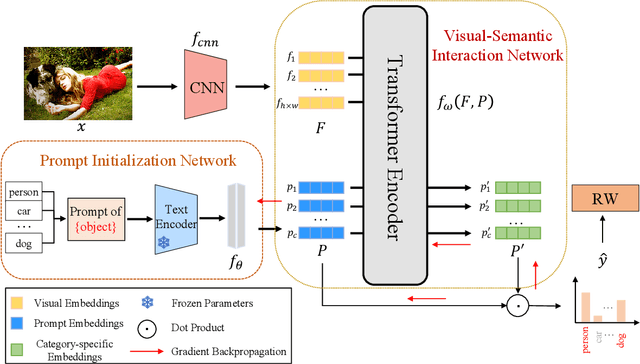
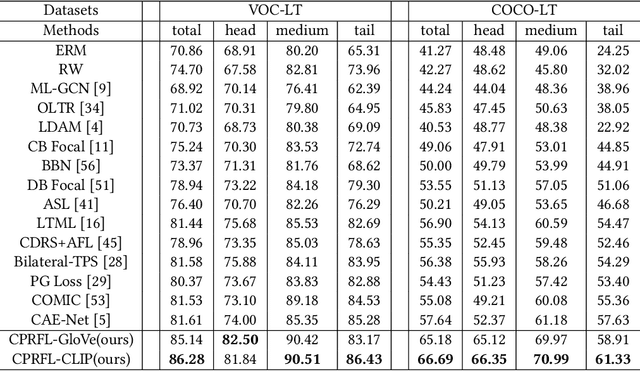
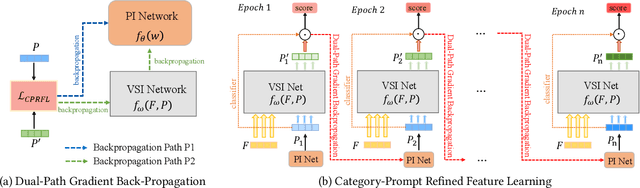
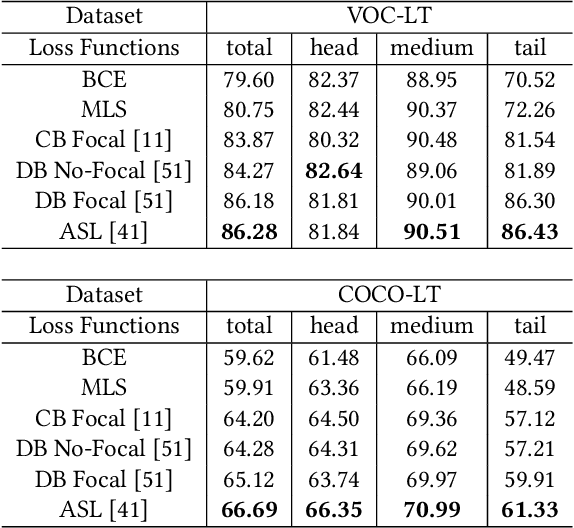
Real-world data consistently exhibits a long-tailed distribution, often spanning multiple categories. This complexity underscores the challenge of content comprehension, particularly in scenarios requiring Long-Tailed Multi-Label image Classification (LTMLC). In such contexts, imbalanced data distribution and multi-object recognition pose significant hurdles. To address this issue, we propose a novel and effective approach for LTMLC, termed Category-Prompt Refined Feature Learning (CPRFL), utilizing semantic correlations between different categories and decoupling category-specific visual representations for each category. Specifically, CPRFL initializes category-prompts from the pretrained CLIP's embeddings and decouples category-specific visual representations through interaction with visual features, thereby facilitating the establishment of semantic correlations between the head and tail classes. To mitigate the visual-semantic domain bias, we design a progressive Dual-Path Back-Propagation mechanism to refine the prompts by progressively incorporating context-related visual information into prompts. Simultaneously, the refinement process facilitates the progressive purification of the category-specific visual representations under the guidance of the refined prompts. Furthermore, taking into account the negative-positive sample imbalance, we adopt the Asymmetric Loss as our optimization objective to suppress negative samples across all classes and potentially enhance the head-to-tail recognition performance. We validate the effectiveness of our method on two LTMLC benchmarks and extensive experiments demonstrate the superiority of our work over baselines. The code is available at https://github.com/jiexuanyan/CPRFL.