 Add to Chrome
 Add to Firefox
 Add to Edge
Lossless Tensor Compression as Program Synthesis
Aug 03, 2026
Model checkpoints are growing in both number and size, which makes archival, transfer, and deployment increasingly costly. General-purpose compressors can reduce storage requirements but ignore tensor structure, whereas existing tensor-specific compressors rely on fixed and format-specific pipelines. We present Brevis, which formulates lossless tensor compression as program synthesis. We design a typed domain-specific language (DSL) that captures recurring tensor structures, such as repeated regions and floating-point fields, through a set of reversible operators. Given a tensor, Brevis synthesizes a self-contained DSL program that reconstructs it bit-exactly. A checkpoint-specific production prior, learned from a small representative sample of tensors, guides a bounded A* search to synthesize compact programs, which can later be executed directly for bit-exact decompression. On 10 public checkpoints spanning language, audio, and image generation models, Brevis reduces 2.13 TB of checkpoint data to 1.41 TB, a 33.93% storage reduction. It produces archives up to 30.87% smaller than those of four general-purpose compressors, including zstd and gzip, and smaller archives than the tensor-specific compressors ZipNN and DFloat11. Under a practical concurrency configuration, Brevis achieves 3.60 GB/s compression and 6.61 GB/s decompression while preserving every source byte.

SciCodePile: A 128GB Corpus and Executable Benchmark for Challenging Scientific Code Generation
Jul 21, 2026Large language models (LLMs) excel at general-purpose code generation, yet how well they handle scientific code remains an open question. Existing datasets and benchmarks are limited in scale, domain coverage, or executable verification, leaving the true gap between current LLMs and reliable scientific code generators inadequately assessed. To address these limitations, we present SciCodePile, the largest scientific code corpus to date, constructed from 37,737 public repositories and collectively comprising 128GB of code that spans multiple computational science disciplines. From this corpus, we further curate an executable benchmark of 200 tasks, each equipped with a sandboxed execution environment and an automated test harness for functional verification. We evaluate 15 LLMs from both open-source and closed-source families on three tasks: prefix-to-suffix completion, fill-in-the-middle infilling, and executable code generation. Results show that scientific code generation remains highly challenging: The best CodeBLEU reaches only 38.13 and 38.37 on the two completion tasks, while the strongest model achieves just 12.30\% Pass@1 on the executable benchmark, underscoring how far current models remain from reliable scientific code generation. To demonstrate the training utility of SciCodePile, we further show that continued pretraining on our corpus improves CodeBLEU by $\times$2.84 on scientific code completion, and instruction tuning on our data improves Pass@1 by $\times$4.79 on the executable benchmark. All code and data are available at https://huggingface.co/SciCodePile.
DynaFix: Iterative Automated Program Repair Driven by Execution-Level Dynamic Information
Dec 31, 2025Automated Program Repair (APR) aims to automatically generate correct patches for buggy programs. Recent approaches leveraging large language models (LLMs) have shown promise but face limitations. Most rely solely on static analysis, ignoring runtime behaviors. Some attempt to incorporate dynamic signals, but these are often restricted to training or fine-tuning, or injected only once into the repair prompt, without iterative use. This fails to fully capture program execution. Current iterative repair frameworks typically rely on coarse-grained feedback, such as pass/fail results or exception types, and do not leverage fine-grained execution-level information effectively. As a result, models struggle to simulate human stepwise debugging, limiting their effectiveness in multi-step reasoning and complex bug repair. To address these challenges, we propose DynaFix, an execution-level dynamic information-driven APR method that iteratively leverages runtime information to refine the repair process. In each repair round, DynaFix captures execution-level dynamic information such as variable states, control-flow paths, and call stacks, transforming them into structured prompts to guide LLMs in generating candidate patches. If a patch fails validation, DynaFix re-executes the modified program to collect new execution information for the next attempt. This iterative loop incrementally improves patches based on updated feedback, similar to the stepwise debugging practices of human developers. We evaluate DynaFix on the Defects4J v1.2 and v2.0 benchmarks. DynaFix repairs 186 single-function bugs, a 10% improvement over state-of-the-art baselines, including 38 bugs previously unrepaired. It achieves correct patches within at most 35 attempts, reducing the patch search space by 70% compared with existing methods, thereby demonstrating both effectiveness and efficiency in repairing complex bugs.
Intention Chain-of-Thought Prompting with Dynamic Routing for Code Generation
Dec 16, 2025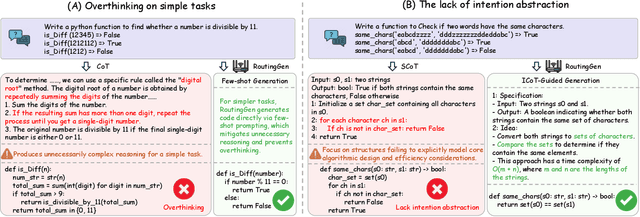
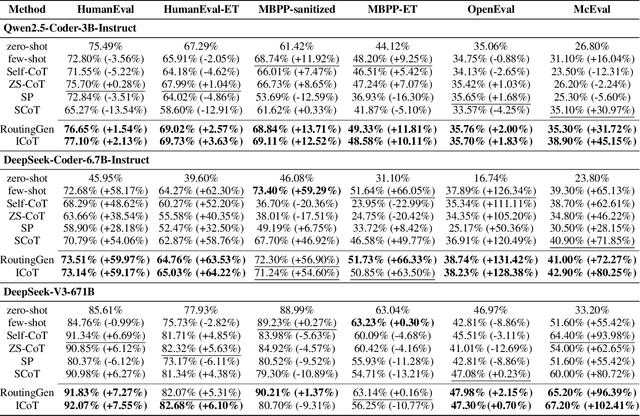
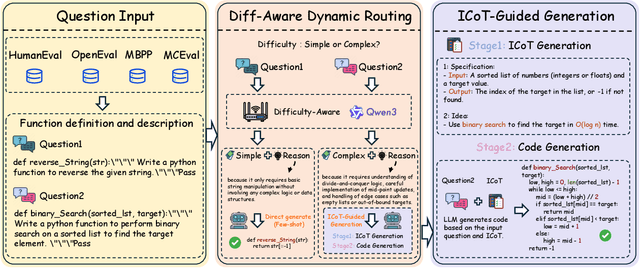
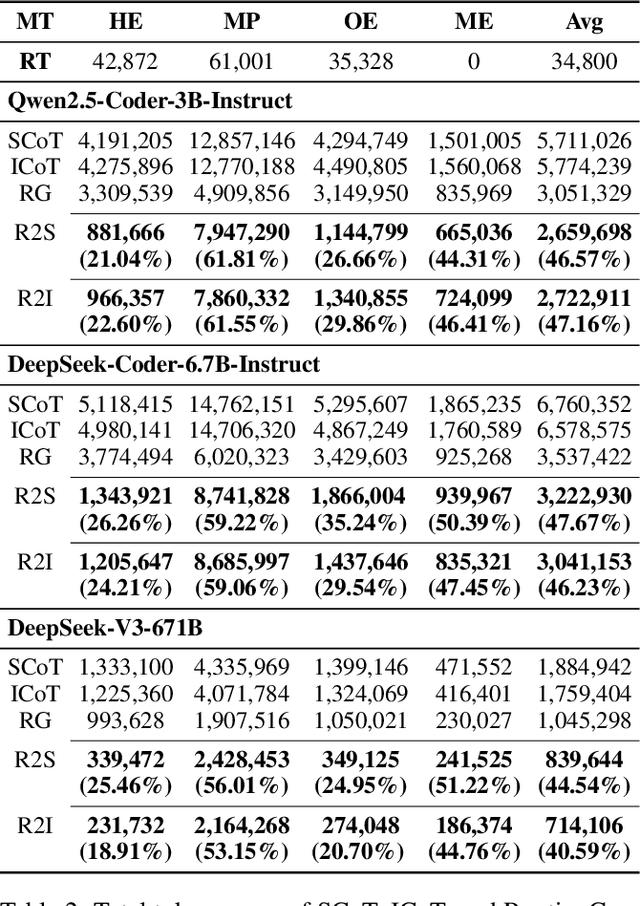
Large language models (LLMs) exhibit strong generative capabilities and have shown great potential in code generation. Existing chain-of-thought (CoT) prompting methods enhance model reasoning by eliciting intermediate steps, but suffer from two major limitations: First, their uniform application tends to induce overthinking on simple tasks. Second, they lack intention abstraction in code generation, such as explicitly modeling core algorithmic design and efficiency, leading models to focus on surface-level structures while neglecting the global problem objective. Inspired by the cognitive economy principle of engaging structured reasoning only when necessary to conserve cognitive resources, we propose RoutingGen, a novel difficulty-aware routing framework that dynamically adapts prompting strategies for code generation. For simple tasks, it adopts few-shot prompting; for more complex ones, it invokes a structured reasoning strategy, termed Intention Chain-of-Thought (ICoT), which we introduce to guide the model in capturing task intention, such as the core algorithmic logic and its time complexity. Experiments across three models and six standard code generation benchmarks show that RoutingGen achieves state-of-the-art performance in most settings, while reducing total token usage by 46.37% on average across settings. Furthermore, ICoT outperforms six existing prompting baselines on challenging benchmarks.
ISTA-Inspired Network for Image Super-Resolution
Oct 14, 2022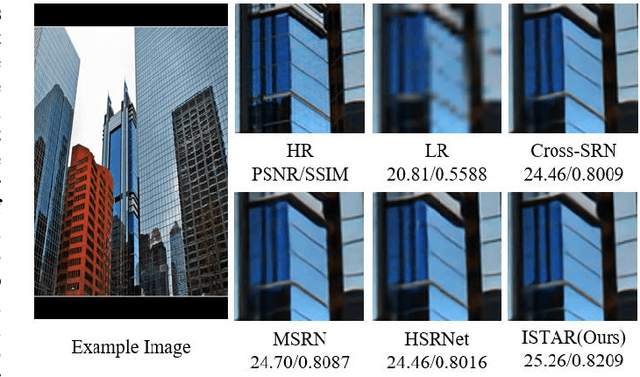
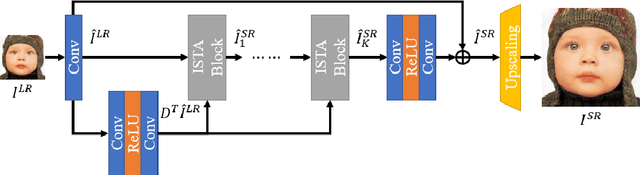
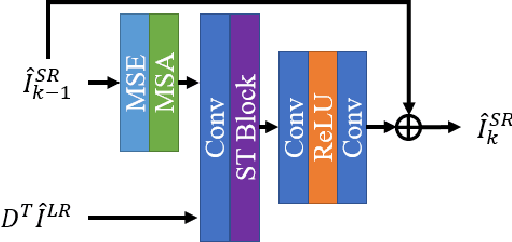
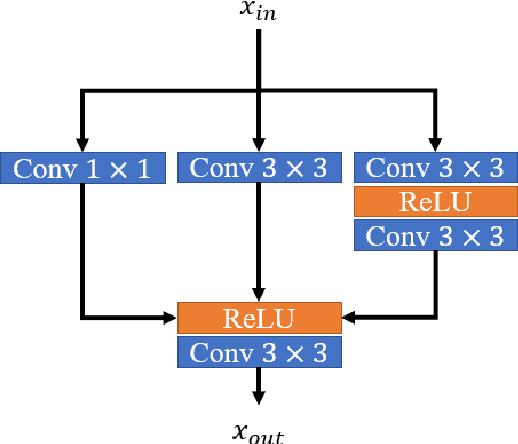
Deep learning for image super-resolution (SR) has been investigated by numerous researchers in recent years. Most of the works concentrate on effective block designs and improve the network representation but lack interpretation. There are also iterative optimization-inspired networks for image SR, which take the solution step as a whole without giving an explicit optimization step. This paper proposes an unfolding iterative shrinkage thresholding algorithm (ISTA) inspired network for interpretable image SR. Specifically, we analyze the problem of image SR and propose a solution based on the ISTA method. Inspired by the mathematical analysis, the ISTA block is developed to conduct the optimization in an end-to-end manner. To make the exploration more effective, a multi-scale exploitation block and multi-scale attention mechanism are devised to build the ISTA block. Experimental results show the proposed ISTA-inspired restoration network (ISTAR) achieves competitive or better performances than other optimization-inspired works with fewer parameters and lower computation complexity.
RelationRS: Relationship Representation Network for Object Detection in Aerial Images
Oct 13, 2021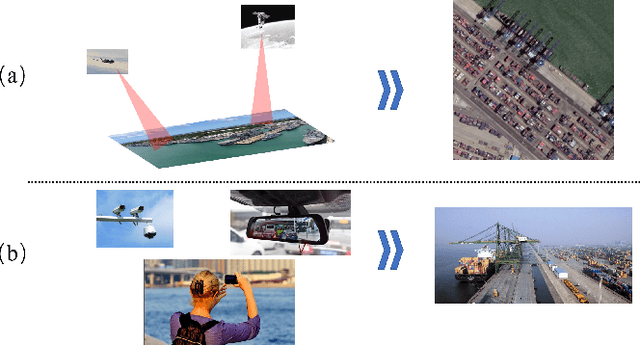
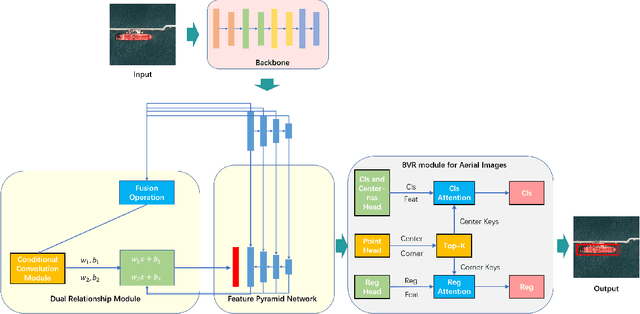
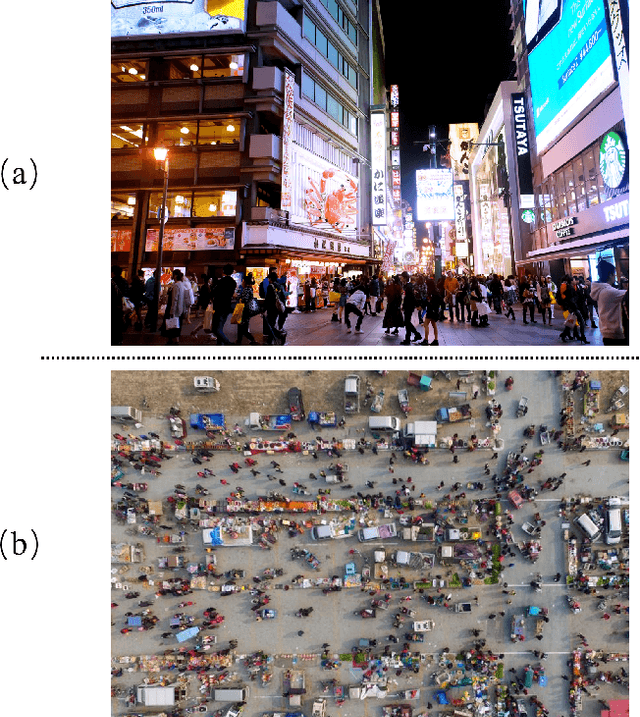

Object detection is a basic and important task in the field of aerial image processing and has gained much attention in computer vision. However, previous aerial image object detection approaches have insufficient use of scene semantic information between different regions of large-scale aerial images. In addition, complex background and scale changes make it difficult to improve detection accuracy. To address these issues, we propose a relationship representation network for object detection in aerial images (RelationRS): 1) Firstly, multi-scale features are fused and enhanced by a dual relationship module (DRM) with conditional convolution. The dual relationship module learns the potential relationship between features of different scales and learns the relationship between different scenes from different patches in a same iteration. In addition, the dual relationship module dynamically generates parameters to guide the fusion of multi-scale features. 2) Secondly, The bridging visual representations module (BVR) is introduced into the field of aerial images to improve the object detection effect in images with complex backgrounds. Experiments with a publicly available object detection dataset for aerial images demonstrate that the proposed RelationRS achieves a state-of-the-art detection performance.
Cyber Intrusion Detection by Using Deep Neural Networks with Attack-sharing Loss
Mar 17, 2021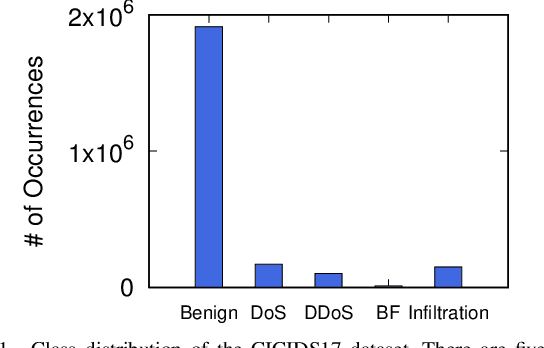
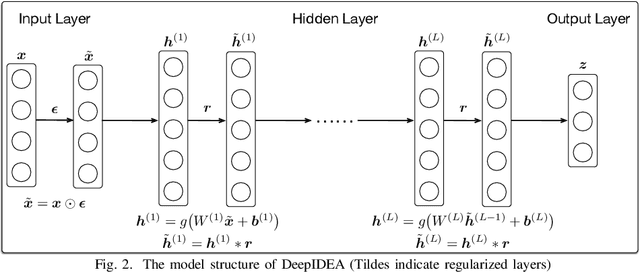
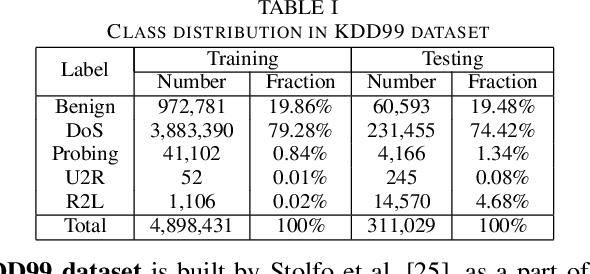
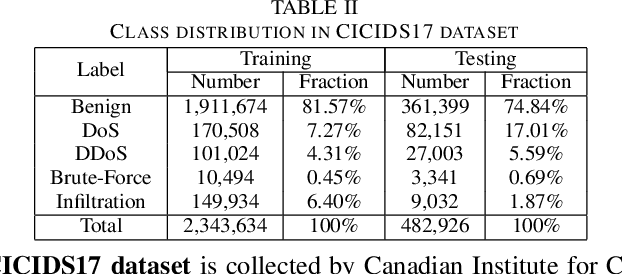
Cyber attacks pose crucial threats to computer system security, and put digital treasuries at excessive risks. This leads to an urgent call for an effective intrusion detection system that can identify the intrusion attacks with high accuracy. It is challenging to classify the intrusion events due to the wide variety of attacks. Furthermore, in a normal network environment, a majority of the connections are initiated by benign behaviors. The class imbalance issue in intrusion detection forces the classifier to be biased toward the majority/benign class, thus leave many attack incidents undetected. Spurred by the success of deep neural networks in computer vision and natural language processing, in this paper, we design a new system named DeepIDEA that takes full advantage of deep learning to enable intrusion detection and classification. To achieve high detection accuracy on imbalanced data, we design a novel attack-sharing loss function that can effectively move the decision boundary towards the attack classes and eliminates the bias towards the majority/benign class. By using this loss function, DeepIDEA respects the fact that the intrusion mis-classification should receive higher penalty than the attack mis-classification. Extensive experimental results on three benchmark datasets demonstrate the high detection accuracy of DeepIDEA. In particular, compared with eight state-of-the-art approaches, DeepIDEA always provides the best class-balanced accuracy.