 Add to Chrome
 Add to Firefox
 Add to Edge
SynH-Rank: Quality-Aware Code Search via Diverse Data Synthesis and Hierarchical Ranking Training
Jul 19, 2026
Code search enhances developer productivity by enabling efficient code reuse. Current code search systems often use a retrieve-then-rerank pipeline, where rerankers focus on modeling semantic relevance between queries and code. However, these rerankers overlook critical non-functional qualities like execution speed, memory usage, and maintainability, which are essential for practical software development. Studies reveal developers expect results to maintain high coding standards and satisfy specific needs, such as resource optimization, highlighting the importance of quality-aware code search. Achieving quality-aware code search faces two major challenges: the scarcity of quality-annotated datasets for effective training and the limitations of standard contrastive learning objectives, which fail to capture the ordinal relationships among high-quality, low-quality, and irrelevant code. Although contrastive learning excels in distinguishing relevant from irrelevant code, its binary objective does not support nuanced quality distinctions.To address these challenges, we propose SynH-Rank, a quality-aware code reranking framework that combines LLM-driven diverse data synthesis with hierarchical ranking training. SynH-Rank employs a three-level labeling scheme to explicitly model the hierarchy: high-quality relevant > low-quality relevant > irrelevant. Additionally, we introduce a new benchmark with 4,209 pairs and two novel metrics: Quality Preference Accuracy (QPA) for assessing prioritization of high-quality code and Multi-Condition Accuracy (MCA) for evaluating performance under complex constraints.Experimental results show SynH-Rank improves QPA by 20.15\% over backbone models and outperforms standard relevance-only contrastive training by 15.80\%, while simultaneously enhancing traditional relevance metrics and multi-condition generalizability.

Zero-Shot Cross-Domain Code Search without Fine-Tuning
Apr 10, 2025
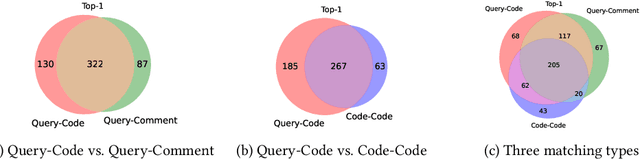

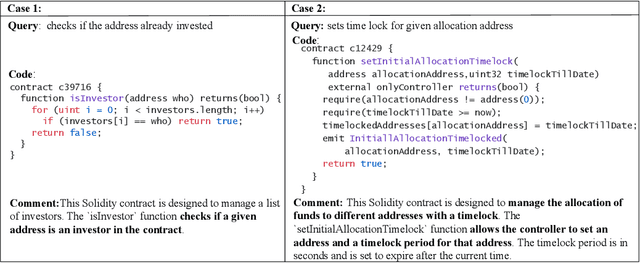
Code search aims to retrieve semantically relevant code snippets for natural language queries. While pre-trained language models (PLMs) have shown remarkable performance in this task, they struggle in cross-domain scenarios, often requiring costly fine-tuning or facing performance drops in zero-shot settings. RAPID, which generates synthetic data for model fine-tuning, is currently the only effective method for zero-shot cross-domain code search. Despite its effectiveness, RAPID demands substantial computational resources for fine-tuning and needs to maintain specialized models for each domain, underscoring the need for a zero-shot, fine-tuning-free approach for cross-domain code search. The key to tackling zero-shot cross-domain code search lies in bridging the gaps among domains. In this work, we propose to break the query-code matching process of code search into two simpler tasks: query-comment matching and code-code matching. Our empirical study reveals the strong complementarity among the three matching schemas in zero-shot cross-domain settings, i.e., query-code, query-comment, and code-code matching. Based on the findings, we propose CodeBridge, a zero-shot, fine-tuning-free approach for cross-domain code search. Specifically, CodeBridge uses Large Language Models (LLMs) to generate comments and pseudo-code, then combines query-code, query-comment, and code-code matching via PLM-based similarity scoring and sampling-based fusion. Experimental results show that our approach outperforms the state-of-the-art PLM-based code search approaches, i.e., CoCoSoDa and UniXcoder, by an average of 21.4% and 24.9% in MRR, respectively, across three datasets. Our approach also yields results that are better than or comparable to those of the zero-shot cross-domain code search approach RAPID, which requires costly fine-tuning.