 Add to Chrome
 Add to Firefox
 Add to Edge
LightMem-Ego: Your AI Memory for Everyday Life
Jul 13, 2026
Personal AI assistants on mobile and wearable devices continuously perceive users' daily lives through visual and audio streams. However, answering queries about past experiences requires lightweight multimodal memory that can continuously accumulate, organize, and retrieve long-term experiences, which remains challenging. To address this challenge, we present LightMem-Ego, a lightweight streaming multimodal memory system for everyday-life assistance. The system continuously captures egocentric visual and audio streams, aligns them on a shared timeline, and organizes them into a hierarchical memory consisting of current, short-term, and long-term memory. Given a user query, LightMem-Ego dynamically routes retrieval to the appropriate memory level and generates answers grounded in multimodal evidence. The demonstration can be deployed on smartphones and AI glasses, supporting object finding, conversation recall, life summarization, routine discovery, and personalized assistance. Code is available at https://github.com/zjunlp/LightMem-Ego.

Decentralized Pose Graph Riemannian Optimization for Object-based Multi-Robot SLAM
Jun 23, 2026Pose graph optimization (PGO) is a key back-end component for state estimation in networked multi-robot simultaneous localization and mapping (SLAM). In object-based multi-robot SLAM, the problem becomes more tightly coupled because robots must jointly estimate both their trajectories and the poses of persistent objects observed by multiple agents. Existing decentralized solutions often assume that the communication graph closely matches the physical interaction topology, which is restrictive in realistic deployments where communication is sparse, intermittent, or time-varying. This paper presents a fully decentralized Riemannian optimization framework for object-based multi-robot PGO that decouples the coupled estimation problem via a consensus mechanism, enabling flexible communication topologies. To improve convergence under limited communication budgets, we further develop a distributed approximate-Newton scheme that exploits local second-order information while operating directly on the SE(d) manifold to preserve geometric consistency, and we establish the convergence to Riemannian first-order stationary points and provide a local condition-number analysis explaining the benefit of approximate second-order information over first-order Riemannian descent. The resulting method reduces iteration count and communication overhead without sacrificing estimation accuracy. Extensive evaluations on public benchmarks, large-scale simulations, and real-world multi-robot experiments demonstrate improved accuracy, runtime efficiency, scalability across network topologies, and robustness to communication failures.
CoCoL: A Communication Efficient Decentralized Collaborative Method for Multi-Robot Systems
Aug 28, 2025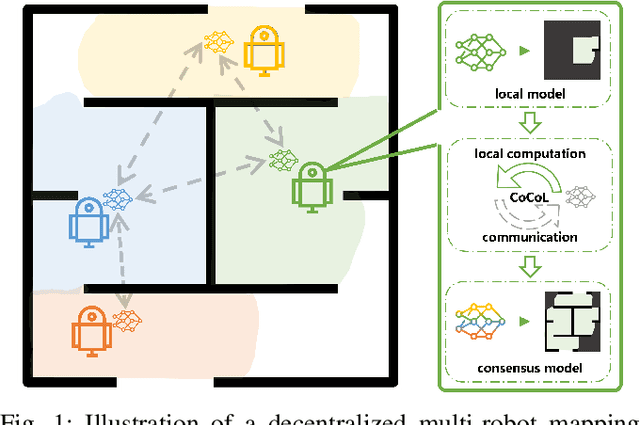
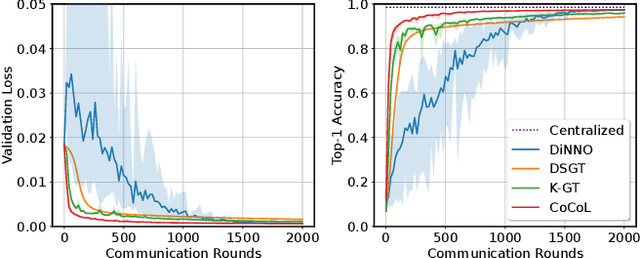
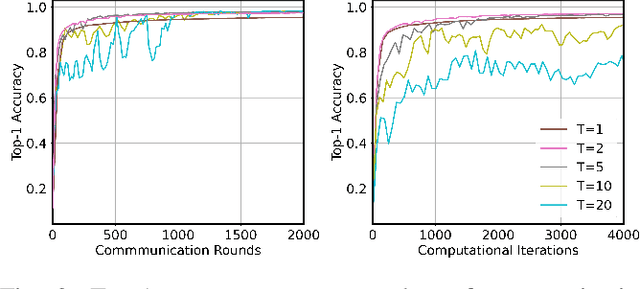
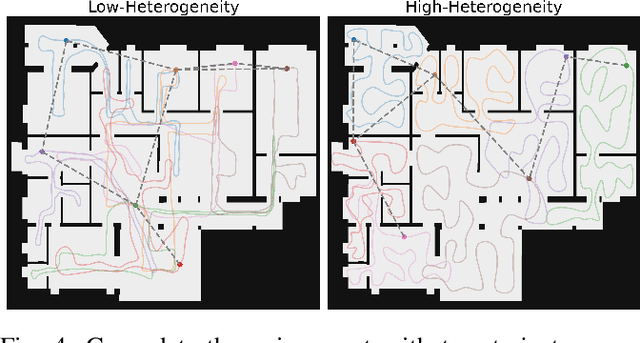
Collaborative learning enhances the performance and adaptability of multi-robot systems in complex tasks but faces significant challenges due to high communication overhead and data heterogeneity inherent in multi-robot tasks. To this end, we propose CoCoL, a Communication efficient decentralized Collaborative Learning method tailored for multi-robot systems with heterogeneous local datasets. Leveraging a mirror descent framework, CoCoL achieves remarkable communication efficiency with approximate Newton-type updates by capturing the similarity between objective functions of robots, and reduces computational costs through inexact sub-problem solutions. Furthermore, the integration of a gradient tracking scheme ensures its robustness against data heterogeneity. Experimental results on three representative multi robot collaborative learning tasks show the superiority of the proposed CoCoL in significantly reducing both the number of communication rounds and total bandwidth consumption while maintaining state-of-the-art accuracy. These benefits are particularly evident in challenging scenarios involving non-IID (non-independent and identically distributed) data distribution, streaming data, and time-varying network topologies.
Ego3DT: Tracking Every 3D Object in Ego-centric Videos
Oct 11, 2024
The growing interest in embodied intelligence has brought ego-centric perspectives to contemporary research. One significant challenge within this realm is the accurate localization and tracking of objects in ego-centric videos, primarily due to the substantial variability in viewing angles. Addressing this issue, this paper introduces a novel zero-shot approach for the 3D reconstruction and tracking of all objects from the ego-centric video. We present Ego3DT, a novel framework that initially identifies and extracts detection and segmentation information of objects within the ego environment. Utilizing information from adjacent video frames, Ego3DT dynamically constructs a 3D scene of the ego view using a pre-trained 3D scene reconstruction model. Additionally, we have innovated a dynamic hierarchical association mechanism for creating stable 3D tracking trajectories of objects in ego-centric videos. Moreover, the efficacy of our approach is corroborated by extensive experiments on two newly compiled datasets, with 1.04x - 2.90x in HOTA, showcasing the robustness and accuracy of our method in diverse ego-centric scenarios.