 Add to Chrome
 Add to Firefox
 Add to Edge
A Multi-Modal Neuro-Symbolic Approach for Spatial Reasoning-Based Visual Grounding in Robotics
Oct 30, 2025
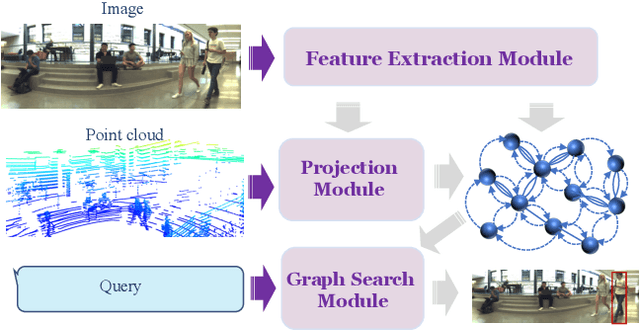
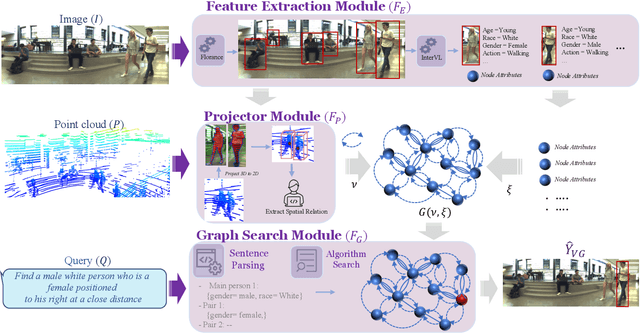
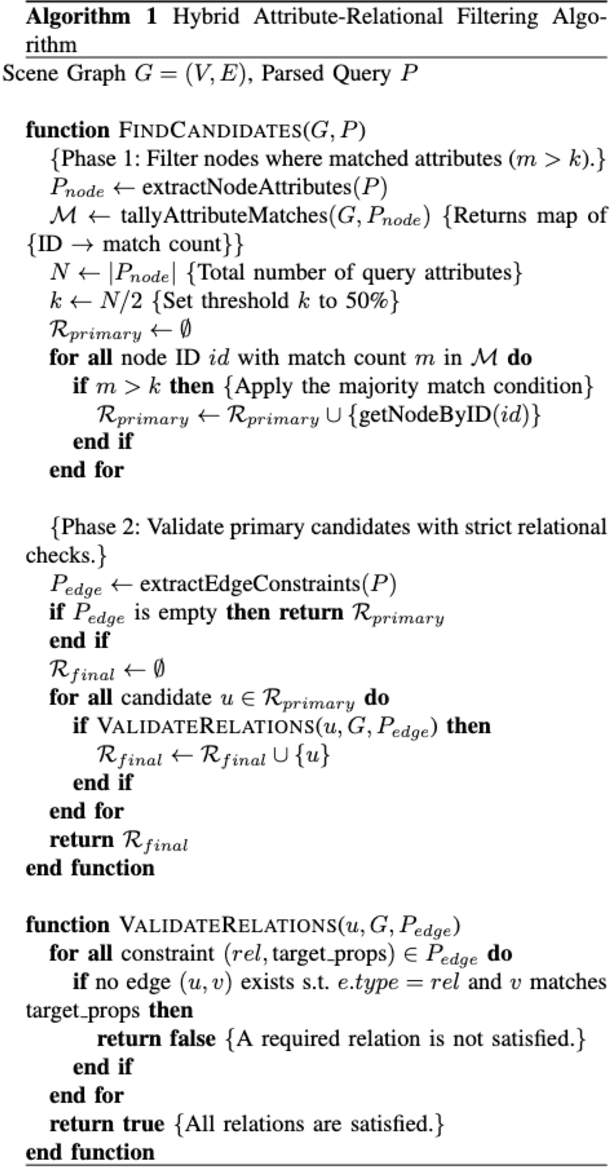
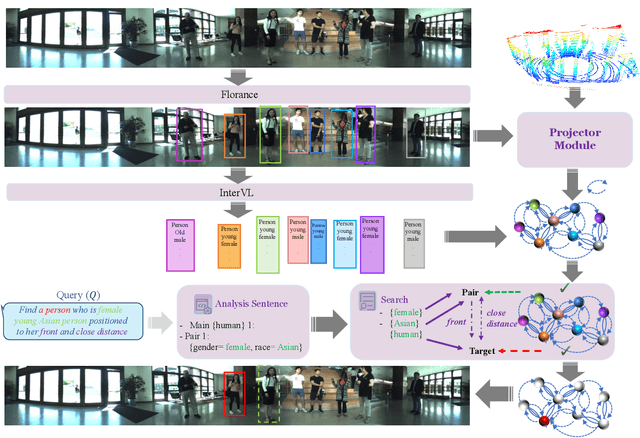
Visual reasoning, particularly spatial reasoning, is a challenging cognitive task that requires understanding object relationships and their interactions within complex environments, especially in robotics domain. Existing vision_language models (VLMs) excel at perception tasks but struggle with fine-grained spatial reasoning due to their implicit, correlation-driven reasoning and reliance solely on images. We propose a novel neuro_symbolic framework that integrates both panoramic-image and 3D point cloud information, combining neural perception with symbolic reasoning to explicitly model spatial and logical relationships. Our framework consists of a perception module for detecting entities and extracting attributes, and a reasoning module that constructs a structured scene graph to support precise, interpretable queries. Evaluated on the JRDB-Reasoning dataset, our approach demonstrates superior performance and reliability in crowded, human_built environments while maintaining a lightweight design suitable for robotics and embodied AI applications.

JRDB-Reasoning: A Difficulty-Graded Benchmark for Visual Reasoning in Robotics
Aug 14, 2025Recent advances in Vision-Language Models (VLMs) and large language models (LLMs) have greatly enhanced visual reasoning, a key capability for embodied AI agents like robots. However, existing visual reasoning benchmarks often suffer from several limitations: they lack a clear definition of reasoning complexity, offer have no control to generate questions over varying difficulty and task customization, and fail to provide structured, step-by-step reasoning annotations (workflows). To bridge these gaps, we formalize reasoning complexity, introduce an adaptive query engine that generates customizable questions of varying complexity with detailed intermediate annotations, and extend the JRDB dataset with human-object interaction and geometric relationship annotations to create JRDB-Reasoning, a benchmark tailored for visual reasoning in human-crowded environments. Our engine and benchmark enable fine-grained evaluation of visual reasoning frameworks and dynamic assessment of visual-language models across reasoning levels.