 Add to Chrome
 Add to Firefox
 Add to Edge
Think Sparse, Predict Dense: Continuous Thought Machines for Image Super-Resolution
Jul 21, 2026
Continuous Thought Machines introduce an internal temporal dimension in which neuron-level histories and synchronization-derived representations evolve over a sequence of thought ticks. Extending this mechanism to dense visual prediction is non-trivial, because tasks such as image super-resolution require spatial evidence to remain available at every output location rather than being compressed into a single global representation. In the proposed window-level use of CTM, the thought dynamics produce a compact summary representation for each local window. DQ-CTM transforms this compact thought representation into window-aligned dense queries through a structured low-rank, parameter-efficient compact-to-dense query mechanism. Each position within a window receives its own query, while shared thought dynamics progressively refine the dense representation across ticks. In its super-resolution instantiation, termed ThinkSR, encoded feature maps are partitioned into local visual windows without token pooling, restored to the original feature field after shared refinement, and decoded into a high-resolution image. Preliminary experiments under a fixed four-tick training horizon reveal a progressive reconstruction trajectory. PSNR-Y increases from 28.1045 dB at $T=0$ to 30.2817 dB at $T=4$, while PSNR-RGB increases from 26.6271 dB to 28.7781 dB and the mean $\ell_1$ error decreases from 0.034602 to 0.023545. All 100 evaluated images improve from $T=1$ to $T=4$. These initial results establish the feasibility of sparse latent thought for dense spatial reconstruction and motivate broader continuous-thought architectures for dense vision.

Do Blind Spots Matter for Word-Referent Mapping? A Computational Study with Infant Egocentric Video
Nov 13, 2025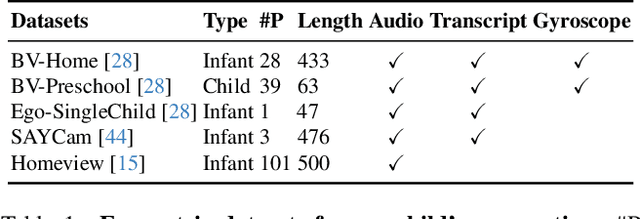
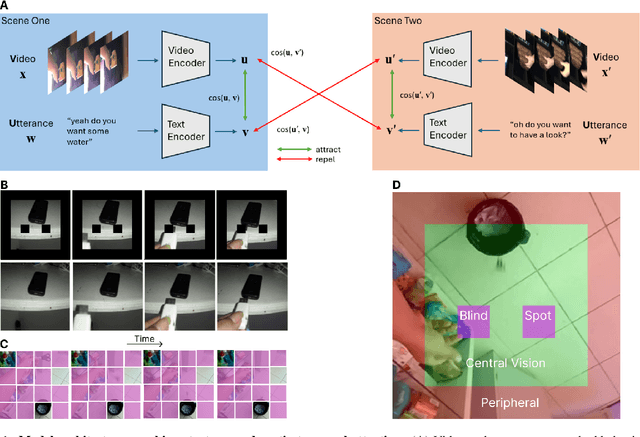
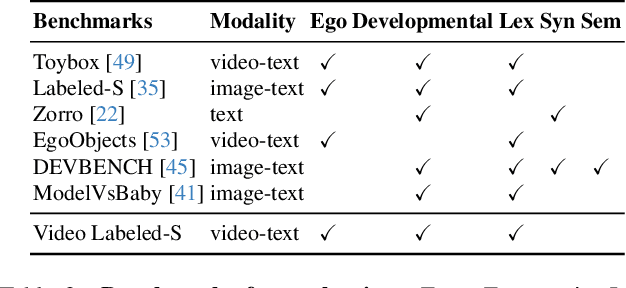
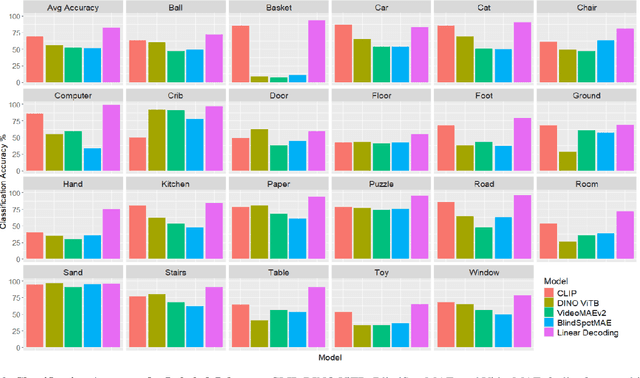
Typically, children start to learn their first words between 6 and 9 months, linking spoken utterances to their visual referents. Without prior knowledge, a word encountered for the first time can be interpreted in countless ways; it might refer to any of the objects in the environment, their components, or attributes. Using longitudinal, egocentric, and ecologically valid data from the experience of one child, in this work, we propose a self-supervised and biologically plausible strategy to learn strong visual representations. Our masked autoencoder-based visual backbone incorporates knowledge about the blind spot in human eyes to define a novel masking strategy. This mask and reconstruct approach attempts to mimic the way the human brain fills the gaps in the eyes' field of view. This represents a significant shift from standard random masking strategies, which are difficult to justify from a biological perspective. The pretrained encoder is utilized in a contrastive learning-based video-text model capable of acquiring word-referent mappings. Extensive evaluation suggests that the proposed biologically plausible masking strategy is at least as effective as random masking for learning word-referent mappings from cross-situational and temporally extended episodes.