 Add to Chrome
 Add to Firefox
 Add to Edge
Investigating the Viability of Employing Multi-modal Large Language Models in the Context of Audio Deepfake Detection
Jan 02, 2026
While Vision-Language Models (VLMs) and Multimodal Large Language Models (MLLMs) have shown strong generalisation in detecting image and video deepfakes, their use for audio deepfake detection remains largely unexplored. In this work, we aim to explore the potential of MLLMs for audio deepfake detection. Combining audio inputs with a range of text prompts as queries to find out the viability of MLLMs to learn robust representations across modalities for audio deepfake detection. Therefore, we attempt to explore text-aware and context-rich, question-answer based prompts with binary decisions. We hypothesise that such a feature-guided reasoning will help in facilitating deeper multimodal understanding and enable robust feature learning for audio deepfake detection. We evaluate the performance of two MLLMs, Qwen2-Audio-7B-Instruct and SALMONN, in two evaluation modes: (a) zero-shot and (b) fine-tuned. Our experiments demonstrate that combining audio with a multi-prompt approach could be a viable way forward for audio deepfake detection. Our experiments show that the models perform poorly without task-specific training and struggle to generalise to out-of-domain data. However, they achieve good performance on in-domain data with minimal supervision, indicating promising potential for audio deepfake detection.

AV-Deepfake1M++: A Large-Scale Audio-Visual Deepfake Benchmark with Real-World Perturbations
Jul 28, 2025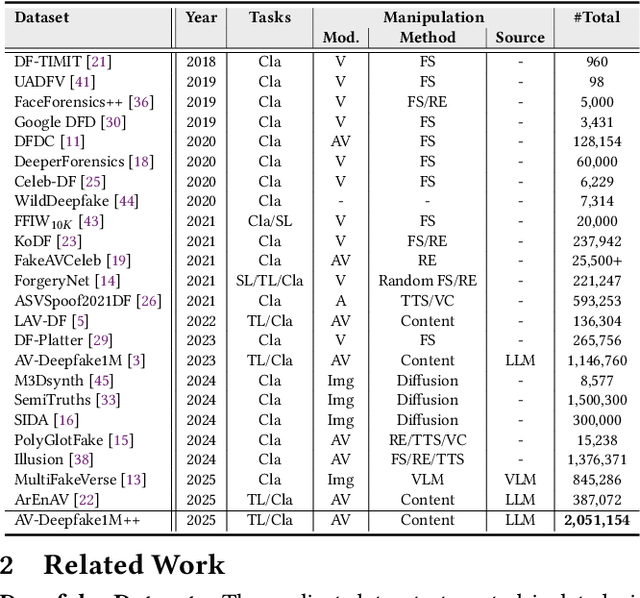
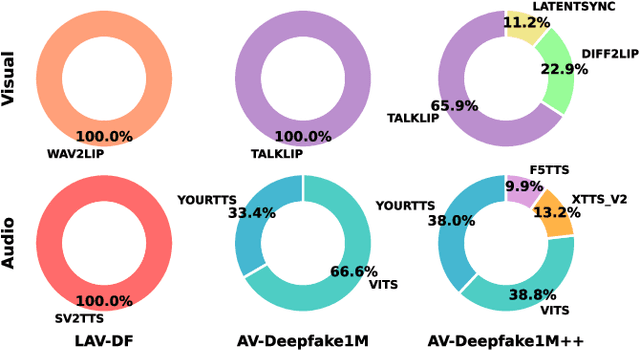
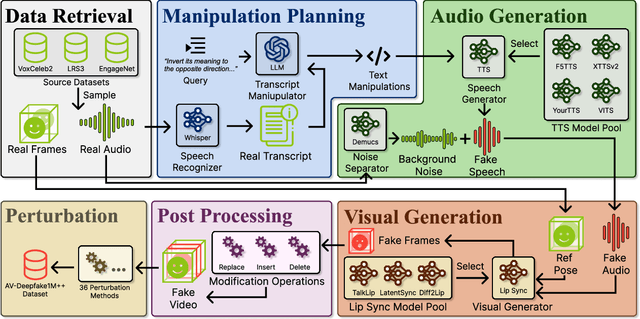
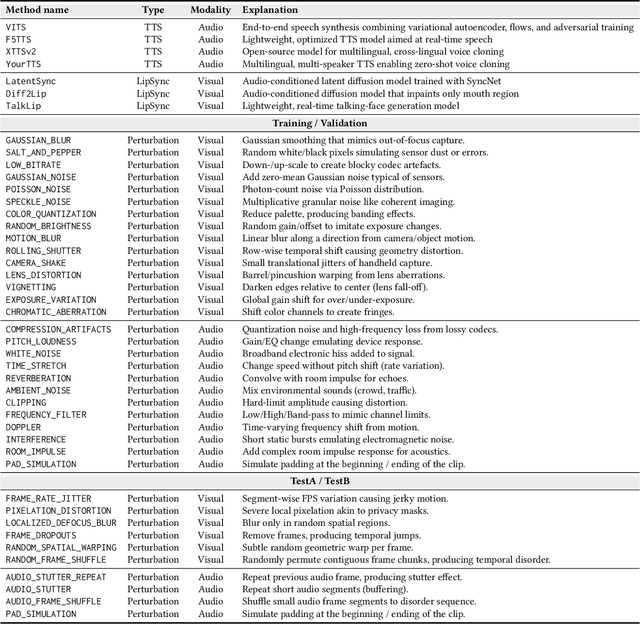
The rapid surge of text-to-speech and face-voice reenactment models makes video fabrication easier and highly realistic. To encounter this problem, we require datasets that rich in type of generation methods and perturbation strategy which is usually common for online videos. To this end, we propose AV-Deepfake1M++, an extension of the AV-Deepfake1M having 2 million video clips with diversified manipulation strategy and audio-visual perturbation. This paper includes the description of data generation strategies along with benchmarking of AV-Deepfake1M++ using state-of-the-art methods. We believe that this dataset will play a pivotal role in facilitating research in Deepfake domain. Based on this dataset, we host the 2025 1M-Deepfakes Detection Challenge. The challenge details, dataset and evaluation scripts are available online under a research-only license at https://deepfakes1m.github.io/2025.