 Add to Chrome
 Add to Firefox
 Add to Edge
Off-Manifold Collapse in Guided Protein Language Models
Aug 19, 2026
Protein language models are widely used priors for protein sequence design, and a growing body of work controls them at inference time as an alternative to fine-tuning. Such guidance faces a dilemma: mild enough to preserve natural activation statistics, it barely moves the property; strong enough to move it, the generations become progressively harder to fold. We show the failure has a specific and cheaply detectable signature, an off-manifold collapse of the model's own representations. Guided activations fall toward a region statistically indistinguishable from random amino-acid input, and the sequences degenerate to low complexity, yet the property oracle being optimized can still score these generations as a success. The optimized oracle can therefore fail to witness the collapse and, for solubility, can actively reward it, whereas structure and composition expose the failure. Because the failure is already visible in a finished candidate, we detect it at the output rather than modify the generator. We introduce a cheap density prior over natural protein activations and keep only the candidates that remain typical under it, a training-free post-hoc step we call Mahalanobis filtering. At matched guidance settings it improves both the property score and the structural plausibility of the sequences it keeps at negligible cost, without touching the generator, and transfers across different guidance methods. We release the activation statistic at https://huggingface.co/Shuibai12138/off-manifold-collapse-plm

AgentOmnia: Scaling Agentic Models for Full-Scenario Applications
Jul 25, 2026Large language model agents have advanced rapidly, yet progress remains fragmented across domains, capabilities, task difficulty, and interaction settings. We frame this as full-scenario agentic scaling and present AgentOmnia, a framework coordinating task-space definition, data synthesis, post-training, evaluation, and improvement across To-Consumer (ToC), To-Business (ToB), and To-Employee (ToE) applications. An extensible Domain x Capability x Atomic Difficulty taxonomy aligns these stages and enables fine-grained diagnosis with OmniaBench. AgentOmnia combines bidirectional environment-task synthesis with tool-dependency, program-structured, and solver-based pipelines, constructing 5,018 stateful environments with 255,375 tools and 52,361 tasks. Programs, solvers, and verifiers provide correctness signals, while supervised fine-tuning, online agentic reinforcement learning, and a rollback curriculum support post-training. Evaluation failures translate into Product Requirement Documents (PRDs) for targeted self-evolution. Starting from Qwen3-30B-A3B-Thinking-2507, AgentOmnia raises the pass rate on the OmniaBench challenging subset from 9.16% to 37.11% and the macro-average across OmniaBench, $τ^2$-Bench, DeepPlanning, and VitaBench from 22.86% to 41.69%. Under a unified protocol,it leads the evaluated agentic post-trained baselines on OmniaBench and retains the highest four-benchmark macro-average. It also surpasses Qwen3-235B-A22B-Thinking-2507 on all four benchmarks and exceeds Qwen3.5-35B-A3B on the macro-average. Gains span three application splits, ten capability dimensions, eight atomic-difficulty factors, and 76 of 90 level-1 domains, indicating broad rather than category-specific improvement. A one-round study provides initial evidence for PRD-guided self-evolution, motivating validation at larger scales and in industrial settings.
Improving PET/CT-Based Whole-Body Lesion Segmentation Using Prediction Uncertainty-Augmented Models
Jun 08, 2026Accurate lesion segmentation from whole-body Positron Emission Tomography (PET)/Computed Tomography (CT) scans is essential for cancer staging and treatment planning. PET provides functional metabolic information with different radiotracers, while CT offers anatomical localization. Lesion delineation from PET/CT imaging is clinically challenging due to subtle imaging features, confounders, and inter-reader variability. Existing deep learning approaches suffer from training-related stochasticity, inconsistent predictions, missed lesions in high tumor-burden cases, and lack uncertainty quantification, limiting their clinical reliability. Using nnU-Net as a baseline, we propose an uncertainty-aware framework for whole-body PET/CT lesion segmentation that integrates (1) Bayesian ensembling to reduce training stochasticity, (2) voxel-wise uncertainty quantification with epistemic and aleatoric decomposition, and (3) epistemic uncertainty-augmented training to improve lesion detection. Two public datasets, AutoPET-III (1,611 scans) and Deep-PSMA (200 scans), comprising FDG and PSMA studies across multiple cancer types, are used for training and evaluation. Bayesian ensembling improves robustness and performance over deterministic nnU-Net models on the unseen AutoPET-III test set. Uncertainty maps highlight regions of model disagreement and correlate with misclassifications, particularly false positives. Uncertainty-augmented training improves lesion recovery at the cost of increased FPVol, reflecting a precision-recall trade-off. A case-adaptive routing strategy further improves Dice by selecting between the base and augmented models. To our knowledge, this is the first study to systematically investigate uncertainty quantification in multi-tracer, pan-cancer PET/CT segmentation and to combine Bayesian ensembling with uncertainty-aware modeling for this task.
Continuous Diffusion Scales Competitively with Discrete Diffusion for Language
May 18, 2026While diffusion has drawn considerable recent attention from the language modeling community, continuous diffusion has appeared less scalable than discrete approaches. To challenge this belief we revisit Plaid, a likelihood-based continuous diffusion language model (DLM), and construct RePlaid by aligning the architecture of Plaid with modern discrete DLMs. In this unified setting, we establish the first scaling law for continuous DLMs that rivals discrete DLMs: RePlaid exhibits a compute gap of only $20\times$ compared to autoregressive models, outperforms Duo while using fewer parameters, and outperforms MDLM in the over-trained regime. We benchmark RePlaid against recent continuous DLMs: on OpenWebText, RePlaid achieves a new state-of-the-art PPL bound of $22.1$ among continuous DLMs and superior generation quality. These results suggest that continuous diffusion, when trained via likelihood, is a highly competitive and scalable alternative to discrete DLMs. Moreover, we offer theoretical insights to understand the advantage of likelihood-based training. We show that optimizing the noise schedule to minimize the ELBO's variance naturally yields linear cross-entropy (information loss) over time. This evenly distributes denoising difficulty without any case-specific time reparameterization. In addition, we find that optimizing embeddings via likelihood creates structured geometries and drives the most significant likelihood gain.
Expert-Choice Routing Enables Adaptive Computation in Diffusion Language Models
Apr 02, 2026Diffusion language models (DLMs) enable parallel, non-autoregressive text generation, yet existing DLM mixture-of-experts (MoE) models inherit token-choice (TC) routing from autoregressive systems, leading to load imbalance and rigid computation allocation. We show that expert-choice (EC) routing is a better fit for DLMs: it provides deterministic load balancing by design, yielding higher throughput and faster convergence than TC. Building on the property that EC capacity is externally controllable, we introduce timestep-dependent expert capacity, which varies expert allocation according to the denoising step. We find that allocating more capacity to low-mask-ratio steps consistently achieves the best performance under matched FLOPs, and provide a mechanistic explanation: tokens in low-mask-ratio contexts exhibit an order-of-magnitude higher learning efficiency, so concentrating compute on these steps yields the largest marginal return. Finally, we show that existing pretrained TC DLMs can be retrofitted to EC by replacing only the router, achieving faster convergence and improved accuracy across diverse downstream tasks. Together, these results establish EC routing as a superior paradigm for DLM MoE models and demonstrate that computation in DLMs can be treated as an adaptive policy rather than a fixed architectural constant. Code is available at https://github.com/zhangshuibai/EC-DLM.
Scaling Beyond Masked Diffusion Language Models
Feb 16, 2026Diffusion language models are a promising alternative to autoregressive models due to their potential for faster generation. Among discrete diffusion approaches, Masked diffusion currently dominates, largely driven by strong perplexity on language modeling benchmarks. In this work, we present the first scaling law study of uniform-state and interpolating discrete diffusion methods. We also show that Masked diffusion models can be made approximately 12% more FLOPs-efficient when trained with a simple cross-entropy objective. We find that perplexity is informative within a diffusion family but can be misleading across families, where models with worse likelihood scaling may be preferable due to faster and more practical sampling, as reflected by the speed-quality Pareto frontier. These results challenge the view that Masked diffusion is categorically the future of diffusion language modeling and that perplexity alone suffices for cross-algorithm comparison. Scaling all methods to 1.7B parameters, we show that uniform-state diffusion remains competitive on likelihood-based benchmarks and outperforms autoregressive and Masked diffusion models on GSM8K, despite worse validation perplexity. We provide the code, model checkpoints, and video tutorials on the project page: http://s-sahoo.github.io/scaling-dllms
FORESTLLM: Large Language Models Make Random Forest Great on Few-shot Tabular Learning
Jan 16, 2026Tabular data high-stakes critical decision-making in domains such as finance, healthcare, and scientific discovery. Yet, learning effectively from tabular data in few-shot settings, where labeled examples are scarce, remains a fundamental challenge. Traditional tree-based methods often falter in these regimes due to their reliance on statistical purity metrics, which become unstable and prone to overfitting with limited supervision. At the same time, direct applications of large language models (LLMs) often overlook its inherent structure, leading to suboptimal performance. To overcome these limitations, we propose FORESTLLM, a novel framework that unifies the structural inductive biases of decision forests with the semantic reasoning capabilities of LLMs. Crucially, FORESTLLM leverages the LLM only during training, treating it as an offline model designer that encodes rich, contextual knowledge into a lightweight, interpretable forest model, eliminating the need for LLM inference at test time. Our method is two-fold. First, we introduce a semantic splitting criterion in which the LLM evaluates candidate partitions based on their coherence over both labeled and unlabeled data, enabling the induction of more robust and generalizable tree structures under few-shot supervision. Second, we propose a one-time in-context inference mechanism for leaf node stabilization, where the LLM distills the decision path and its supporting examples into a concise, deterministic prediction, replacing noisy empirical estimates with semantically informed outputs. Across a diverse suite of few-shot classification and regression benchmarks, FORESTLLM achieves state-of-the-art performance.
Block Diffusion: Interpolating Between Autoregressive and Diffusion Language Models
Mar 12, 2025Diffusion language models offer unique benefits over autoregressive models due to their potential for parallelized generation and controllability, yet they lag in likelihood modeling and are limited to fixed-length generation. In this work, we introduce a class of block diffusion language models that interpolate between discrete denoising diffusion and autoregressive models. Block diffusion overcomes key limitations of both approaches by supporting flexible-length generation and improving inference efficiency with KV caching and parallel token sampling. We propose a recipe for building effective block diffusion models that includes an efficient training algorithm, estimators of gradient variance, and data-driven noise schedules to minimize the variance. Block diffusion sets a new state-of-the-art performance among diffusion models on language modeling benchmarks and enables generation of arbitrary-length sequences. We provide the code, along with the model weights and blog post on the project page: https://m-arriola.com/bd3lms/
Unveiling the Potential of Multimodal Retrieval Augmented Generation with Planning
Jan 26, 2025Multimodal Retrieval Augmented Generation (MRAG) systems, while promising for enhancing Multimodal Large Language Models (MLLMs), often rely on rigid, single-step retrieval methods. This limitation hinders their ability to effectively address real-world scenarios that demand adaptive information acquisition and query refinement. To overcome this, we introduce the novel task of Multimodal Retrieval Augmented Generation Planning (MRAG Planning), focusing on optimizing MLLM performance while minimizing computational overhead. We present CogPlanner, a versatile framework inspired by human cognitive processes. CogPlanner iteratively refines queries and selects retrieval strategies, enabling both parallel and sequential modeling approaches. To rigorously evaluate MRAG Planning, we introduce CogBench, a new benchmark specifically designed for this task. CogBench facilitates the integration of lightweight CogPlanner with resource-efficient MLLMs. Our experimental findings demonstrate that CogPlanner surpasses existing MRAG baselines, achieving significant improvements in both accuracy and efficiency with minimal computational overhead.
CMViM: Contrastive Masked Vim Autoencoder for 3D Multi-modal Representation Learning for AD classification
Mar 25, 2024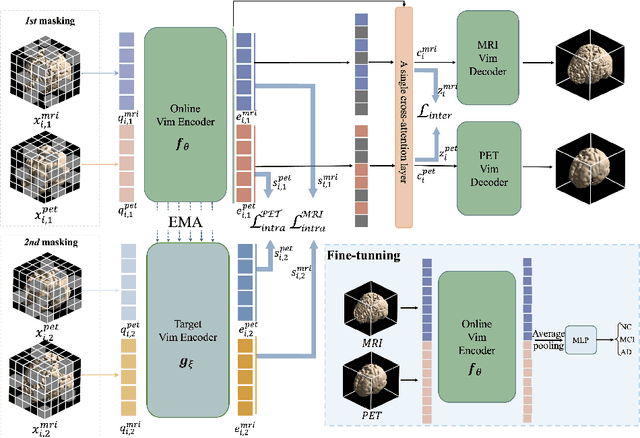
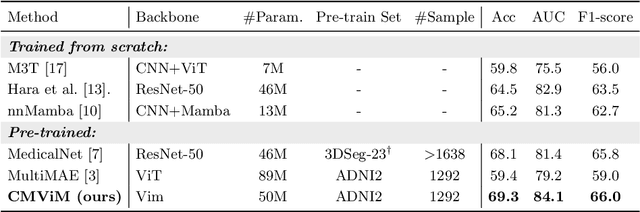
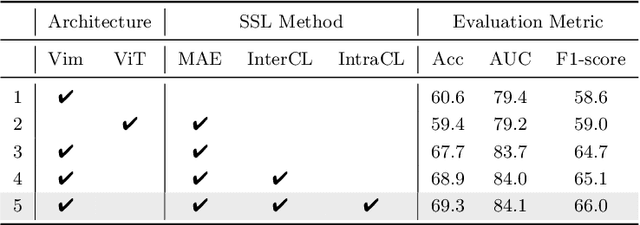
Alzheimer's disease (AD) is an incurable neurodegenerative condition leading to cognitive and functional deterioration. Given the lack of a cure, prompt and precise AD diagnosis is vital, a complex process dependent on multiple factors and multi-modal data. While successful efforts have been made to integrate multi-modal representation learning into medical datasets, scant attention has been given to 3D medical images. In this paper, we propose Contrastive Masked Vim Autoencoder (CMViM), the first efficient representation learning method tailored for 3D multi-modal data. Our proposed framework is built on a masked Vim autoencoder to learn a unified multi-modal representation and long-dependencies contained in 3D medical images. We also introduce an intra-modal contrastive learning module to enhance the capability of the multi-modal Vim encoder for modeling the discriminative features in the same modality, and an inter-modal contrastive learning module to alleviate misaligned representation among modalities. Our framework consists of two main steps: 1) incorporate the Vision Mamba (Vim) into the mask autoencoder to reconstruct 3D masked multi-modal data efficiently. 2) align the multi-modal representations with contrastive learning mechanisms from both intra-modal and inter-modal aspects. Our framework is pre-trained and validated ADNI2 dataset and validated on the downstream task for AD classification. The proposed CMViM yields 2.7\% AUC performance improvement compared with other state-of-the-art methods.